

An inspection should reflect the quality children experience every day, not how quickly a setting can organise itself in the final week. Ofsted preparation without last minute fixes starts with that distinction. Leaders often know what needs attention, but it can be difficult to decide which gaps matter most and keep improvement moving alongside the demands of daily practice.
That pressure is understandable. Policies may be in place, yet practice can vary between rooms, shifts or staff members. A last-minute review can help organise records, but it can’t replace consistent interactions, sound routines and a clear understanding of children’s needs.
This article explains how to build a realistic readiness routine, identify gaps early and focus improvement work on what children experience. You’ll find ways to set priorities, review progress without creating unnecessary workload, and help staff explain and demonstrate their everyday practice with confidence.
It also looks at how a constructive mock inspection and tailored consultancy can help leaders test what is working, agree next steps and turn findings into manageable actions that last.
Key Takeaways
- Build Ofsted preparation without last minute fixes around a repeatable cycle of observing practice, discussing findings, agreeing actions and reviewing impact.
- Use supervision, routine observations and team discussions to connect leadership oversight with what children experience each day.
- Prioritise gaps by their impact on children, safeguarding implications and how often they appear, rather than by how easy they are to document.
- Give each improvement action a clear owner, then follow up to see whether it has strengthened practice.
- Use a constructive mock inspection to review everyday practice and identify focused next steps for sustained improvement.
Why Ofsted preparation without last-minute fixes starts with everyday practice
Nursery leaders balance staffing, family communication, children’s needs and the work of supporting a team. When an inspection is expected, preparation can feel like another urgent responsibility, pulling time towards checking files and refreshing documents. But a tidy folder cannot, on its own, show how consistently a policy shapes what happens in the room.
Ofsted preparation without last minute fixes means building readiness into the way the setting operates, rather than staging a short-term display of compliance. Policies, staff understanding and children’s day-to-day experiences need to align. For example, a written approach to children’s safety has value when staff understand their responsibilities and follow the approach consistently. Use examples like this as prompts for reflection, not as a complete inspection checklist.
Preparation should strengthen the setting, not attempt to predict a particular inspection outcome. Understanding Ofsted’s role and responsibilities can provide useful background. Use current official guidance when checking inspection requirements. For a wider view of practical preparation, explore this Ofsted preparation guide for nurseries.
What does lasting Ofsted readiness look like in a nursery?
It looks like staff who can explain why routines matter and demonstrate them reliably, rather than recite a policy they rarely use. A practitioner might describe how they support children through a transition, then show that approach in a calm, familiar interaction. Leaders can connect oversight to children’s experiences by observing routines, discussing what they notice with staff and considering whether children are safe, included and able to engage in learning.
These are prompts for reflection, not a prescribed list. The central question is whether the setting’s stated approach is visible across the team. If it is, readiness is part of the working culture, not a performance reserved for an inspection.
Why do inspection-week fixes fall short?
A last-minute change can make a record look more complete without resolving why a gap appeared. Rewriting a procedure, for instance, won’t help staff apply it consistently if expectations remain unclear or leaders have not checked how it works in practice. Paperwork can record an action, but it cannot replace shared understanding, sound judgement and follow-through.
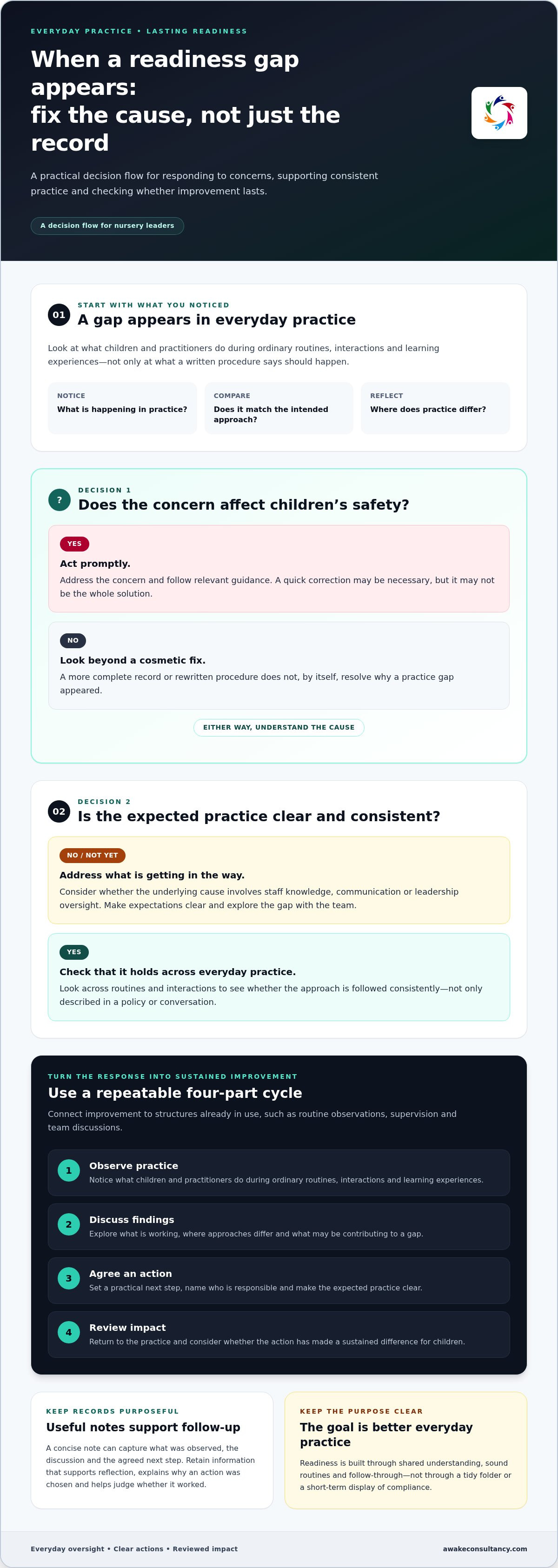
Some issues need immediate correction. If a leader identifies a concern affecting children’s safety, the setting should act promptly and follow relevant guidance. But when the underlying cause involves staff knowledge, communication or oversight, a quick correction is only the beginning. Leaders need to make the expected practice clear, give the team a chance to apply it and check whether it has become consistent. This addresses the cause, not just the visible symptom.
How to build Ofsted readiness into nursery leadership and daily routines
Readiness becomes manageable when leaders make it part of normal oversight, rather than a separate project competing with daily responsibilities. A simple cycle helps turn observations into considered improvements: observe practice, discuss findings, agree actions and review impact. Adapt the cycle to the setting’s needs instead of imposing an arbitrary review schedule.
Connect it to structures already in use. A routine observation might raise a question about how children experience a transition. Supervision can explore the practitioner’s reasoning, while a team discussion can clarify a shared approach. Leaders can then observe again to see whether the agreed change is working consistently. This builds Ofsted preparation without last minute fixes into leadership practice, rather than relying on inspection notice to prompt action.
- Observe practice. Notice what children and practitioners do during ordinary routines, interactions and learning experiences.
- Discuss findings. Explore what is working, where approaches differ and what may be contributing to a gap.
- Agree an action. Set a practical next step and name who will take responsibility for it.
- Review impact. Return to the practice and consider whether the action has made a sustained difference for children.
Keep records purposeful. A concise note of what was observed, the discussion and the agreed next step can help leaders track decisions and revisit progress. The aim isn’t to create the largest possible evidence file. Retain information that supports reflection, explains why an action was chosen and helps the team judge whether it has worked. Check current inspection and EYFS expectations against Official Ofsted guidance and updates and the relevant official EYFS guidance, rather than relying on older summaries.
How can leaders review practice before inspection notice?
Use observations and conversations to understand the working day as it is, not just how it is described in written procedures. Compare the intended approach with what practitioners do across different routines. For instance, if staff have agreed ways to support children’s independence, notice how those opportunities appear in ordinary interactions. Record strengths and gaps in a way that makes follow-up clear.
How should improvement actions become everyday habits?
Give each action an owner, a practical next step and a point for review. Use supervision, coaching or team meetings to explore what the change looks like in practice, not just circulate an instruction. A later observation and professional discussion can show whether staff understand the approach and apply it consistently. If it hasn’t taken hold, identify the obstacle and adjust the support.
Where leaders would value an external perspective, tailored Ofsted readiness support can help assess practice, identify priorities and shape manageable next steps. A collaborative review should inform improvement, not suggest that any process can guarantee a particular inspection outcome.
How to prioritise Ofsted readiness gaps without cosmetic fixes
When leaders find several areas to improve, distinguish what needs immediate attention from what calls for planned development and what merely makes preparation look busy. Ask whether an action changes children’s experience or reduces a real risk, or whether it only improves the appearance of the evidence. This keeps Ofsted preparation without last minute fixes focused on meaningful improvement.
Use three categories to make the difference visible:
| Type of activity | What it means | How to respond |
|---|---|---|
| Immediate action | A concern may affect children’s safety, welfare or care now. | Act promptly, follow relevant procedures and check current official requirements. |
| Sustained improvement | A practice gap needs clearer expectations, coaching or changes to oversight. | Agree an owner, practical steps and follow-up to see whether practice improves. |
| Cosmetic activity | A task changes the presentation of records without addressing practice. | Ask what it will improve for children before giving it priority. |
Which gaps should a nursery address first?
Consider the potential impact on children, any safeguarding implications and how widely or repeatedly the gap appears. A concern in one situation may need a focused response; a similar pattern across rooms may point to a shared understanding or oversight issue. For compliance-related questions, use the current Early Years Foundation Stage (EYFS) framework and relevant official guidance rather than an old checklist.
Record why each priority matters, what evidence led to the decision and what action follows. This gives leaders a rationale they can revisit, helps distinguish urgent corrections from development work and makes it easier to judge whether the response is proportionate. Related examples of avoidable pitfalls are explored in common nursery Ofsted inspection mistakes.
How can a mock inspection support honest reflection?
A mock inspection offers a structured opportunity to compare what staff say with what happens in practice. It may reveal where an explanation is clear but its application varies, or where leaders need a stronger understanding of how a concern is followed up. Treat the findings as diagnostic information to inform priorities, not as a rehearsal for a particular judgement. A mock inspection cannot guarantee a rating or predict an inspection outcome. For more on its purpose, see this nursery mock inspection guide.
The value lies in what happens next: leaders examine the findings, decide which changes matter most and build them into practice. A polished document may be easy to produce; consistent improvement takes clear expectations, support and follow-through.
A practical Ofsted readiness routine nursery leaders can sustain
A useful readiness routine should fit the setting’s working pattern, not create another layer of administration. Adapt the sequence below to your team, existing meetings and priorities. The purpose is to keep oversight connected to practice and ensure decisions lead to follow-up, without imposing an arbitrary review frequency.
- Review. Look at current practice, relevant records and progress on existing priorities. Include what staff and children’s everyday experiences reveal, not just what is easy to document.
- Discuss. Invite staff perspectives and compare how an agreed approach works across the setting. Make space for questions and differences in experience.
- Assign ownership. Agree a clear next step, who will take it forward and what support may help. Keep the action proportionate to the issue.
- Follow up. Return to the action and gather evidence that it has been completed and applied in practice. A written update alone does not show that the change has taken hold.
- Reflect. Consider what has improved, what remains unclear and whether the priority or support needs to change.
Keep records concise enough to use. A note of the issue, decision, owner and follow-up can help leaders see progress and outstanding gaps without turning the routine into a paperwork exercise. Store relevant guidance where staff can access it during ordinary working conditions, and make responsibilities clear through induction, supervision and team communication. Check compliance-related expectations against current official guidance. Don’t rely on an old summary or a document that no longer reflects the setting’s approach.
What should a regular readiness review cover?
Start with a specific priority, then consider what leaders know from observation, relevant records and staff discussion. Ask whether the intended approach is visible across the setting, what practitioners say helps or hinders it, and whether the action has been followed through. This connects leadership decisions to what staff do and what children experience, while making clear what still needs attention.
How can leaders prepare staff without creating inspection anxiety?
Explain that preparation is about helping the team provide confident, consistent practice for children, not about passing a test or predicting a judgement. Communicate expectations clearly and give staff a constructive way to raise questions when a policy or routine is unclear. Avoid scripts and rehearsed answers. Staff should be able to describe their responsibilities in their own words and show how they apply them in everyday work.
If leaders need structured external input to review their routine and identify development priorities, discuss Ofsted readiness support with Awake Early Years Consultancy. Tailored preparation and practical advice can help turn findings into manageable next steps for the setting.
How Awake Early Years Consultancy can support sustained Ofsted readiness
Sometimes a leadership team needs an external perspective to make sense of competing priorities. Awake Early Years Consultancy provides tailored Ofsted preparation and practical advice for nurseries and other early-years settings, shaped around their circumstances and development needs. The support helps leaders examine what is happening in practice, clarify where to focus and strengthen plans the team can sustain.
This can be useful when written procedures appear sound but leaders want a clearer picture of how they work across the setting. A collaborative review can explore the gap between intention and experience, test assumptions and identify whether an issue is local or points to a wider development need. It keeps Ofsted preparation without last minute fixes centred on strengthening practice, rather than adding activity for appearance’s sake.
What can tailored Ofsted preparation support help leaders do?
Support can help leaders identify which readiness questions connect most directly to current priorities. Together, they can examine findings, decide which actions are proportionate and make responsibilities clear. For example, if staff explain an approach differently across rooms, leaders can explore what needs clarification and how to support consistent application. Practical actions can then be monitored through the setting’s existing leadership and staff-development processes.
This also connects written approaches with everyday practice. Rather than treating policies as standalone documents, leaders can consider whether staff understand the relevant expectations, know where to access guidance and can apply agreed approaches during ordinary routines. The focus remains developmental: review the evidence, discuss what it suggests and shape next steps that fit the setting’s circumstances.
When is a nursery mock inspection useful?
A mock inspection can be valuable when leaders want an external perspective on how practice and leadership explanations align. It offers a structured opportunity to explore what is working, identify questions that need further attention and consider how children experience the setting’s routines. Feedback should prompt reflection and proportionate follow-up, not a scramble to prepare scripted answers or create a performance for inspection day.
Awake provides mock inspection support to help leaders assess practice and identify next steps. It can inform a focused improvement plan, but it isn’t a prediction of what an Ofsted inspector will decide and cannot guarantee a judgement or rating. The value lies in the honest discussion and practical development that follow.
If your team would benefit from a considered external perspective, you’re welcome to discuss Ofsted preparation support with Awake Early Years Consultancy. Together, you can clarify priorities and strengthen readiness in a way that supports the setting beyond inspection.
Make readiness part of your next leadership decision
The next step needn’t be a major review or a new set of documents. Choose one question that matters to your setting, such as whether a shared approach is clear to every practitioner, then decide how you’ll understand what happens in practice. A small, well-chosen action gives leaders and staff a useful place to begin.
That is the practical value of Ofsted preparation without last minute fixes: readiness develops through considered decisions that strengthen the setting over time. Awake Early Years Consultancy offers tailored early-years consultancy and Ofsted preparation support. A mock inspection can help leaders assess practice and identify improvement priorities, with feedback shaped around the setting’s needs. This support can strengthen readiness, but no inspection judgement or rating is guaranteed.
If an external perspective would help you decide what to focus on next, discuss a practical approach to Ofsted readiness with Awake. Take the next step with a clear focus on progress that lasts.
Frequently Asked Questions
Can a nursery prepare for Ofsted without knowing when an inspection will happen?
Yes. A nursery can build readiness into its normal leadership and staff practices without knowing an inspection date. This is the practical basis of Ofsted preparation without last minute fixes: keep responsibilities clear, make relevant guidance accessible and address concerns as they arise. For example, after a change in staffing or routine, leaders can check that everyone understands how the setting’s approach applies, rather than waiting for an inspection to prompt the conversation.
Is an Ofsted mock inspection the same as an Ofsted inspection?
No. A mock inspection is consultancy support, not an official Ofsted inspection, and it cannot issue an Ofsted judgement. It can give leaders an external perspective on how the setting’s practice is working and where further reflection may help. For example, a review might prompt leaders to look more closely at how staff explain a routine and how children experience it. Use the feedback to inform improvement, not to predict an outcome.
How often should a nursery review its Ofsted readiness?
There isn’t one review interval that suits every nursery. Choose a rhythm that leaders can maintain alongside their responsibilities, and revisit priorities when circumstances change. A new approach, a recurring concern or feedback from staff may warrant an earlier check; a stable area may need a different level of attention. The key is to avoid treating readiness as a one-off exercise and to make sure review findings lead to considered decisions.
What evidence should a nursery have ready for Ofsted?
Keep relevant records organised and accessible, and use current official guidance and the setting’s circumstances to decide what is needed. Records may help leaders explain how they reached a decision, followed up a concern or reviewed an approach. For instance, a concise account of an action and its follow-up can clarify the sequence of events. Evidence should support an accurate account of practice, not become a separate performance or an attempt to anticipate every question.
Can an Ofsted consultant guarantee a better inspection rating?
No. A consultant cannot guarantee an Ofsted rating or determine the outcome of an inspection. Consultancy can help leaders assess current practice, examine areas for development and plan appropriate improvements. Awake Early Years Consultancy provides tailored advice and mock inspection support to help settings strengthen readiness. The purpose is practical development and informed leadership, not a promise of a particular judgement. Leaders remain responsible for applying changes in their setting.
How can leaders prepare nursery staff without making them anxious?
Frame preparation as support for confident work with children, not as a test staff must rehearse for. Explain why a change matters, invite questions and give practitioners a straightforward way to raise uncertainty. If a team member asks how a procedure applies in an unfamiliar situation, discuss the reasoning and where to find the relevant guidance. This builds understanding staff can use in real situations, rather than relying on memorised answers that may not reflect their practice.


