

A useful nursery mock inspection reveals what happens when nobody is performing for a visitor. It tests the consistency of everyday practice, not simply whether policies and paperwork look complete. Its value lies in showing how children experience care, learning and support across the setting.
It’s understandable to wonder what a review will cover, or whether it will become a superficial compliance exercise. A meaningful assessment looks beyond documents: it observes interactions, explores how leaders and practitioners understand their responsibilities, and considers whether written procedures are reflected in daily routines. That gives you a clearer view of strengths and areas that need attention.
This article explains what a nursery mock inspection can assess, how to judge whether its feedback is useful and how to turn findings into realistic improvements. You’ll also see how tailored advice can connect evidence from the visit with staff development, leadership decisions and sustained Ofsted readiness, rather than a short-lived effort to look prepared.
Key Takeaways
- A nursery mock inspection can help leaders assess readiness and practice, but it cannot predict or guarantee an Ofsted judgement.
- Agreeing the scope and reviewing relevant evidence helps make the assessment focused and useful.
- Possible review themes include leadership, safeguarding, teaching and learning, inclusion and children’s experiences.
- Judge feedback by whether it is specific, proportionate and grounded in observable practice, rather than a checklist alone.
- After a nursery mock inspection, validate the findings, prioritise urgent concerns and set realistic steps to review progress.
What is a nursery mock inspection, and what can it tell you?
A nursery mock inspection is a structured, independent review of a setting’s practice and readiness. It gives owners, managers and practitioners the opportunity to examine how leadership expectations, policies and routines work in practice, and whether children’s experiences are consistent throughout the day. The review can recognise what is working well and identify gaps, differences in practice or issues that need closer attention.
Its value is not in producing a score or rehearsing set answers. It lies in asking useful questions: Do practitioners understand the approach leaders expect? Can leaders explain why a routine is in place and how they know it supports children? Does what happens in each room reflect the setting’s stated values? Findings should help the team see what to build on and where further evidence or discussion may be needed.
Early years settings support children’s development through relationships, care and learning, within the broad context of early childhood education. A focused review therefore considers more than whether documents exist. A policy may set out an agreed approach, for example, but discussion and observation can show whether staff interpret it consistently. A difference is a prompt to explore, not automatically proof of poor practice.
How a mock inspection differs from an Ofsted inspection
A mock review is an opportunity for informed feedback, not an official inspection. It does not determine an Ofsted judgement, guarantee an outcome or reproduce every aspect of an inspector’s visit. Agree its scope and emphasis around the setting’s needs. Leaders can use the findings to reflect, test assumptions and plan development, while recognising that an official inspection is a separate process.
This distinction matters. A mock inspection should not encourage staff to perform for a visitor or memorise polished responses. A constructive reviewer points to evidence and practice, then gives leaders space to consider what the findings mean. The review can support Ofsted readiness, but its purpose is broader: helping the setting understand the quality and consistency of its everyday work.
Who may find a nursery mock inspection useful?
Owners, managers and leaders may find a review useful when they want a clearer setting-wide view, whether preparing for inspection or reviewing established routines. A setting might examine how staff understand a recently revised approach, or explore why practice differs between rooms. The scope should reflect its context, current priorities and questions, rather than apply a generic checklist without regard to how the nursery operates.
This is distinct from general preparation advice. The Ofsted preparation guide for nurseries covers wider readiness; a mock review offers a structured way to examine how readiness and practice appear in a particular setting. Used well, it gives leaders a grounded starting point for reflection, not a verdict to file away.
How does a nursery mock inspection examine practice and evidence?
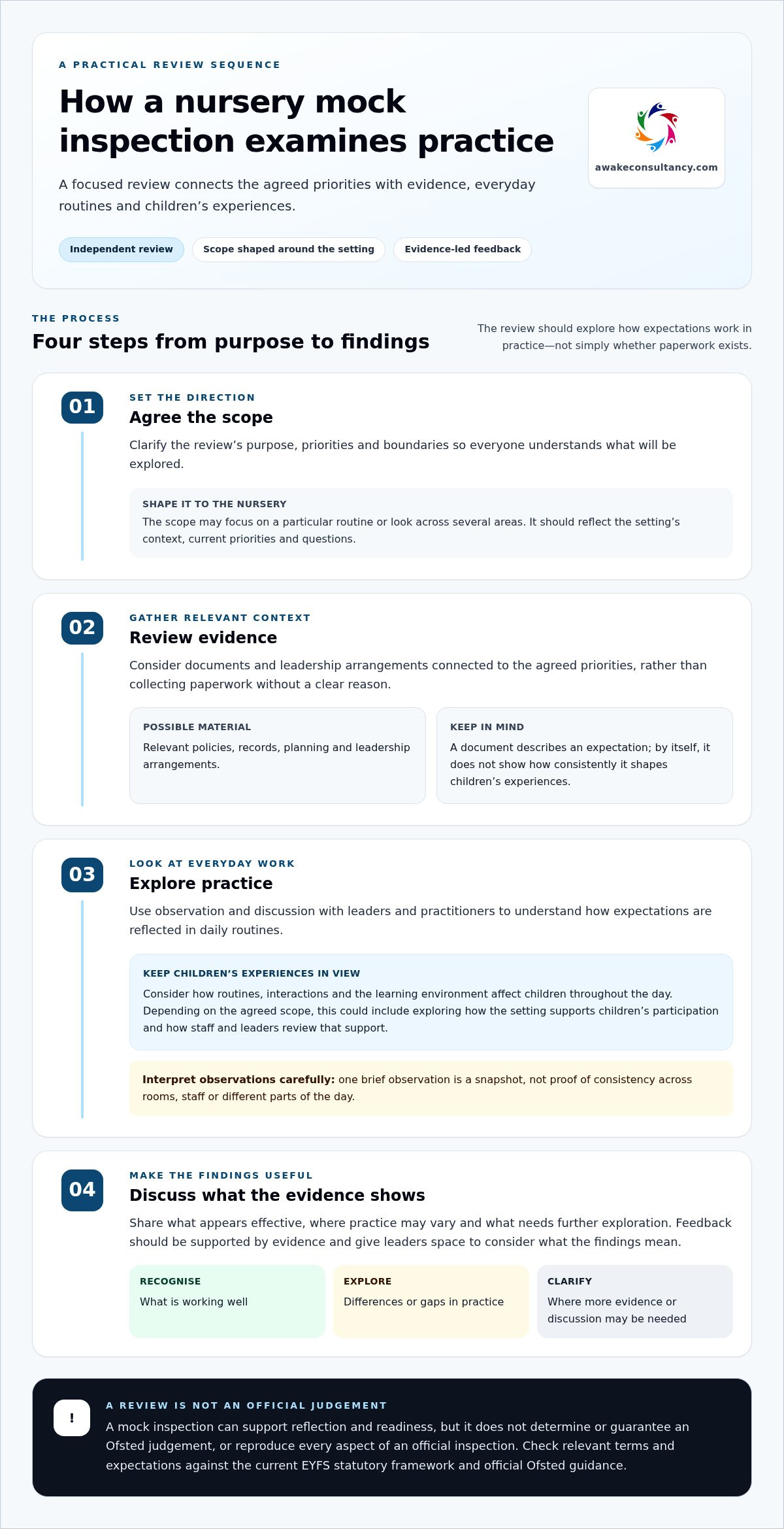
A useful review follows a clear process without imposing the same checklist on every setting. Its scope should reflect the nursery’s context, leaders’ priorities and the questions the review is intended to answer. A focused assessment might explore how a particular routine is applied, while a broader one may look across several areas of practice.
A practical sequence is:
- Agree the scope. Clarify the review’s purpose, priorities and boundaries so everyone understands what will be explored.
- Review relevant evidence. Consider documents and leadership arrangements connected to those priorities, rather than gathering paperwork without a clear reason.
- Explore practice. Use observation and discussion with leaders and practitioners to understand how expectations work in daily routines.
- Discuss findings. Share what appears effective, where practice may vary and what needs further exploration, supporting feedback with evidence.
Leaders should check the terms and expectations they use against the current EYFS statutory framework and relevant official Ofsted guidance. A review can identify questions, but it should not rely on outdated terminology or treat a familiar document as proof that practice is consistently embedded.
What evidence might a reviewer consider?
Evidence depends on the agreed scope. It may include relevant policies, records, planning or leadership arrangements, alongside conversations with the people who use them. The reviewer can explore whether staff understand an agreed approach and how leaders know it is being followed. A document describes an expectation; on its own, it does not show how consistently that expectation shapes children’s experiences. Discussion and observation provide context, not automatic confirmation.
How should the review approach children’s experiences?
Consider how routines, interactions and the learning environment affect children throughout the day. For example, a review of inclusion might explore how the setting adapts its approach to support children’s participation, then discuss what staff observe and how leaders review that support. Safeguarding and the EYFS may also be relevant, depending on the agreed scope. One brief observation offers a snapshot, not proof of consistency across rooms, staff or different parts of the day.
This focus on lived experience matters: quality is reflected in what children encounter, not only in what a setting records. The US Administration for Children and Families’ report, Early Care and Education Quality and Child Outcomes, examines the relationship between early education quality and outcomes, offering broader context for why practice merits careful attention.
Leaders need a balanced account that connects evidence with everyday experience and leaves room to clarify uncertainties. Awake’s mock inspection and consultancy support can help settings examine those connections and identify practical areas for development.
What can a nursery mock inspection assess across the setting?
A nursery mock inspection can explore several connected aspects of a setting, but its scope should be agreed rather than treated as a universal checklist. The aim is to understand how expectations are communicated, interpreted and applied by staff, and what that means for children’s everyday experiences. Relevant themes may include:
- Leadership: how leaders set priorities, support staff and review whether agreed approaches are working.
- Safeguarding: how safeguarding arrangements are understood and put into practice across the setting.
- Teaching and learning: how interactions, routines and provision support children’s learning and development.
- Inclusion: how the setting considers individual needs and supports children’s participation.
- Children’s experiences: how care, relationships, routines and the environment feel from a child’s perspective.
These themes overlap. Leadership decisions may shape staff understanding of safeguarding, for example, while that understanding influences what children experience in practice. A review that only checks whether a policy exists can miss this connection. More useful questions explore how the expectation is understood, what staff do in relevant situations and how leaders know whether the approach is consistent.
Leadership, safeguarding and the EYFS
For leadership, a reviewer might explore how managers explain an agreed approach, support practitioners to apply it and respond when practice varies. Safeguarding can be considered as a setting-wide responsibility, through staff understanding and relevant arrangements rather than paperwork alone. Check framework references against the current Early Years Foundation Stage statutory framework and official Ofsted guidance before publication or use.
The wording matters. The EYFS statutory framework sets requirements for early years providers, while Ofsted’s current inspection materials provide context for official inspections. A mock review can help leaders examine how their practice relates to relevant expectations; it should not invent additional requirements or present informal advice as statutory direction. Where a question turns on a specific requirement, verify the wording in the current official source.
Children’s experiences, inclusion and consistency
Consider what children encounter during ordinary routines and interactions: whether transitions feel settled, whether adults respond to children’s cues and whether the provision enables children to take part. View inclusion in context, with attention to how the setting understands individual needs and adapts its approach. One observation can prompt useful questions, but cannot establish that practice is consistent throughout the nursery.
This distinction helps separate development from rehearsal. A superficial exercise may concentrate on whether staff can repeat expected phrases or whether rooms appear prepared during a visit. A developmental review explores why practice happens, how it varies and what children experience as a result. It considers examples alongside other evidence and staff perspectives, then identifies where a pattern is clear and where further exploration is needed.
Leaders should treat findings as evidence for reflection, not as a prediction of an inspection outcome. Strong feedback explains what was observed, connects it to the agreed review themes and recognises the limits of the evidence. That gives the team a fair basis for deciding what to maintain, clarify or strengthen in everyday practice.
How can leaders judge whether a nursery mock inspection is useful?
Judge the review by the quality of its evidence and the direction it gives your team, not by how closely it resembles an official inspection day. Useful feedback is specific, proportionate and connected to what the reviewer examined. It should help leaders understand what is working, where practice varies and what action could make a practical difference.
A mock inspection is not a forecast of an Ofsted grade. An independent review can offer informed observations, but it cannot determine or guarantee the outcome of an official inspection. Treat claims to predict a particular judgement with caution. The more useful test is whether the feedback helps you make sound decisions about practice and improvement.
| Evidence-led feedback | Checklist-only or performance-focused approach |
|---|---|
| Links a finding to an example, discussion or relevant evidence from the review. | Lists items as met or unmet without explaining the evidence or context. |
| Recognises effective practice and identifies specific areas to explore or strengthen. | Concentrates on gaps, paperwork or how the setting appeared during the visit. |
| Offers realistic recommendations that reflect the setting’s circumstances and priorities. | Suggests generic actions or rehearsed answers without showing how they improve daily practice. |
| Explains any limits in the evidence and invites leaders to clarify what they know. | Presents broad judgements as certain, even when the review has only a partial view. |
Signs of constructive, evidence-led feedback
Look for a clear link between what the reviewer observed, why it matters and what leaders might consider next. For example, feedback about differing staff approaches should identify where the difference emerged and invite discussion about the shared expectation. Balanced advice recognises established strengths, then recommends practical steps proportionate to the issue and the setting’s capacity.
Useful feedback gives leaders something to investigate or act on, rather than a label to accept. It should distinguish a confirmed concern from a question that needs more evidence. That makes the review fairer and helps leaders discuss findings openly with practitioners, test whether they reflect wider practice and decide what deserves attention first.
Warning signs of a superficial rehearsal
A review that prioritises polished rooms, memorised answers or paperwork prepared for the visit may say little about an ordinary day. Vague comments such as “improve consistency”, without examples or explanation, also leave leaders unsure where to begin. Check whether each recommendation connects to evidence and describes a realistic next step.
Awake’s Ofsted preparation support helps leaders use tailored review and advice to assess readiness and identify practical areas for development. Look for feedback that strengthens understanding and everyday practice, not assurances about a future judgement.
What should a nursery do after a mock inspection?
A review becomes useful when leaders make time to understand and act on its findings. Start by discussing the feedback with the people involved, then check that each point is supported by the evidence gathered. A difference between written expectations and observed practice may need further exploration before it becomes an agreed action.
Use a simple sequence to move from feedback to follow-up:
- Discuss the findings. Give leaders and practitioners space to clarify what they understand and add relevant context. Keep the conversation focused on practice and children’s experiences, not blame.
- Validate the evidence. Compare observations and comments with other relevant information. Decide whether a finding reflects a wider pattern or needs further checking.
- Prioritise proportionately. Address urgent concerns promptly, and separate them from longer-term development priorities that need planning and support.
- Review progress. Agree how leaders will check whether actions are understood and making a difference in everyday practice.
This distinction matters. An issue that could affect children’s safety or wellbeing needs prompt attention, while a development priority may call for coaching, discussion or a change to routines over time. Avoid treating every recommendation as equally urgent. Clear priorities help teams direct attention where it is most needed without losing sight of broader improvement.
Turn findings into proportionate next steps
For each agreed action, identify who will lead it and when progress will be reviewed. Keep the step practical: if staff interpret an expectation differently, leaders might clarify the shared approach in a team discussion, then revisit how it is applied. Connect changes to existing routines and staff understanding, so improvement becomes part of daily work rather than a separate task.
At review points, ask what has changed, what evidence supports that view and whether further adjustment is needed. If progress is limited, consider whether the action was realistic or whether staff need clearer guidance. This cycle of discussion, action and review keeps improvement grounded in the setting’s circumstances.
When tailored mock inspection support may help
An external perspective can help leaders test assumptions, notice differences across the setting and consider evidence they may have overlooked. It can be particularly useful when feedback raises questions about how an approach is understood by different practitioners, or when leaders want to connect readiness with sustained development. A review should inform the setting’s judgement and planning, not replace them.
Awake provides tailored mock inspections and early years consultancy to support practice improvement, readiness and leadership. A nursery mock inspection offers a structured point of reflection, while tailored advice can help leaders translate findings into realistic operational steps. It cannot guarantee an Ofsted judgement, but it can support a clearer, more considered approach to improvement.
If an independent perspective would help your team turn findings into practical next steps, discuss nursery mock inspection support with Awake.
Build readiness into your setting’s ongoing development
Readiness is more sustainable when it informs everyday leadership, rather than becoming a separate project that gathers pace only before an inspection. Use questions raised by a review to shape ongoing conversations with staff, revisit shared expectations and notice whether agreed changes are becoming established practice. This keeps improvement connected to the way the setting operates and gives leaders a clearer basis for deciding what needs attention next.
A nursery mock inspection can also be a useful point to consider what support would help your team move forward. Awake’s tailored early years consultancy and mock inspections focus on strengthening practice, Ofsted readiness and leadership. The aim is constructive support for development, not a promised inspection result.
Discuss tailored nursery mock inspection support with Awake and consider a practical next step for your setting. With clear priorities and steady leadership, your team can keep building confidence in the quality of its everyday practice.
Frequently Asked Questions
What is a nursery mock inspection?
A nursery mock inspection is a structured review that helps a setting examine its readiness, evidence and everyday practice. Unlike an official Ofsted inspection, it doesn’t issue an Ofsted judgement or guarantee an outcome. Its value depends on a clear purpose, relevant evidence and feedback leaders can use. For example, a review might help managers explore whether practitioners consistently understand a recently agreed approach.
Can a mock inspection predict an Ofsted rating?
No. A mock inspection cannot reliably predict or guarantee an Ofsted judgement. It offers a view of practice and readiness at a particular point, within the agreed scope and evidence available. Ofsted’s inspection is separate and may consider matters beyond that review. Use the findings to recognise what is working and identify areas to develop, rather than treating a reviewer’s opinion as a promised result.
What does a nursery mock inspection look at?
The scope may include leadership, safeguarding, the Early Years Foundation Stage (EYFS), inclusion and children’s experiences, depending on the setting’s priorities. A reviewer may consider relevant records, speak with staff and explore how routines work in practice. Reviews don’t all follow an identical checklist. If feedback refers to a framework requirement or inspection term, compare it with the current official EYFS and Ofsted guidance.
How long does a nursery mock inspection take?
There’s no single duration that applies to every setting. The time required depends on the nursery’s size and context, the agreed areas of focus and the evidence to be considered. Leaders can make the review more purposeful by agreeing priorities, relevant arrangements and who should take part in advance. This helps keep the work focused without assuming it follows the timetable of an official inspection.
Should nursery staff be told about a mock inspection?
Leaders should decide how to communicate the review in light of its purpose and the setting’s circumstances. Staff need to understand that feedback is intended to support development, not assign blame. Managers can explain what the review will explore and how findings will be discussed. The aim is to understand ordinary practice: rehearsed answers or a temporary display of performance can obscure what staff and children experience day to day.
What should a nursery do with mock inspection feedback?
Start by checking the evidence behind each finding and inviting relevant staff to add context. Then recognise effective practice, agree proportionate priorities and make clear who will take each action forward. A change to a daily handover, for instance, may need to be explained to everyone involved and revisited after it has been used. Treat findings as a prompt for ongoing development, not a last-minute display of compliance.
Is a nursery mock inspection the same as an Ofsted inspection?
No. A nursery mock inspection is a developmental review arranged to help a setting examine its practice and readiness. It isn’t an official Ofsted inspection, cannot award an Ofsted judgement and shouldn’t be treated as a full reproduction of the official process. For information about inspection procedures or current expectations, use the latest guidance published by Ofsted. The mock review can help leaders identify questions for their own reflection.


