

An inspection-ready nursery isn’t built in the week before Ofsted arrives. It’s built through the decisions, relationships and routines children experience every day.
It’s understandable that leaders feel uncertain when expectations change or question whether their records reflect what happens in practice. In England, the revised EYFS statutory framework came into force on 1 September 2026, and updated Ofsted inspection materials apply to inspections from that date. Readiness means more than knowing what’s in a folder: staff need to understand how their practice supports children’s learning, welfare and safety, while leaders keep improvement work focused on children’s experiences.
This guide to Ofsted preparation for nurseries explains how to assess and maintain readiness in a clear, proportionate way. It shows how to connect everyday practice with current expectations, strengthen staff understanding and use evidence to support, rather than replace, children’s lived experience. You’ll also learn how leadership review, focused development priorities and a mock inspection can help identify strengths and decide where further support could make a difference.
Key Takeaways
- Understand how observation, professional discussion and relevant records help inspectors build a picture of nursery quality.
- Use a focused review to examine safeguarding, leadership oversight, curriculum and children’s everyday experiences.
- Build a manageable cycle of team reflection, agreed actions and follow-up to keep improvement work moving.
- Ofsted preparation for nurseries is most effective when it reflects the setting’s real strengths and priorities, rather than a staged inspection-day performance.
- Consider a mock inspection or tailored consultancy when leadership changes, priorities are unclear or practice varies across the setting.
Ofsted preparation for nurseries: what readiness really means
Readiness is not a polished folder or a rehearsed answer for inspection day. It is the consistent quality of children’s everyday experiences, supported by clear leadership, effective safeguarding and practice that staff understand and can explain. Leaders should be able to describe why routines work as they do. Practitioners should be able to explain how those routines support children’s safety, care, learning and development.
Sustained readiness means understanding and strengthening the provision children experience each day, not assembling documents at the last minute to create an inspection-day impression. Records can help leaders track decisions and spot patterns, but they cannot replace observation of how adults respond to children, how routines are carried out and whether the environment supports individual needs.
What does Ofsted readiness look like in a nursery?
Readiness is visible in the connection between what leaders intend and what children experience. For example, a room leader might explain how the team adapts a routine for a child who needs additional support, while colleagues put that approach into practice consistently. Staff should understand safeguarding procedures as part of their daily responsibilities, not simply know where to find a policy. Ofsted’s wider remit is outlined in this overview of Ofsted’s role in early years regulation.
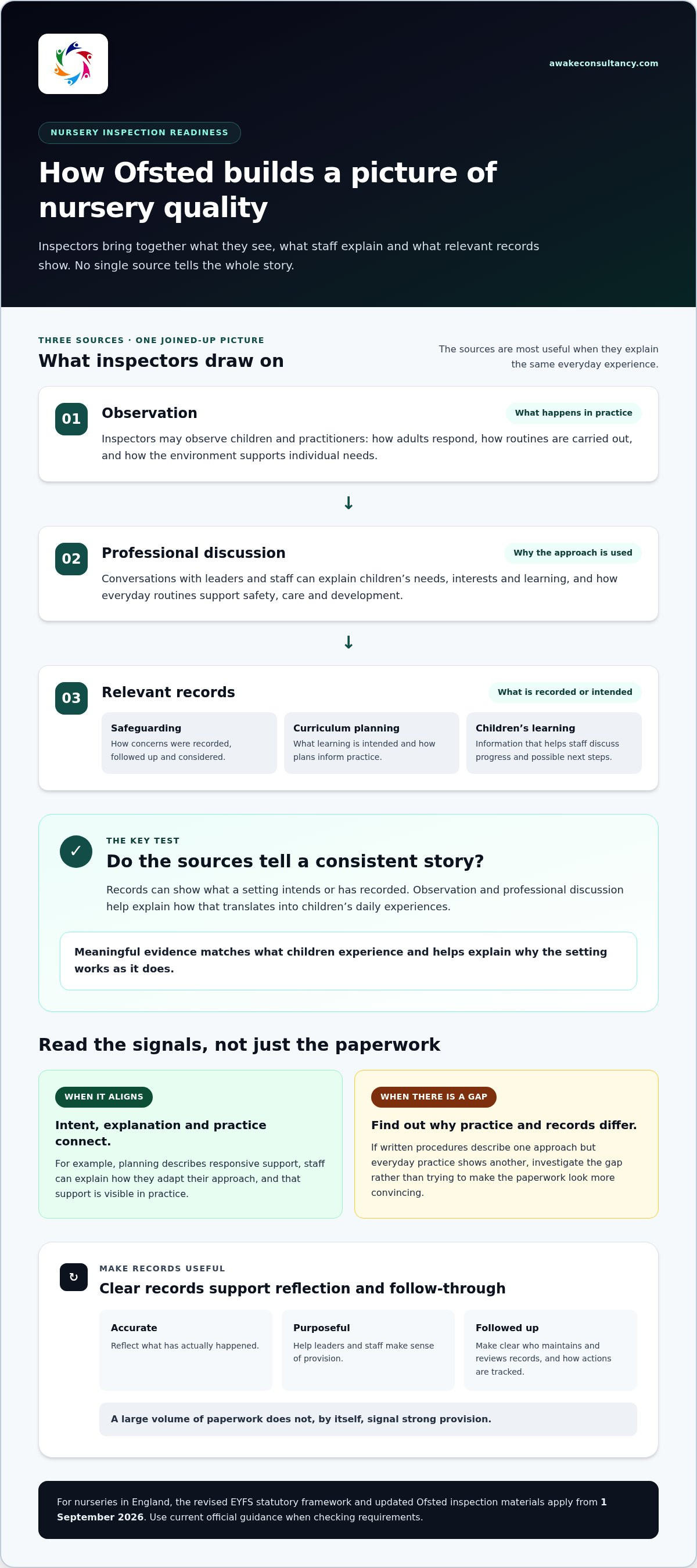
Evidence should help the setting make sense of its provision. Attendance, planning or safeguarding records may inform leaders’ understanding, but they are most useful alongside staff discussion and direct observation. If written procedures describe one approach and everyday practice shows another, investigate the gap rather than trying to make the paperwork look more convincing.
Which requirements should leaders keep in view?
For nurseries in England, the EYFS statutory framework sets requirements for early years learning, development, care and welfare. Ofsted’s inspection framework and supporting materials guide how inspectors evaluate provision. The two are connected but not interchangeable: statutory duties establish what providers must meet, while inspection expectations shape how the quality and impact of practice are considered.
The group and school-based EYFS framework in force from 1 September 2026 includes updated safeguarding and welfare requirements. Ofsted’s inspection materials were also updated in 2026, with the revised materials applying to inspections from September. Use the current versions when reviewing your setting rather than relying on an old checklist or remembered guidance. Requirements can change, so confirm details against the latest official EYFS framework and Ofsted guidance before treating them as current.
Keep statutory requirements distinct from internal preparation tools. A self-review template, staff discussion prompt or mock inspection can help identify questions and development priorities, but it does not create a legal duty or replace the framework. Ofsted arrangements apply in England. Scotland, Wales and Northern Ireland have separate inspection and regulatory systems, so settings in those nations should follow their relevant national guidance.
How Ofsted inspectors can build a picture of nursery quality
Inspectors draw on more than one source of information. They may observe children and practitioners, speak with leaders and staff, and consider relevant records. These sources are most useful together: records can show what a setting intends or has recorded, while observation and professional discussion help explain how that translates into children’s daily experiences.
Evidence is meaningful when it matches what children experience and helps explain why the setting works as it does. A well-organised file cannot demonstrate quality on its own. If planning describes responsive support but staff cannot explain how they adapt their approach, leaders have a gap to understand and address.
How should nursery records support inspection conversations?
Records should be accurate, purposeful and clear enough to support reflection. Safeguarding records can help leaders review how concerns were recorded, followed up and considered. Curriculum planning can explain intended learning, while information about children’s learning can help staff discuss progress and possible next steps. These records are useful when they relate to real practice, not because a large volume of paperwork signals strong provision.
Make records easier to use by agreeing who maintains each type, who reviews it and how actions are followed up. For instance, reviewing planning might prompt a conversation about whether children have opportunities to revisit an idea or whether an approach needs adapting for an individual child. Use current Official Ofsted guidance for nurseries when checking inspection information, and keep internal templates distinct from statutory requirements.
How do staff explain the practice behind the evidence?
Practitioners don’t need scripts. They need a shared, working understanding of children’s needs, interests and learning, expressed in plain language. A staff member might explain what a child is exploring, how they respond during play and what they plan to offer next. Their explanation should connect with what an inspector can see, not rely on technical terms or a memorised description.
Strengthen this understanding through ordinary team reflection. Discuss a specific routine or interaction: what are children communicating, how are adults responding, and is the approach consistent across the team? This helps staff connect the EYFS with children’s individual circumstances and keep their explanations grounded in familiar practice. Ofsted preparation for nurseries is stronger when evidence, staff understanding and observed provision tell a coherent story.
If those elements feel disconnected, a structured external review can help leaders compare records with practice and identify useful development priorities. Awake Early Years Consultancy’s Ofsted preparation support can include a mock inspection to examine provision and inform improvement. It is a practical review, not a prediction or guarantee of an inspection outcome.
How to assess nursery Ofsted readiness and identify meaningful gaps
A useful readiness review turns broad concerns into specific questions about provision. Keep the process manageable: decide what to examine, gather relevant evidence, compare leaders’ expectations with staff and children’s experiences, prioritise gaps, then check whether actions have made a difference. Include safeguarding, leadership oversight, curriculum intent and daily experiences across rooms, routines and staff teams.
- Scope the review. Choose the areas, rooms or routines you need to understand, and make sure the review reflects the setting as a whole.
- Gather evidence. Bring together relevant records, staff perspectives and observations of practice, rather than relying on one source.
- Compare. Look for alignment between written procedures, leaders’ explanations, staff understanding and what children experience.
- Prioritise. Separate immediate safeguarding or compliance concerns from wider improvements to learning and provision. Check current official guidance before describing a concern as a legal breach or duty.
- Review. Set a follow-up point to check whether the action has been completed and whether practice has changed.
Which questions help leaders review provision honestly?
Ask whether children experience the intended care and learning consistently across rooms, routines and staff teams. Can leaders explain what is working well, what needs attention and what evidence supports that view? Do written procedures match staff understanding and observed practice? Compare different perspectives without assuming that one isolated example represents the whole setting. Current Ofsted early years inspection guidance can help leaders check their review against the relevant inspection materials.
How should a nursery prioritise improvement actions?
Weigh each finding by its effect on children’s safety, welfare, learning and daily experience. Address a potential compliance concern promptly and verify the applicable requirement using current guidance. Plan broader development priorities in proportion to their likely impact, rather than treating every observation as equally urgent. A mock inspection can provide a structured way to test the review and surface priorities, but it cannot predict an inspection judgement.
Turn each finding into an owned action with a clear measure of progress and a date to review its effect on children. For example, if staff respond differently to the same routine, agree who will support a shared approach, what consistent practice should look like and when leaders will observe it again. Record the action and its outcome, not just the meeting where it was discussed.
Ofsted preparation for nurseries becomes more purposeful when leaders can see which gaps need immediate attention and which require sustained development. Awake’s Ofsted preparation and mock inspection support can help leaders examine provision and turn findings into improvement priorities.
How nursery leaders can sustain Ofsted readiness through everyday practice
Readiness is easier to maintain when review is part of leadership, not an extra project that appears before an inspection. A simple cycle keeps improvement connected to existing work: discuss a focused area with the team, look at practice, agree any necessary action and return to check its effect. Keep the cycle proportionate. It should make decisions clearer, not create another layer of administration.
For example, a team discussion about a daily transition could consider whether children feel secure, whether staff respond consistently and whether any children need a different approach. A safeguarding reflection might explore whether practitioners know how to raise a concern and where uncertainty remains. Curriculum reflection can ask whether planned experiences engage children and what staff have noticed about their interests. These conversations connect expectations with actual practice.
How can leaders build a shared staff understanding?
Use regular team time to explore one practical question rather than revisiting every policy at once. Invite staff to share what works, where routines feel unclear and what they’ve observed about children. Leaders can address gaps through focused training, coaching or follow-up discussion. This helps practitioners ask for clarification and gives leaders a clearer view of how shared expectations are understood across the team.
Keep the conversation open. Staff should be able to raise uncertainty without feeling they need to give a polished answer. A practitioner who explains what they are unsure about gives leaders an opportunity to clarify expectations, check whether guidance is accessible and support more consistent practice. Training is most useful when it addresses an identified need and leaders later check how learning is being applied.
How can improvement actions remain active over time?
Give each agreed action a clear owner and a realistic review point. Keep the record brief: what needs to change, who will lead it, what would show progress and when the team will revisit it. Avoid recording activity for its own sake. The key question is whether the action has changed practice or improved children’s experience.
At review, leaders might observe a routine, speak with staff or consider relevant information already gathered through normal work. If the intended change hasn’t taken hold, explore why before adding another action. If children’s needs or the evidence change, adjust the priority. A review cycle should help the setting respond thoughtfully, not lock teams into a plan that no longer fits.
Sustained readiness doesn’t require constant inspection-focused paperwork. Use existing meetings, supervision and practice reviews when they serve the purpose. Add documentation only when it helps clarify responsibility, track a decision or check progress. This keeps attention on leadership oversight and the quality of provision, rather than an ever-growing file.
Ofsted preparation for nurseries becomes more sustainable when leaders build staff understanding, follow through on priorities and adapt as practice develops. If your team would benefit from tailored leadership or practitioner support, explore early years consultancy and training support.
When Ofsted preparation support can help a nursery move forward
An external perspective can help when a nursery’s own review has stalled. This may happen after a leadership change, when priorities feel unclear or when practice differs between rooms or teams. Leaders may have plenty of information but need help making sense of it: what is working, what needs attention and what action is realistic within the setting’s capacity.
Tailored support should start with the nursery’s circumstances, not a generic checklist. An adviser can help leaders examine provision, discuss how staff understand their responsibilities and connect review findings to achievable improvements. The purpose is to build clarity and capability, not create an inspection-day performance or promise a particular outcome.
What can a nursery mock inspection help leaders understand?
A mock inspection offers a structured opportunity to look at practice, leadership understanding and relevant supporting evidence. It can help reveal where the setting’s account of its provision aligns with what staff can explain and what children experience. Feedback gives leaders a basis for discussing strengths, identifying questions and deciding which areas merit further attention.
It isn’t an Ofsted inspection, and it cannot promise or predict an Ofsted grade. Its value lies in the quality of the review and the usefulness of the reflection that follows. A constructive process should help leaders see their setting more clearly, not leave them with a score to treat as a forecast.
How can leaders turn external feedback into next steps?
External feedback only helps if it leads to action the team can sustain. Rather than addressing every observation at once, leaders can agree a small number of priorities that fit the setting’s needs and current improvement work. Each action should have a responsible person, a clear review point and a practical way to assess whether it has changed practice.
Relevant staff need to understand the purpose of an action and have a chance to contribute to how it is carried out. Leaders can revisit progress through existing team discussions, supervision or observation, then adapt the plan if children’s needs or new evidence call for a different response. This keeps the work grounded in the nursery instead of turning external feedback into a separate paperwork exercise.
Awake Early Years Consultancy provides tailored Ofsted preparation and mock inspection support for nurseries and pre-schools, helping leaders examine provision and translate findings into development priorities. The work can also include leadership advice and practitioner training, shaped around the setting’s needs. Discuss your nursery’s Ofsted preparation needs with Awake to explore practical next steps.
Make your next readiness step practical
Lasting readiness doesn’t require leaders to solve every challenge at once. Choose one priority that would make a meaningful difference to children or staff, agree who will take it forward, and set a point to review what has changed. That first step can turn a broad intention into work the team can understand and sustain.
Where an independent perspective would help, Awake can work with your setting through tailored early years and Ofsted preparation consultancy, including mock inspections, leadership advice and practitioner training. The focus is on using review findings to shape realistic improvement, not promising an inspection result.
Consider what would be most useful for your nursery now: a clearer view of current practice, shared staff understanding or support to strengthen leadership oversight. Discuss Ofsted preparation support for your setting and identify a practical way forward. Steady, purposeful improvement can help your team build confidence in the quality of provision children experience every day.
Frequently Asked Questions
What does Ofsted look for when inspecting a nursery?
Ofsted considers the quality of children’s education and care, including how well the setting supports their learning, welfare and individual needs. Under the current framework, inspectors evaluate achievement; behaviour, attitudes and routines; children’s welfare and well-being; curriculum and teaching; inclusion; and leadership and governance. Safeguarding is judged separately as met or not met. Leaders should check the latest inspection toolkit, which sets out how these areas are assessed.
How often are nurseries inspected by Ofsted?
In England, routine inspections are moving to a four-year cycle, with the transition intended to ensure all providers are inspected at least once by March 2030. New providers registered on or after 1 April 2026 will usually receive a first inspection within 18 months; providers registered earlier generally fall within a 30-month window. These are usual timeframes, so leaders should consult current Ofsted guidance for their circumstances.
Can a nursery receive an Ofsted inspection without notice?
Inspection arrangements can involve short notice. Under the current process, Ofsted’s inspection begins with a notification and planning call on the day before the on-site visit. Leaders should keep essential information accessible and ensure the person taking the call can discuss the setting’s self-reflection. Don’t rely on having weeks to prepare, and check Ofsted’s current operating guide for the arrangements that apply to your inspection.
Is Ofsted preparation different for nurseries outside England?
Yes. Ofsted regulates and inspects early years provision in England; Scotland, Wales and Northern Ireland have separate regulatory and inspection arrangements. For example, the Care Inspectorate oversees relevant care services in Scotland, while Care Inspectorate Wales has a role in regulating childcare and play services in Wales. Northern Ireland has its own arrangements too. Follow the requirements of the relevant national body rather than applying England’s EYFS and Ofsted processes automatically.
Do nursery staff need to memorise answers for an Ofsted inspection?
No. Staff should be able to explain their responsibilities and describe their normal practice in their own words. A practitioner might explain how they respond if a child becomes distressed or how they pass on a safeguarding concern. Leaders can help by making time for staff to ask questions and discuss real situations. Rehearsed scripts can sound detached from practice and may not help inspectors understand what happens in the setting.
Can a mock inspection guarantee a better Ofsted rating?
No. A mock inspection cannot guarantee or predict an Ofsted grade. It can give leaders a structured opportunity to examine provision, test how well staff understand practice and identify areas for development. Its value depends on how the setting uses the findings afterwards. Treat feedback as a prompt for considered improvement, not as a forecast of a future inspection outcome.
What should a nursery do if its inspection identifies areas for improvement?
Start by reading the inspection report carefully and clarifying what the findings mean for the setting. Identify any actions that need prompt attention, check the relevant statutory guidance, then agree who will lead each improvement and how progress will be reviewed. Involve the staff whose work is affected so changes are understood and practical. If leaders need support interpreting findings or planning next steps, tailored Ofsted preparation for nurseries can help structure that work.


