

What if the most useful evidence for improving your setting is already present in its daily routines, interactions and conversations? Effective early years quality improvement starts there, not with a document created solely for an inspection.
It’s understandable that improvement can lose momentum. Priorities compete, action plans grow, and staff may feel criticised or overloaded when changes arrive without enough discussion. The challenge is to make improvement practical: identify what matters most, agree achievable steps and build them into everyday work.
This guide explains how to turn observations, feedback and review into sustained improvements in practice. You’ll learn how to use evidence from daily experiences to choose priorities, involve staff in changes and check whether those changes are helping children. It also explains how a setting-specific health check, tailored advice or practitioner development can support a clear improvement cycle. The aim is stronger, more consistent provision, not a short-term focus on inspection preparation.
Key Takeaways
- Use early years quality improvement as an ongoing cycle grounded in children’s everyday experiences, not a one-off audit or inspection task.
- Move from noticing and understanding an issue to choosing one focused priority, taking action and reviewing what changes.
- Track whether agreed actions are happening and whether children’s experiences are improving, using indicators that help inform decisions.
- Make changes manageable by clarifying responsibilities, timescales and team check-ins before implementation begins.
- Consider how a tailored health check, consultancy or practitioner training could help clarify priorities and support consistent practice.
What does early years quality improvement mean in a nursery?
Early years quality improvement is the ongoing, evidence-informed work of strengthening children’s experiences and outcomes. It starts with what a setting can observe in practice: how children are supported through routines, how adults respond to their interests, and whether learning opportunities are accessible to each child. Leaders and practitioners use those observations, alongside relevant feedback and review, to understand what is working and where a change could help.
Improvement isn’t a task to complete once and file away. An audit, policy update or inspection preparation exercise may reveal an issue, but lasting progress depends on whether the team changes practice, checks the effect and adapts when needed. For example, a revised inclusion policy has limited value on its own. The practical question is whether children can participate more fully in activities and routines as a result.
There is no single improvement plan that fits every nursery. Priorities should reflect the children who attend, their families’ perspectives, staff knowledge and capacity, and the setting’s circumstances. A change that supports children settling into one setting may not address the needs of another. Leaders need to interpret evidence in context, rather than copy a target simply because it appears in a checklist or another setting’s plan.
The regulatory context also matters. In England, early years providers work within the EYFS statutory framework. Scotland, Wales and Northern Ireland use different frameworks and guidance, so England-specific requirements shouldn’t automatically be applied elsewhere. Ground improvement decisions in the requirements and guidance relevant to the setting’s location, then consider how to strengthen practice beyond meeting those requirements.
How is quality improvement different from meeting minimum requirements?
Meeting statutory requirements is essential, but compliance alone doesn’t describe the full quality of children’s daily experiences. A setting might have policies and procedures in place while still needing to strengthen responsive interactions, inclusive routines or meaningful learning opportunities. Likewise, one rating, checklist or observation can inform a review, but it can’t capture every relationship, routine or moment of learning. Use these sources as evidence, not as a complete verdict.
Why should improvement begin with children’s everyday experiences?
Leadership decisions shape what children experience throughout the day, from arrival and mealtimes to play and transitions. A small change, such as allowing more time for children to respond during a routine, can matter when adults apply it consistently and adapt to individual cues. Family conversations can add context about a child’s interests or needs. They inform professional judgement rather than replace it. The related concept of early childhood intervention also focuses attention on support that responds to children’s developmental needs.
How does a continuous quality improvement cycle work?
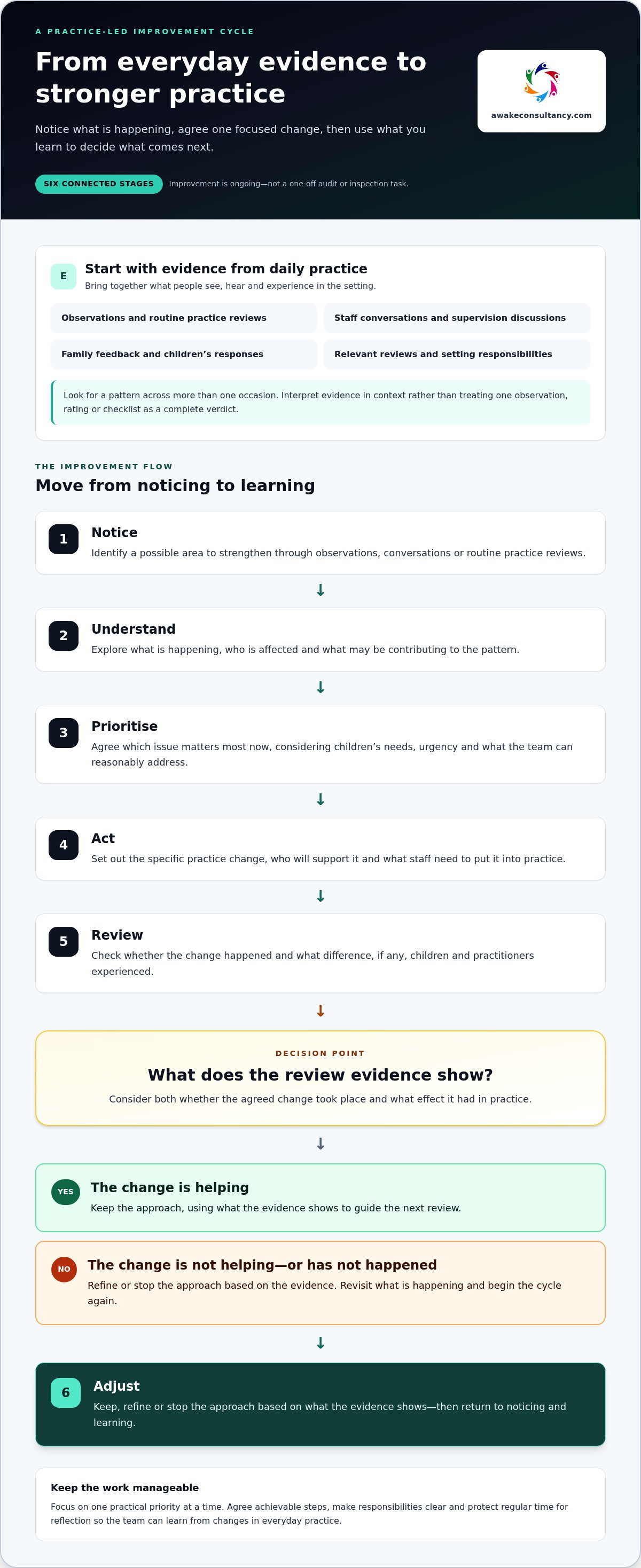
Continuous quality improvement is the disciplined process of using evidence from everyday practice to choose a change, learn from its effects and decide what to do next. A clear cycle helps a nursery move from concern to action without turning every observation into a new initiative. It also makes improvement a shared way of working, rather than a plan held by one leader.
Use six connected stages:
- Notice: Identify a possible area to strengthen through observations, conversations or routine practice reviews.
- Understand: Explore what is happening, who is affected and what may be contributing to the pattern.
- Prioritise: Agree which issue matters most now, considering children’s needs, urgency and what the team can reasonably address.
- Act: Set out the specific practice change, who will support it and what staff need to put it into practice.
- Review: Check whether the change happened and what difference, if any, children and practitioners experienced.
- Adjust: Keep, refine or stop the approach based on what the evidence shows, then begin the cycle again.
The cycle doesn’t require several projects to run at once. A setting might focus on helping children move between activities with less waiting. Leaders can agree one practical adjustment, give staff time to try it, then review what they observe before adding another priority. Protecting a short, regular time for reflection helps the team learn while the experience is still fresh. Recording the decision and sharing it with staff makes the reasoning visible.
How should a setting identify a meaningful improvement priority?
Bring together observations, supervision discussions, family feedback, children’s responses and reviews of routine practice. Look for a pattern across more than one occasion before treating an issue as a wider concern. Then weigh its relevance to children, urgency, feasibility and the setting’s responsibilities. This helps leaders distinguish a priority that needs sustained attention from an isolated event that calls for a different response.
For example, if observations and staff discussions both suggest that some children have limited opportunities to contribute during group routines, explore when and why that happens before choosing an action. Family perspectives may add helpful context, but practitioners still need to interpret the evidence professionally. A useful priority is clear enough to guide action and focused enough to review.
How can staff take part without adding unnecessary pressure?
Involve practitioners early. Ask what is working, where practice feels inconsistent and what support would make a change achievable. Agree responsibilities and allow time to practise, rather than adding a task without adjusting expectations. Brief check-ins can surface barriers, share useful observations and recognise progress. Leadership research, including the U.S. Department of Health and Human Services’ Theory of Change for early care and education leadership, also examines how leadership supports improvement.
Keep the discussion curious, not punitive. If the change proves difficult to apply, ask what needs adapting: the approach, the resources or the support available. A setting-specific early years consultancy perspective can help leaders review evidence and agree realistic next steps while keeping the cycle rooted in everyday practice.
How can a nursery tell whether quality improvement is working?
Review two things separately: whether the team has put the agreed change into practice, and whether children’s experiences appear to be improving. These questions are related, but they aren’t interchangeable. If staff have adopted a new approach but children’s engagement hasn’t changed, leaders may need to adjust the approach or allow more time to understand its effects. If practice hasn’t been implemented consistently, it’s too early to judge the intended impact.
Choose a small number of indicators linked directly to the improvement question. A useful indicator helps the team make a decision; extra data that doesn’t shape action can create work without adding insight. Pair simple records, where relevant, with focused observation and staff reflection. Numbers need context: an attendance pattern, for example, may prompt a question, but it doesn’t explain on its own what children experience or why a pattern exists.
What evidence can leaders use to review practice?
Use evidence that fits the priority, such as focused observations, supervision notes, attendance patterns, family feedback and children’s engagement. Keep records proportionate and handle them in line with applicable confidentiality and safeguarding requirements. No single indicator proves quality or impact. Consider how the sources fit together, and use professional judgement to interpret what they show.
| Improvement question | Possible evidence | Review method |
|---|---|---|
| Are children taking part in the planned activity? | Focused observation of children’s engagement and choices | Compare observations from ordinary sessions before and after the change |
| Is the agreed practice being used consistently? | Observation notes and staff reflections across routines | Discuss examples at a team check-in and identify any differences in practice |
| Are families noticing a relevant change? | Feedback gathered through normal conversations | Look for themes alongside observation and practitioner insight |
Use the table as a starting point, not a fixed measurement system. For each priority, agree in advance what evidence would help the team decide to continue, adapt or stop the change. A useful lens is whether the practice responds to children’s development and individual needs. NAEYC’s Developmentally Appropriate Practice (DAP) resource may help frame reflection, while local statutory requirements and guidance remain the relevant reference for a setting.
How can a setting separate real progress from inspection-day polish?
Look for the agreed practice across rooms, routines, staff and ordinary operating days, not only during a planned visit. Check again after reminders, meetings or external input have ended. If improvement depends on a particular person being present, consider what support would help the whole team sustain it.
Ofsted readiness is stronger when it grows from sound daily practice, but inspection preparation shouldn’t become the sole purpose of improvement. The aim of early years quality improvement is to understand what children experience, learn from evidence and strengthen provision over time. Review findings with staff, record the next decision clearly and return to the question that prompted the work.
How can leaders make early years quality improvement manageable?
A manageable plan turns one agreed priority into a practical change the team can understand, try and review. It should make the work visible without creating a second workload of paperwork. Keep the plan short enough to use in supervision and team discussions, and connect actions to routines that already happen wherever possible.
Before implementation, make these points clear:
- Priority: Name the practice to strengthen and the evidence that led the team to choose it.
- Purpose: Describe the intended difference for children, using clear, everyday language.
- Action: Set out what staff will do differently and where that change fits into existing routines.
- Ownership: Assign a lead to coordinate the work, while sharing responsibility across the team rather than placing the whole task on one practitioner.
- Support: Identify any discussion, resources or development staff need to practise the change confidently.
- Review: Agree a realistic check-in point and the evidence that will help leaders decide whether to continue, adapt or pause the approach.
Make these details easy to find in a simple action plan or team record. A visible owner, review point and check-in date reduce uncertainty. They also help leaders spot when an agreed action is competing with another demand. The plan should guide work, not become a document staff update without using.
How should leaders turn a priority into manageable action?
Translate a broad concern into an observable practice change. Instead of “improve transitions”, specify which transition needs attention, what adults will do differently and what children should experience as a result. Choose an action that fits the setting’s capacity, then agree support and review evidence before starting. This clarity helps staff understand both the purpose and how leaders will assess progress.
What should leaders do when progress stalls?
A delay or uneven result is a reason to review the plan, not to assign blame. Ask whether the priority is clear, whether the proposed action is feasible in the daily routine and whether staff have enough time or development to use it consistently. Listen for practical barriers. Then record what changed, what remains unresolved and what the team will test next.
Protect workload by keeping improvement priorities focused and avoiding several major changes at once. Where possible, use existing supervision, staff meetings and practice reviews to check progress, rather than creating additional meetings. If a new initiative is essential, consider what can be paused or simplified so practitioners can give it proper attention.
A nursery practice review can help examine how routines are working, while an action plan can make agreed responsibilities and review points clear. These tools are most useful when they connect evidence to decisions and are revisited with the team. Awake’s tailored early years consultancy supports leaders to shape realistic improvement plans around their setting’s needs.
How can tailored early years consultancy support sustained improvement?
An external perspective can help when leaders have gathered evidence but remain unsure which issue to address, when a familiar routine is difficult to assess objectively, or when agreed changes aren’t becoming consistent practice. A constructive adviser can ask questions, test assumptions and help the team connect findings to realistic next steps. The aim is not to take ownership away from leaders, but to help them strengthen their own improvement process.
What can an external review contribute to a setting’s improvement work?
A setting health check or practice review gives leaders a structured opportunity to examine strengths alongside development needs. It can bring different evidence into focus and help clarify whether a concern reflects an isolated instance or a pattern worth addressing. A mock inspection offers another perspective on practice and areas for development, but it is one source of insight, not a substitute for consistently strong experiences for children.
Findings are most useful when they lead to a manageable response: agree a focused action, consider what support staff need, and set a point to review how the change is working. Without those steps, feedback can remain a list of observations rather than support sustained improvement. A review should inform the setting’s own cycle of learning, not create a separate process that staff struggle to maintain.
How can Awake support improvement that fits your setting?
Awake Early Years Consultancy works with nurseries, pre-schools and other early years settings on tailored consultancy and practice improvement. Support is shaped around the setting’s context, priorities and operational realities, rather than applying a single improvement plan to every team. That matters because a useful next step needs to be both relevant to children and achievable in the setting’s day-to-day work.
Awake provides health checks to help examine practice and identify priorities, practitioner training to strengthen consistency, and mock inspection support to offer another perspective. These services can contribute to a broader improvement effort, alongside leadership, staff involvement and ongoing review. No consultancy or mock inspection can guarantee a particular Ofsted outcome. The focus remains on learning, implementation and stronger practice beyond the visit itself.
Before seeking support, leaders can note the concern they want to explore, the evidence they have and the question they need help answering. That gives an initial discussion a practical starting point and keeps the focus on the setting’s needs. If you’re considering how to move your early years quality improvement work forward, talk with Awake about your setting’s priorities and the support that could help your team take the next step.
Make improvement part of how your setting learns
The next step doesn’t need to be a major programme. Choose one question your team wants to understand better, then make space to learn from the answer. Over time, this habit can help staff raise concerns early, share what they notice and contribute to decisions with confidence. That’s how early years quality improvement becomes part of a setting’s culture, rather than a plan that depends on one leader or a particular review date.
Consider what would help your team move forward now. You may need a clearer starting point, a more manageable way to involve practitioners or an outside perspective to help test your assumptions. Awake provides tailored consultancy for nurseries, pre-schools and other early years settings, with support shaped around each setting’s priorities and context.
Discuss a focused improvement approach for your setting and identify a practical next step for your team. Meaningful progress begins with a clear question and a willingness to keep learning together.
Frequently Asked Questions
How often should an early years setting review its quality improvement priorities?
Review priorities often enough to respond to what’s happening, but don’t change direction simply to create activity. Set a planned review point that suits the action, then revisit it sooner if children’s needs, staffing or operating circumstances change. For example, a new pattern in children’s participation may call for an earlier discussion. Keep a note of why a priority remains active, changes or closes so decisions are clear to the team.
Can a small nursery use continuous quality improvement without a large team?
Yes. A small nursery can make improvement part of existing conversations rather than creating a separate committee or process. The manager might bring one focused question to a staff meeting, invite each practitioner to share an observation, and agree a practical next step together. In a very small team, it can also help to ask a colleague to review the evidence with fresh eyes, while keeping responsibility and decisions clear.
How can families contribute to early years quality improvement?
Families can offer insight into children’s interests, experiences and changes that may not be visible during nursery routines. Ask focused, open questions through regular conversations or an appropriate feedback opportunity, then consider what the responses suggest alongside observations and practitioner knowledge. For instance, a family may share that a child is showing interest in a topic at home. This can inform planning, while staff retain professional responsibility for decisions about provision.
Does early years quality improvement require a formal accreditation scheme?
No. A setting can improve practice through a clear process of reflection and action without joining an accreditation scheme. External standards or review tools may offer useful prompts, but they shouldn’t replace the requirements that apply to the setting or its own understanding of children’s needs. Choose an approach that helps staff make sound decisions and sustain learning, rather than pursuing a badge that doesn’t guide everyday practice.
What should a nursery do if an improvement action has not worked?
First, establish what “not worked” means: was the action tried as intended, did it reach the children concerned, or did the expected difference fail to appear? Gather specific examples before deciding whether to change the action or reconsider the original assumption. If the approach created an unintended difficulty, pause and address it. A useful record captures the learning, not just the outcome, so the next attempt starts from better information.
How can a nursery involve staff who are hesitant about change?
Start by asking what concerns them. Hesitation may reflect a practical barrier, uncertainty about the purpose or previous changes that added pressure. Explain what the proposed adjustment is meant to improve, invite staff to identify workable ways to test it, and make space to raise concerns without blame. A small, time-limited trial can help the team examine the effect before deciding whether to embed the change more widely.
