

What if the most useful early years consultancy doesn’t add another action plan, but helps your team improve the practice already happening every day? External advice can be valuable when it addresses your setting’s priorities and turns them into changes staff can sustain.
When quality, leadership, staffing and operations are all on your mind, it can be hard to see how the challenges connect. A report that creates more tasks without changing daily practice is unlikely to help. Effective consultancy starts by understanding your context, then offers focused insight, practical challenge and clear next steps.
This guide explains what early years consultancy can address, from quality improvement and leadership guidance to Ofsted preparation and mock inspections. It also outlines how to prepare for a constructive engagement, agree priorities and keep improvement manageable. You’ll see how Awake’s tailored support can help your setting strengthen practice and build changes into everyday routines, rather than relying on short-term fixes.
Key Takeaways
- Understand how early years consultancy can help you examine the issues behind a concern, not just its visible symptoms.
- Use a clear improvement sequence to turn observations into actions your team can put into practice and review.
- Compare focused reviews, ongoing consultancy, mock inspections and practitioner training to identify a suitable starting point.
- Prepare for a more useful first discussion by clarifying your key question, setting context, relevant evidence and who should contribute.
- Explore how Awake’s tailored support can connect Ofsted readiness with wider development in practice and leadership.
What does early years consultancy mean for a nursery or setting?
Early years consultancy is setting-specific external advice that helps a team reflect on its practice, make informed decisions and put practical improvements into effect. It brings an independent perspective to questions a setting is already facing, taking account of its children, staff, routines and operating context.
Consultancy is not the same as an inspection, which assesses a setting against relevant expectations. It also differs from training, which develops knowledge or skills, and routine management, which remains the responsibility of the setting’s leaders. A consultant can ask questions, review what is happening and help clarify possible next steps. Leaders and practitioners bring the day-to-day knowledge needed to make those steps workable.
The aim is stronger everyday practice, not simply more polished documents or a better performance on an inspection day. Early childhood education has a broad foundation of ideas and approaches, as outlined in this overview of early childhood education. In a UK setting, consultancy needs to connect those educational aims with practical realities such as team capacity, leadership responsibilities and how the provision operates.
Which early years settings can benefit from consultancy?
Nurseries, pre-schools and other early years settings can all benefit, but they won’t necessarily need the same support. A larger team may need to understand why routines vary between rooms. A smaller setting may be working through a leadership change or trying to clarify its priorities. The right focus depends on the setting’s size, staff experience, leadership structure and circumstances.
Context matters. A recommendation that looks straightforward on paper may be difficult to apply if it doesn’t fit the team’s responsibilities or working patterns. Useful consultancy considers how a proposed change would work within the setting’s daily operation, rather than assuming one model suits everyone.
What problems can early years consultancy help clarify?
Settings may seek external input when a concern keeps returning, staff are unsure which improvement to tackle first, or a leadership transition raises questions about roles and consistency. Operational pressures can also affect practice. For example, a team may find it hard to maintain consistent routines while managing staffing or responsibility changes.
The presenting concern is not always the underlying issue. If practice differs between rooms, the cause might be unclear expectations, uneven confidence or too few opportunities for shared discussion, rather than a lack of commitment from practitioners. If priorities keep shifting, leaders may need to distinguish immediate pressures from longer-term development needs. An independent perspective can help examine these contributing conditions without assigning blame or prescribing a generic answer.
This makes consultancy useful as a thinking and decision-making process. It helps a setting describe what it is seeing, explore why it may be happening and identify where closer attention is needed. The setting remains central: external insight can sharpen the questions, but sustainable change has to make sense in everyday practice.
How early years consultancy can turn a review into practical change
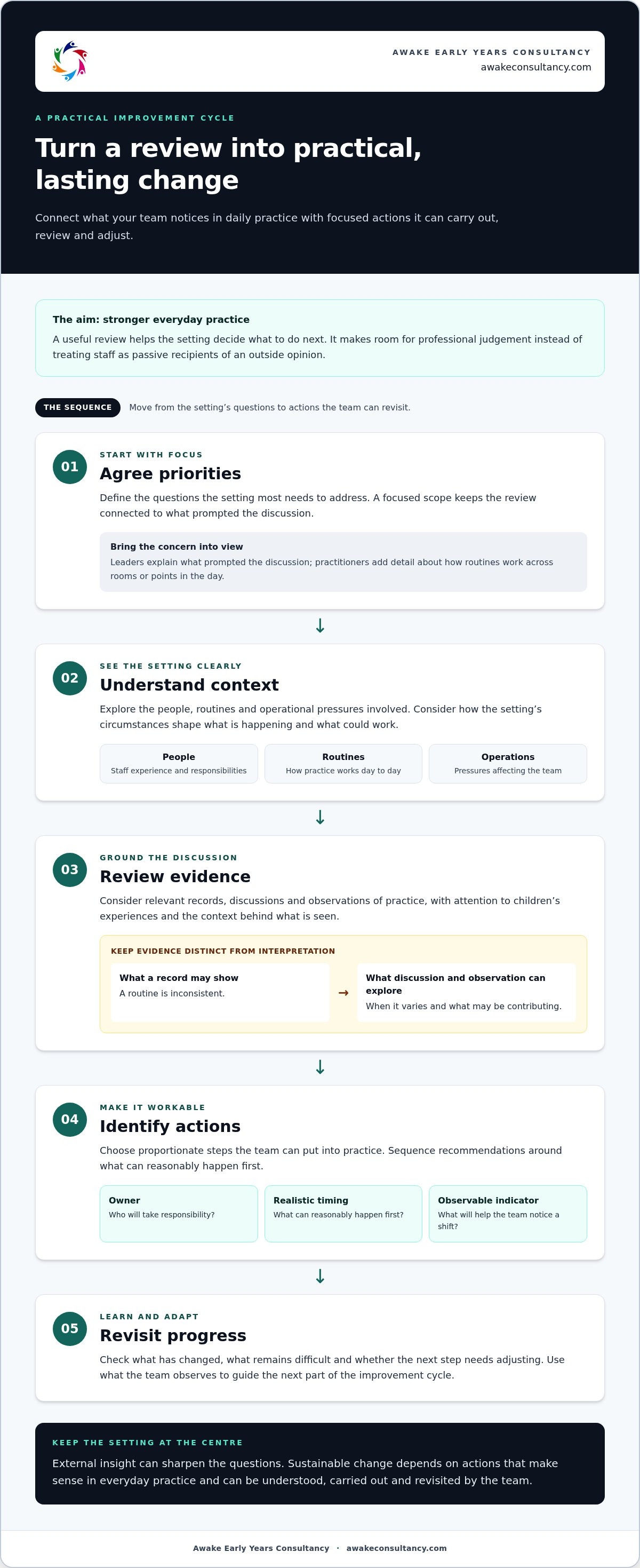
A review is useful when it helps a setting decide what to do next. A clear process connects what leaders and practitioners notice in daily practice with actions the team can understand, carry out and revisit. It should make room for professional judgement, rather than treating staff as passive recipients of an outside opinion.
A practical improvement cycle can follow five steps:
- Agree priorities: Define the questions the setting most needs to address.
- Understand context: Explore the people, routines and operational pressures involved.
- Review evidence: Consider relevant records, discussions and observations of practice.
- Identify actions: Choose proportionate steps, with an owner, realistic timing and an observable indicator.
- Revisit progress: Check what has changed, what remains difficult and whether the next step needs adjusting.
From initial priorities to a focused review
A focused scope keeps the review tied to the setting’s actual questions. Leaders can explain what prompted the discussion, while practitioners add detail about how routines work in different rooms or at different points in the day. Relevant records and observation can help test assumptions, with attention to children’s experiences and the context behind what is seen. Professional resources, such as those from the National Association for the Education of Young Children (NAEYC), can inform reflection, but recommendations still need to fit the setting.
The review should distinguish evidence from interpretation. A record, for instance, may show that a routine is inconsistent, while staff discussion and observation help explain when it varies and what may be contributing. This keeps the conversation respectful and specific. It also gives the team a shared basis for deciding which issue warrants action, rather than treating every observation as a separate priority.
From recommendations to sustained implementation
Recommendations become workable when leaders sequence them. Agree who will take responsibility, what can reasonably happen first and what the team will look for to judge whether practice is shifting. An indicator might be a routine being applied more consistently or staff being clearer about an agreed approach. Keep the indicator observable and relevant to the original concern.
Communication and professional learning help actions become part of the working day. Leaders can explain why a change matters, make time for practitioners to discuss how to apply it and connect learning needs with suitable development. A short routine review can then identify progress or barriers before they become entrenched. Avoid launching multiple changes at once if the team cannot give them meaningful attention.
A review identifies where to focus; implementation and follow-up determine whether that insight becomes part of everyday practice. External input can support the cycle, but the setting’s leaders and practitioners must shape and carry forward the agreed work. Awake’s tailored early years consultancy can help connect review, leadership and practical improvement.
Which early years consultancy approach fits your setting’s needs?
The right form of support depends on the question you need to answer and how much change the team can take on. A focused review may be enough to clarify one concern. Priorities involving several people or stages of implementation may call for ongoing consultancy. Support can also include a mock inspection or practitioner training, with a clear scope and purpose for each activity.
| Approach | Purpose | A suitable starting point | Practical output |
|---|---|---|---|
| Focused review | Examine a defined question or practice area. | Leaders want an independent perspective on a specific concern. | Clear observations and prioritised areas for attention. |
| Ongoing consultancy | Support staged discussion and development. | Work involves connected priorities or needs revisiting as actions progress. | Agreed next steps that can be reviewed and refined over time. |
| Mock inspection | Provide a structured readiness exercise through review and professional discussion. | The setting wants to understand how its practice and evidence may be experienced during an inspection. | Feedback to inform preparation and further improvement, not a prediction of an Ofsted outcome. |
| Practitioner training | Build knowledge or skills linked to a development need. | Staff would benefit from shared learning to support more consistent practice. | Learning that practitioners can consider in relation to their daily work. |
Focused review, ongoing advice or mock inspection?
Start with the nature of the uncertainty. Choose a focused review when the question is contained and a fresh perspective could help clarify it. Ongoing advice is more appropriate when leaders need to work through related priorities in stages, allowing discussion and implementation to inform each other. A mock inspection can help a setting examine its readiness, but it cannot guarantee or forecast a grade. Research from the National Institute for Early Education Research (NIEER) offers wider evidence on early education that can inform professional reflection, while local context remains central.
When training or wider operational support may be relevant
Training is useful when a clear knowledge or skills need sits behind a practice concern, or when practitioners need a shared understanding of an approach. It shouldn’t be treated as a substitute for clarifying what is affecting practice. Recruitment or financial guidance may also be relevant if operational pressures are shaping the improvement challenge. Keep each element tied to the priority, and agree what can realistically be addressed first.
A setting might combine approaches, for example a review followed by targeted training. But combining support should not mean tackling everything at once. Prioritise the issue that matters most, keep the scope manageable and give each activity a clear purpose. Inspection preparation is most useful when it supports a sound understanding of everyday practice, rather than short-term presentation for a single date.
How to prepare your setting for useful early years consultancy
A little preparation can help early years consultancy focus on the question that matters, without turning the engagement into another compliance exercise. You don’t need to create a presentation or assemble every document your setting holds. Start by clarifying what you want to understand, what has already been tried and whose experience will help build an accurate picture.
What leaders can clarify before the engagement
Before the first discussion, separate urgent concerns from longer-term development priorities. An immediate issue may need prompt attention, while broader questions about consistency or leadership can be explored as planned improvement work. Distinguishing between the two helps keep the conversation proportionate and focused.
A short preparation checklist can help:
- State the main question. What prompted you to seek support, and why does it matter now?
- Describe useful change. What would staff, leaders or children experience differently if the issue improved?
- Summarise the context. Note relevant features of the setting, recent changes and operational pressures that shape the concern.
- Gather relevant evidence. Select records, existing reflections or examples that relate directly to the question, rather than preparing a showcase.
- Include staff perspectives. Identify which leaders and practitioners can explain how the issue appears in day-to-day practice.
- List existing activity. Note what the setting has already tried, what seems to help and where progress has stalled.
Keep the preparation concise. A brief summary and a few relevant examples can be more useful than a large folder assembled to demonstrate that everything is in order. Honest context, including uncertainty or competing pressures, gives the discussion a practical starting point.
How to make findings manageable for the team
Before recommendations are put into practice, decide who will coordinate follow-up and how staff will hear about the agreed priorities. Use existing team meetings, supervision or review routines where they suit the work. Avoid adding a parallel process that competes for attention. Practitioners should understand what is changing, why it matters and where they can raise practical barriers.
Review progress through observable practice and children’s experiences, not document completion alone. For example, consider whether an agreed routine is becoming more consistent or whether staff can explain and apply a shared approach. Keep the action proportionate to the concern, and revisit it through a familiar review point so leaders can adjust the plan if circumstances change.
Where EYFS or Ofsted expectations are relevant to the question, use the current official guidance that applies to your setting. Requirements and inspection materials can change, so check the latest versions before relying on them; don’t base preparation on outdated summaries. To prepare around your setting’s priorities, discuss tailored consultancy support with Awake.
How Awake Early Years Consultancy supports settings beyond inspection readiness
Inspection readiness can be a useful reason to seek external support, but it needn’t define the whole engagement. Awake Early Years Consultancy works with nurseries, pre-schools and other early years settings to strengthen practice, leadership and quality in line with each setting’s priorities. The focus is not simply on preparing documents or rehearsing for an inspection. It’s on understanding what’s happening in the setting and identifying practical steps that can support improvement in everyday work.
For some settings, Ofsted preparation or a mock inspection can help leaders reflect on readiness and identify areas for further attention. These are forms of preparation, not predictions of an inspection outcome or promises of a particular rating. Wider consultancy can connect that reflection to leadership and practice, keeping improvement relevant beyond a single inspection date.
Tailored support for UK settings and international EYFS partners
Awake supports UK providers and international partners seeking EYFS expertise. Context matters: advice for a UK nursery needs to relate to its setting and applicable guidance, while an international partner may draw on EYFS principles within a different local framework. Consultancy takes these differences into account rather than assuming one approach transfers unchanged. For international work, EYFS expertise can inform development while local requirements and operating conditions remain important.
A tailored approach also means the scope can reflect what is affecting the setting. A question about consistent practice may call for a different emphasis from one involving leadership responsibilities or operational pressures. The aim is to establish a relevant direction, not apply a generic template or promise a particular result.
Choose a practical next step with Awake
Related support is useful when it connects directly to the priority. Practitioner training and development can address a specific learning need or support a shared approach. Recruitment support can help when recruitment pressures affect the setting’s improvement context, while financial guidance can help leaders consider business issues linked to wider plans. These options should support the central priority, not distract from it.
To begin a focused discussion, outline the type of setting you lead, what’s prompting you to seek support and what you’d like to understand or strengthen. Mention any work already under way and the people who should contribute. That gives Awake a practical starting point for exploring a tailored direction, whether the need centres on consultancy, inspection readiness, leadership, practitioner development or a connected operational issue.
Early years consultancy is most useful when external insight meets the setting’s own knowledge and capacity for change. Awake can help you consider the issue, clarify a proportionate next step and keep the conversation grounded in your real priorities. Share your context and the support you’re seeking to begin that discussion.
Turn your next priority into a practical step
Improvement doesn’t need to begin with a complete plan. Start with one question that could make a meaningful difference to children’s experiences or the way your team works. Consider what you already understand, where a fresh perspective could help and what change your setting has capacity to put into practice.
That gives early years consultancy a clear purpose: helping your setting make a considered next move, not adding activity for its own sake. The right support should respond to your circumstances and help build capability over time. With Awake, that may involve tailored consultancy, Ofsted preparation or mock inspection support, alongside practitioner training, recruitment support or financial guidance where these fit your priorities.
Share the issue you’re working through and the outcome you’re aiming for. Discuss your setting’s priorities with Awake and take a measured first step towards improvement your team can sustain.
Frequently Asked Questions
Is early years consultancy only useful when an Ofsted inspection is approaching?
No. A setting can seek support when reviewing a room’s routines, responding to recurring family feedback or adapting to a change in how the service operates. These issues can arise regardless of inspection timing. Addressing them early can help leaders understand what’s behind a concern and consider a proportionate response, rather than waiting until an external inspection creates additional pressure.
Can an early years consultant guarantee an Ofsted rating?
No. A consultant can support preparation, offer a mock inspection and help leaders consider areas for development, but cannot guarantee or determine Ofsted’s assessment. A mock inspection is a point-in-time exercise, not a forecast of the eventual outcome. Treat it as an opportunity to learn and strengthen practice, rather than as assurance of a particular rating.
How long does early years consultancy take?
There’s no fixed duration that applies to every setting. The time required depends on the question, the scope of the review and whether the work involves one area or support as actions are developed. A clearly defined issue may need a different level of input from a transition involving several teams. Agree the intended scope and what the setting hopes to address before work begins.
Does consultancy replace the responsibilities of a nursery manager?
No. Consultancy provides an external perspective, but the manager and provider retain responsibility for leading the setting and making operational decisions. A consultant may identify a gap in how information is shared, for example, but the setting’s leaders decide how to address it, communicate expectations and oversee practice. Use advice to inform professional judgement, not to transfer accountability for the service.
How much does early years consultancy cost?
The fee depends on the type and scope of support, so costs can differ between a focused piece of work and broader consultancy. To discuss the fee for your setting, outline the support you’re considering, the issue you want to address and the people or areas involved. Awake can then discuss the proposed scope and fee with you.
What happens if a consultancy review identifies a serious concern?
Act promptly through your setting’s relevant safeguarding, safety or other response procedures. Don’t wait for a consultancy report or follow-up discussion if a child or another person may be at immediate risk. A consultant can help leaders think through improvement and next steps, but consultancy doesn’t replace the setting’s responsibilities to respond, record and escalate concerns through appropriate channels.
Can early years consultancy support a setting through change or a leadership transition?
Yes. External support can help a setting examine how a transition may affect roles, communication and continuity for staff and children. Leaders might use consultancy to identify where responsibilities need clarifying or where established routines depend on knowledge held by one person. The work can help frame priorities and support considered decisions, while the setting’s leaders remain responsible for implementing them.
