

What if a nursery practice review helped your team make clearer decisions instead of adding another layer of paperwork? A useful review starts with everyday practice: what children experience, what staff do consistently and where evidence points to a need for change. It isn’t an inspection or an official judgement. It’s a structured way to understand what’s working and decide what needs attention.
It’s understandable to feel unsure about how much to review, which areas to prioritise and how to keep actions moving after the discussion ends. You don’t need to examine everything at once. A proportionate process brings together observation, relevant records and staff perspectives, then focuses on a manageable number of meaningful priorities.
This practical checklist will help you agree the scope, gather evidence fairly, involve your team and distinguish consistent strengths from areas to develop. You’ll also learn how to set realistic actions with clear ownership and follow-up, so reflection leads to sustained improvements in everyday practice.
Key Takeaways
- Define the purpose of your review clearly: learn from everyday practice, not assign blame or create an unofficial inspection grade.
- Keep a nursery practice review proportionate by choosing a focused question and gathering evidence that fits the issue.
- Look for repeated patterns before drawing conclusions, and compare what you observe with your setting’s intended approach and current guidance.
- Choose priorities based on children’s experiences, consistency and practical urgency, then give each action an owner and review point.
- Use focused reviews to support leadership conversations and revisit themes over time without turning reflection into constant auditing.
What Is a Nursery Practice Review, and What Should It Achieve?
A nursery practice review is a structured look at everyday experiences, routines and interactions. It helps a team understand what children encounter and decide what to strengthen. The review uses evidence from the setting’s daily work to support learning and improvement. It is not a process for assigning blame, and it does not produce an unofficial inspection grade.
Keep the purpose clear. An inspection is an external evaluation against relevant expectations. Inspection preparation helps a setting understand those expectations and organise its readiness. A mock inspection is a practice exercise that simulates aspects of an inspection process. A practice review can be narrower and more reflective: it asks what is happening in a particular part of daily provision, why it may be happening and whether the team wants to change anything.
This distinction matters. A review should help practitioners examine the experience children receive, not simply assemble documents that look convincing. Records can provide useful context, but they cannot show on their own how an interaction feels or whether a routine works well for children.
What areas of nursery practice can a review examine?
Choose an area linked to a real question or concern, rather than trying to assess everything at once. A review might consider how adults respond to children’s attempts to communicate, how transitions between activities unfold, or whether play gives children meaningful opportunities to explore and make choices. Preschool education encompasses various approaches and curriculum goals. That breadth makes it especially useful to define the question in terms of children’s experience in your own setting.
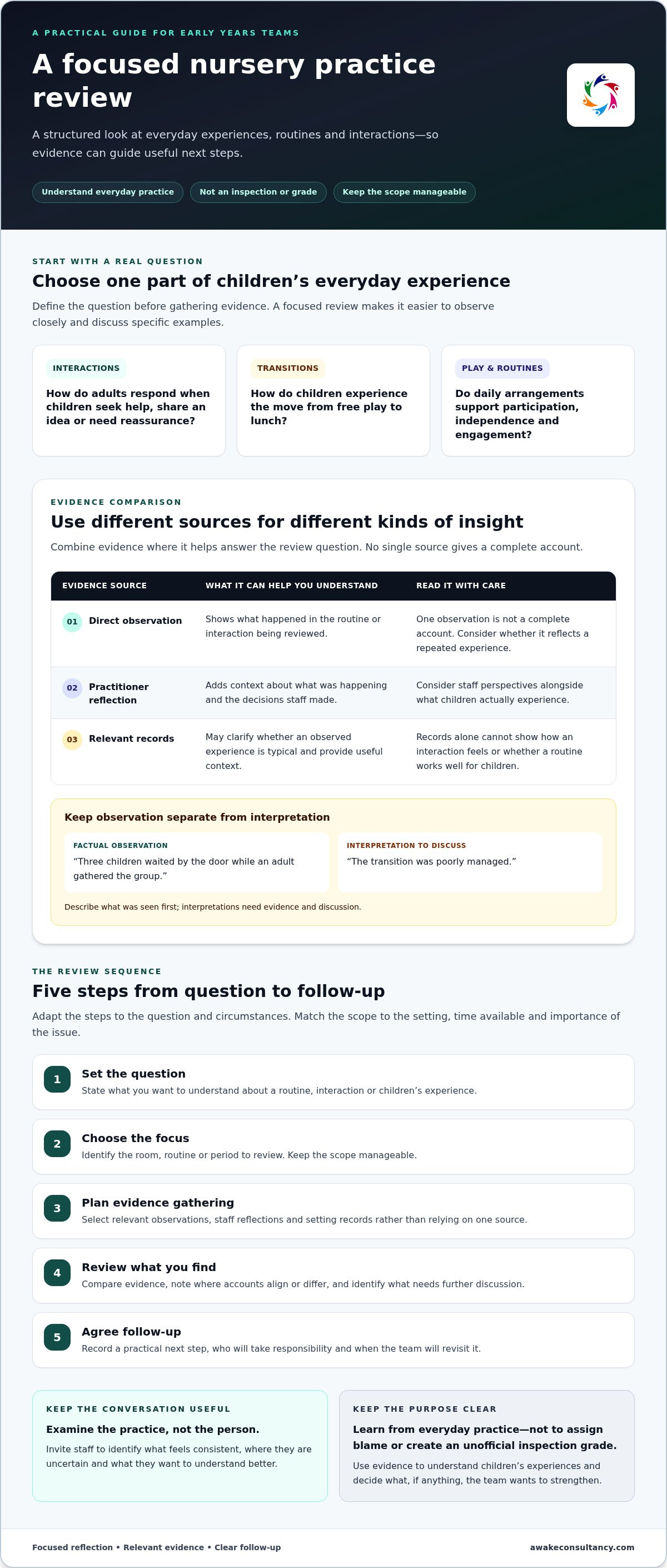
- Interactions: What do children experience when they seek help, share an idea or need reassurance?
- Transitions: How do children move between play, meals, rest or other routines?
- Play and routines: Do daily arrangements support children’s participation, independence and engagement?
Keep the scope manageable. If the question concerns transitions, focus on one transition or a relevant part of the day. This makes it easier to observe practice closely and discuss specific evidence, rather than drawing broad conclusions from a rushed review.
Who should take part in the review?
Include a suitable leader or reviewer and practitioners who know the routines being considered. The reviewer can hold the focus and gather observations. Practitioners can explain what was happening, what decisions they made and what may not be visible in a brief observation. Their context adds depth, but it should be considered alongside what children actually experience.
Agree a respectful approach before starting. Invite staff to identify what feels consistent, where they are uncertain and what they would like to understand better. Keep discussion specific and curious: examine the practice, not the person. This makes it easier for the team to recognise strengths honestly, explore differences in approach and decide whether more evidence is needed before drawing conclusions.
How to Conduct a Nursery Practice Review: A Clear Checklist
A practical review needs a clear question, relevant evidence and a defined way to follow up. It doesn’t need to cover every room or routine at once. Match the scope to the setting’s size, the time available and the importance of the issue. Keep the process focused enough for staff to take part meaningfully.
Set the review question and scope
Start with a question that guides what you observe. For example: “How do children experience the move from free play to lunch?” Decide who will lead the review, which part of the setting it covers and when you’ll gather evidence. Agree that the aim is to understand practice, not catch people out. If the review concerns learning experiences, research-based recommendations for preparing young children for school may help frame what those experiences should support.
Use this checklist as a starting point, adapting each step to the question and circumstances:
- Set the question. State what you want to understand about a routine, interaction or children’s experience.
- Choose the focus. Identify the room, routine or period to review, and keep the scope manageable.
- Plan how to gather evidence. Select relevant observations, staff reflections and setting records rather than relying on one source.
- Review what you find. Compare evidence, note where accounts align or differ, and identify what needs further discussion.
- Agree follow-up. Record a practical next step, who will take responsibility and when the team will revisit it.
Gather and discuss evidence from everyday practice
Use more than one kind of evidence where it helps answer the question. Direct observation can show what happened; practitioner reflection can explain the decisions and context behind it; relevant records may help clarify whether the experience is typical. Each source has limits, so don’t treat one observation or document as a complete account.
Write observations in factual language. For instance, “Three children waited by the door while an adult gathered the group” describes what was seen. “The transition was poorly managed” is an interpretation that needs evidence and discussion. Keeping the two separate helps the team consider other explanations and decide whether the moment reflects a repeated pattern.
Make room for practitioners to add context and identify uncertainties. Their perspectives can reveal factors that weren’t visible during observation, as well as differences between the intended routine and what happens in practice. A respectful discussion makes it possible to recognise effective work and question assumptions without turning the review into a judgement of individuals.
Where a team would benefit from help interpreting findings or strengthening everyday practice, setting-specific early years consultancy can provide a structured perspective.
How to Interpret Nursery Practice Review Findings Fairly
Evidence only becomes useful when the team interprets it carefully. A single observation can prompt a question, but it rarely explains a whole routine or establishes a consistent pattern. In a nursery practice review, separate what was directly observed from what it might mean, then consider whether other evidence supports that interpretation.
How can reviewers distinguish a pattern from a one-off event?
Record the context: what was happening, where, when and who was involved. Then compare the observation with other relevant moments, records and practitioners’ perspectives. If children waited during one transition, for example, explore whether this also happens at other times and what staff say affects the routine. Avoid broad labels such as “disorganised room”; describe the evidence precisely instead.
Differences matter too. If one account suggests a routine is predictable and another describes frequent delays, don’t rush to choose between them. Ask whether the accounts refer to different times, groups or circumstances. The contrast may reveal where the routine works well and where it needs closer attention.
How can a review stay reflective rather than judgemental?
Compare observed practice with the setting’s intended approach and applicable current guidance. Before linking a finding to the EYFS statutory framework or Ofsted guidance, check that you’re using the current version and that the reference applies to the practice under review. A practice review is a tool for learning, not an external judgement.
Use open questions to understand what shaped the practice: “What was happening for the children at this point?” or “What might help this routine feel more settled?” Recognise what is effective and worth sustaining, as well as questions to explore and development needs to address. This keeps discussion grounded in evidence and gives practitioners room to explain context without dismissing concerns.
The comparison below helps teams move from observation to a fair question without treating interpretation as fact.
Evidence observed
During one observed transition, several children waited while an adult prepared the next activity.
Possible interpretation
The transition may not be predictable for children, or this particular moment may have involved an unusual interruption.
Follow-up question
Does waiting occur during other transitions, and what do practitioners notice about children’s experience at those times?
Apply the same distinction to positive evidence. If children move confidently into an activity, record what adults did and how children responded before concluding that the approach is consistently effective. Then classify each finding: effective practice to sustain, a question requiring more evidence, or a development need ready for action. This prevents isolated moments from becoming sweeping conclusions and gives the next discussion a clear, balanced starting point.
Turn Nursery Practice Review Findings into Manageable Next Steps
A finding supports improvement only when the team can act on it. Weigh each point against three considerations: its relevance to children’s experiences, whether the evidence suggests a consistent pattern, and how promptly it needs attention. If a concern requires immediate action, follow the setting’s established procedures rather than waiting for a review cycle to finish.
Not every observation needs to become a separate task. Group related findings, recognise effective practice worth sustaining and select a manageable number of priorities. A short, focused plan is easier to explain, carry out and revisit than a long list competing with daily responsibilities.
An action is useful when its owner and follow-up are clear. Record what will change, who will lead it and when the team will check progress. This makes responsibility visible without treating improvement as one person’s work alone.
Agree actions that can be carried out in daily practice
Describe the intended change in observable terms. “Improve transitions” is broad; “prepare the next activity before inviting children to move” gives practitioners something specific to try. Connect the action to the evidence that prompted it, so staff understand its purpose and can judge whether it is relevant in the moment.
Before agreeing the plan, consider what implementation requires. Practitioners may need time to discuss a shared approach, access to suitable resources or clarity about who does what. Keep the commitment realistic alongside other priorities, and make room to identify barriers instead of assuming they will resolve themselves.
Check whether the change has made a difference
Set a review point that gives staff a fair opportunity to put the change into practice. Return to the original question and gather fresh evidence in a comparable context where possible. Ask practitioners what has changed for children, what feels more consistent and what remains difficult. Keep the conversation open if the evidence is mixed.
Use what you learn to decide whether to continue, adapt or close the action. If the approach is helping, consider how to maintain it in ordinary practice. If it hasn’t made a clear difference, revisit the explanation or try a more suitable response. Closing an action is also a decision: record what supports that conclusion rather than letting the item disappear from view.
Where findings are difficult to interpret or the team needs support turning them into practical changes, work with Awake on tailored early years consultancy to strengthen practice and leadership.
Build a Sustainable Nursery Practice Review Cycle with the Right Support
A review cycle should create space for thoughtful improvement, not leave staff feeling that every part of the day is under constant scrutiny. Use focused reviews to inform leadership discussions about what children experience, what the team has learned and which priorities deserve attention. The aim is a steady rhythm of reflection, not an endless sequence of checks.
Make review a useful part of the setting’s improvement rhythm
Set a pace that fits the setting’s operations and current needs. Some themes may need to be revisited sooner because the team has made a change and wants to understand how it is working. Other areas can wait until they become a relevant priority. Keep each review focused, and avoid reopening settled findings without a clear reason or question.
Share learning with the practitioners involved and any colleagues who need it to support consistent practice. Keep conversations professional and specific: discuss what the team observed, what helped and what remains uncertain. Where a finding points to a shared learning need, practitioner training or leadership development may help build a common understanding. Choose support that connects directly to the practice under review, rather than adding training without a clear purpose.
Over time, themes can inform wider leadership conversations. For example, leaders might notice that several focused reviews raise questions about how routines support children’s independence. That can guide a future review or team discussion without turning every routine into a separate audit. Keep a brief record of priorities, actions and learning so the setting can see what has been revisited and why.
When can external early years consultancy help?
An external perspective can be useful when leaders need to make sense of mixed evidence, test an assumption or agree which issue to address first. Someone outside the setting can help the team examine practice with fresh eyes, while practitioners provide the context needed to interpret what happens day to day. The purpose is to clarify priorities and strengthen improvement work, not to replace the setting’s professional judgement.
Awake Early Years Consultancy provides tailored support to nurseries and other early years settings to improve practice and strengthen leadership. The consultancy can help leaders interpret review findings and consider practical ways to embed learning. Support is shaped around the setting’s needs, keeping attention on meaningful development rather than paperwork for its own sake. A nursery practice review remains a reflective process, not an inspection or a promise of a particular inspection outcome.
If your team would value an external perspective on findings or leadership priorities, explore tailored early years consultancy.
Keep Improvement Moving Beyond the Review
A nursery practice review can start a stronger habit: pause, ask what children are experiencing and make space for the team to learn together. Keep the conversation connected to everyday work so useful changes become part of how the setting operates, rather than a task that fades after the review.
If you’d value support in making sense of findings or developing your next priorities, Awake offers setting-specific early years consultancy, practitioner training and mock inspections. These services can support improvement and leadership development in a way that reflects your setting’s needs. A review remains a tool for reflection, not a promise of an inspection outcome.
Explore tailored early years consultancy to consider what support could help your team move forward. With a clear focus and a willingness to learn, steady progress is within reach.
Frequently Asked Questions
How often should a nursery review its practice?
There’s no single interval that suits every setting. Revisit practice when a clear question arises, leaders notice a concern recurring across the day, or an earlier action is due for follow-up. For instance, after changing how children access outdoor play, schedule a check to see whether the adjustment is workable. Keep the cadence realistic, avoid reviewing every area at once, and let current improvement priorities guide what comes next.
Can children contribute to a nursery practice review?
Yes. Children’s experiences can inform reflection in age-appropriate ways, including their engagement, choices, communication and responses during everyday routines. A practitioner might notice whether children approach an activity willingly or seek alternatives, while taking care not to infer too much from one child’s behaviour. Consider observations alongside other relevant evidence and professional judgement, and make sure the process protects children’s wellbeing and privacy.
Should parents be involved in a nursery practice review?
Parent perspectives can be useful when the review concerns communication, transitions or children’s experiences across home and setting. For example, a leader might invite focused feedback about how families receive updates during a change in routine. Explain why you’re gathering views and how they’ll inform reflection. Not every review needs parent participation, and feedback should never disclose confidential information about staff or individual children.
What should a nursery record during a practice review?
Keep a concise record that lets someone understand the review later: its question and scope, factual observations, relevant reflections, agreed actions and the point for follow-up. Note the date and context of observations where useful, but limit personal information to what the review needs. Good records support continuity when responsibilities change; they don’t replace observing practice directly or making time for professional conversation.
What if practitioners disagree about a review finding?
Return to the observation, its context and the review question rather than trying to settle the difference through assertion. Invite each practitioner to explain what they noticed and what may have shaped their view. If the evidence doesn’t resolve the issue, identify what further observation or discussion could help. Record the open question neutrally, agree a proportionate next step and keep the conversation focused on practice, not personal judgement.
Can a small nursery carry out a practice review without a large team?
Yes. A small setting can take a focused approach: agree one question, make a short observation and set aside time for a reflective discussion. Clarify who will observe and who will contribute, and consider whether a colleague can offer a fresh perspective. Record only findings that will guide a decision or follow-up. Limited staffing calls for a realistic scope, not less attention to children’s everyday experiences.
How is a nursery practice review different from a staff performance review?
A nursery practice review looks at how a routine, interaction or shared approach works in the setting; a staff performance review focuses on an individual’s role and development. They may point to related learning needs, but they aren’t interchangeable. For example, a review may identify inconsistent handovers across a team, while a performance discussion addresses one person’s responsibilities. State the purpose clearly so staff understand the focus.

