

A nursery can have well-organised folders and still be unprepared for inspection. Readiness shows in what children experience each day and how confidently staff explain their practice, not in a last-minute display of paperwork. If you’re asking how to prepare for Ofsted inspection, start by reviewing the routines, decisions and systems already in place.
It’s understandable to feel unsure about what to review first, especially when staff practice and records aren’t always consistent. The aim isn’t to create more paperwork or rehearse perfect answers. It’s to identify what’s working, address gaps and help the whole team explain the care and learning they provide.
This 2026 checklist sets out a manageable sequence: review current requirements, including the EYFS framework updated from 1 September 2026; observe everyday practice; check staff understand safeguarding and their responsibilities; and organise evidence that reflects real improvement. You’ll also find ways to set priorities and use a mock inspection to test your systems constructively, so preparation strengthens practice rather than becoming a separate exercise.
Key Takeaways
- Follow a clear review sequence to understand how to prepare for Ofsted inspection without turning preparation into a paperwork exercise.
- Check current statutory guidance against your setting’s routines, and look at children’s experiences to identify strengths and areas to improve.
- Clarify staff responsibilities and encourage open discussion so colleagues can explain their roles and know how to seek support.
- Turn observations into proportionate actions, with an appropriate person responsible and a clear point to review progress.
- Consider a mock inspection or tailored consultancy when priorities are unclear, while keeping responsibility for lasting improvement within your setting.
How to prepare for an Ofsted inspection by starting with everyday practice
The most dependable way to prepare is to understand what happens in the setting on an ordinary day, not just when someone is arranging a special display. A practical answer to how to prepare for Ofsted inspection is to help leaders and practitioners explain their decisions, show how routines support children and recognise where practice is still developing. Preparation can strengthen quality and confidence, but it can’t guarantee a particular inspection outcome.
Inspection readiness is the shared ability to understand, demonstrate and reflect on consistent everyday practice. It depends on what leaders and staff know and do, not on how polished the setting looks for a visit.
What does inspection readiness look like in an early years setting?
Leaders should have a clear, grounded view of the setting’s strengths, priorities and current improvement work. That means knowing not only what an action plan says, but what has changed as a result. For example, if a team is working to improve children’s access to resources, leaders should be able to describe what they noticed, what they changed and how they’re reviewing the effect.
Practitioners don’t need identical or rehearsed explanations. They should be able to talk naturally about their choices, using examples from daily practice: how they adapt an activity when a child loses interest, share information with a colleague or respond to a child’s emerging need. Evidence can help explain the provision, but folders and records can’t replace knowing the children and understanding their experiences. A broad overview of Ofsted's role and responsibilities can provide useful context, while setting-specific preparation should reflect current inspection guidance.
Why preparation should be part of normal nursery routines
Regular supervision and team discussion give staff and leaders a structured way to spot gaps early. A conversation about a routine, for instance, may reveal that colleagues interpret the written procedure differently or need support to apply it consistently. Addressing that difference through coaching, clarification or training is more useful than asking staff to memorise a response shortly before an inspection.
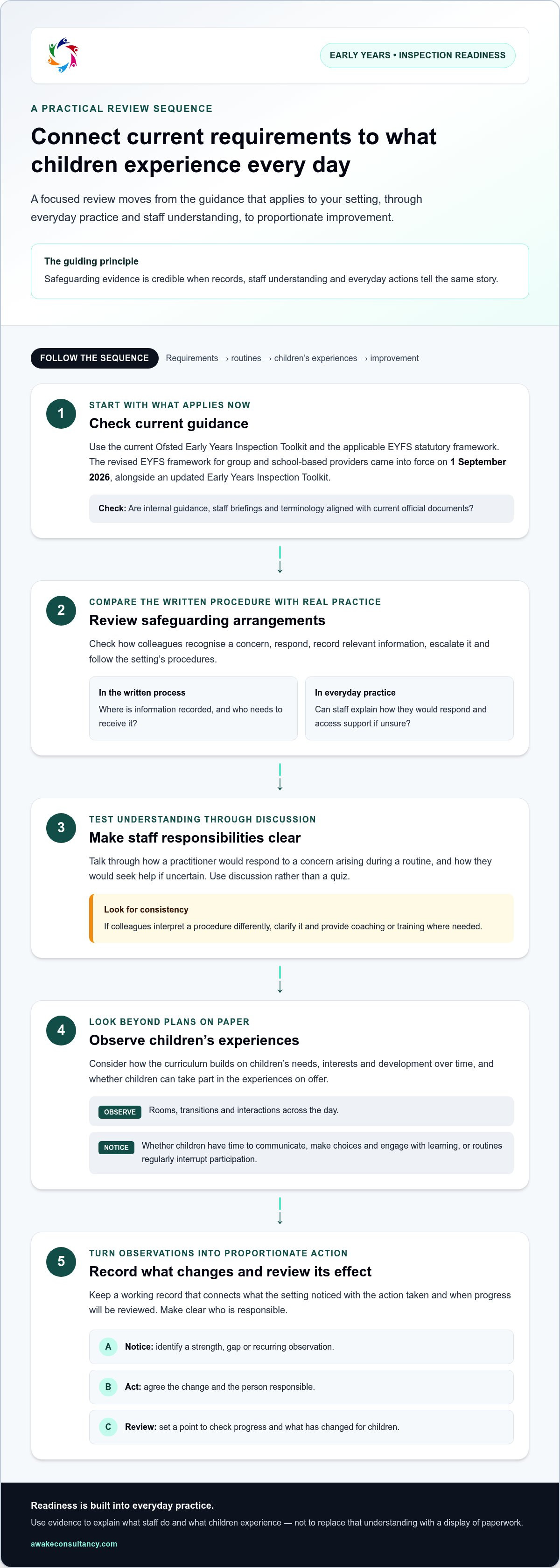
Ongoing self-evaluation should connect observations to real improvement priorities. Keep a working record of what the setting has identified, the action taken and when progress will be reviewed. This gives leaders a useful evidence base without creating a temporary collection of documents for display. It also helps the team distinguish between completing a task and making a change that becomes part of everyday practice.
- Use supervision to explore a specific example of practice and agree any support needed.
- Bring recurring observations into team discussion, then record the action and review point.
- Check that evidence reflects what staff do and what children experience, rather than collecting paperwork for its own sake.
Inspection language and expectations can change. Before revising internal guidance or staff briefings, check the current Ofsted Early Years Inspection Toolkit and applicable EYFS statutory framework. This keeps preparation accurate and focused: understand the requirements, relate them to the setting’s routines, then review whether those routines work consistently in practice.
Review safeguarding, the EYFS and children’s experiences before inspection
A focused review connects current requirements with what staff and children experience in the setting. Start with the statutory framework and current Ofsted guidance that apply to your provision, then check whether policies and procedures are reflected in daily routines. The revised EYFS statutory framework for group and school-based providers came into force on 1 September 2026, alongside an updated Early Years Inspection Toolkit. Use current official documents rather than relying on old summaries or familiar terminology.
Safeguarding evidence is credible when records, staff understanding and everyday actions tell the same story.
Check safeguarding arrangements and staff understanding
Review how colleagues recognise a concern, respond to it and follow the setting’s procedures. Staff should understand their responsibilities and know how to raise a concern promptly. Leaders should be able to explain how concerns are recorded, escalated and reviewed. Test understanding through discussion, not a quiz: ask how a practitioner would respond to a concern arising during a routine and how they would access support if unsure.
Compare the written procedure with actual practice. For example, check whether staff know where to record relevant information and who needs to receive it. Then verify safeguarding expectations and terminology against the current EYFS framework and Ofsted guidance. If a local procedure or staff briefing uses outdated language, update it and make sure the team understands the change.
Evaluate curriculum, interactions and inclusion
Look beyond plans on paper. Consider how the curriculum builds on children’s needs, interests and development over time, and whether children can take part in the experiences on offer. Observe rooms, transitions and interactions across the day. Are children given time to communicate, make choices and engage with learning, or do routines regularly interrupt their participation?
Review how the setting identifies children who may need additional support and adapts provision in response. Consider whether relevant information informs planning, whether the adults working with a child understand any adjustments, and whether leaders review their impact. Avoid treating inclusion as a separate folder. Look at whether children can access activities, communicate their needs and participate meaningfully in everyday nursery life.
A compact evidence map can keep the review practical. For each relevant responsibility, note the written evidence and what leaders can observe in practice:
- Safeguarding: the relevant policy or record, a staff member’s understanding, and the routine that demonstrates the procedure.
- Curriculum and learning: planning or observation, an interaction that brings it to life, and how leaders review children’s progress.
- Inclusion: information about a child’s needs, the adjustments made, and how the setting considers whether they support participation.
Use this map to identify gaps, not to generate paperwork for its own sake. If an independent perspective would help you test how requirements translate into practice, tailored early years consultancy and Ofsted preparation can support a structured review.
Prepare nursery staff for Ofsted through clear roles and honest discussion
Staff confidence comes from understanding the purpose behind their work, not learning polished answers. An important part of how to prepare for Ofsted inspection is to make space for colleagues to talk about practice, raise uncertainties and understand where responsibility sits. This helps leaders distinguish between a knowledge gap that needs support and a communication issue that needs clearer direction.
Help practitioners explain their everyday decisions
Use short conversations rooted in ordinary nursery life. Invite practitioners to describe how they support a child’s learning, wellbeing and participation, and what they might change if an approach isn’t working. For example, a practitioner might explain how they adapt a familiar activity when a child shows a different interest, or how they make space for a quieter child to join a group.
The purpose isn’t to rehearse an inspection conversation. It’s to understand whether staff can connect what they do with why they do it. If someone can describe an action but not its purpose, explore that thoughtfully. They may benefit from observing a colleague, discussing the reasoning in supervision or accessing relevant practitioner training. Agree a proportionate next step, then follow up to see whether it has strengthened understanding.
Keep the discussion open. Ask what feels clear, where practice varies and what would help colleagues feel more assured. Leaders gain a more accurate picture by listening carefully than by correcting every answer into a preferred script.
Make leadership responsibilities and communication clear
Clarity about roles reduces unnecessary uncertainty. Agree who leads communication with the inspector, who can provide accurate information about key areas of practice and how staff should raise a question or request support. The arrangements should help the day run normally, not create a parallel performance that distracts from children and their routines.
Explain the plan in straightforward terms and invite staff to test it. A colleague should know whom to approach if a question falls outside their role, rather than guessing or feeling expected to speak for the whole setting. Leaders should also agree how they’ll share information with one another, so different responses don’t create confusion.
- Hold a brief team discussion using a realistic scenario, such as a colleague needing clarification while the room is busy.
- Ask staff to identify the person they would approach and what information they would pass on.
- Note any uncertainty, assign a practical follow-up and revisit the arrangement after staff have used it.
These conversations don’t need to become another formal checklist. A short discussion in a team meeting or supervision can show whether responsibilities are understood and communication arrangements work in practice. If staff hesitate, treat that as useful information: clarify the route, adjust the plan and make sure the team understands the change.
Effective preparation leaves practitioners able to speak honestly about their work and leaders ready to coordinate calmly. That shared understanding supports staff without asking them to perform, and keeps attention where it belongs: on children and the quality of their everyday experience.
Turn inspection preparation into a realistic review and action plan
A review is useful when it leads to clear decisions, not a larger pile of paperwork. Make progress manageable by working through the evidence in sequence, comparing it with what happens in practice, then agreeing a small number of proportionate actions. This gives leaders a reliable way to decide how to prepare for Ofsted inspection while keeping improvement work connected to the setting’s daily priorities.
- Gather relevant evidence. Bring together records, policies, feedback and existing review notes that help explain how the setting works. Use material generated through meaningful practice rather than creating documents solely for appearance.
- Observe practice. Look at how routines and interactions operate across the day, including whether written procedures are understood and followed.
- Compare perspectives. Consider leaders’ observations alongside staff understanding and the evidence available. Differences may point to inconsistent communication or a need for further support.
- Prioritise actions. Separate urgent safeguarding or compliance concerns from longer-term development. Address immediate risks promptly, while planning realistic steps for broader practice improvements.
- Review progress. Set a point to revisit each action and assess whether the intended change has taken hold. Adjust the plan if the evidence shows it hasn’t.
Prioritise improvement actions without creating a paperwork exercise
Each action should state the issue observed, the change sought, who is responsible and when progress will be reviewed. For example, if staff apply a procedure inconsistently, the action might be to clarify the agreed approach, discuss it with the relevant team and observe whether practice becomes more consistent. Keep the record concise. The purpose is to support follow-through, not produce an elaborate plan that staff rarely use.
Give actions to someone with the understanding and authority to progress them, and make the review point practical. A safeguarding concern requires prompt attention; a longer-term development priority may need discussion, coaching and repeated observation. Distinguishing between the two helps leaders use time appropriately and prevents urgent matters being lost among routine improvement tasks.
Use a mock inspection to test readiness constructively
A mock inspection can provide an independent view of practice, leadership understanding and the evidence available to explain the setting’s work. It can help identify where accounts differ, where routines need clearer explanation or where leaders would benefit from further observation. Treat the findings as material for reflection and action, not as a forecast of Ofsted’s judgement. An external review can inform priorities, but the setting remains responsible for deciding how improvements are embedded and sustained.
For a practical overview of preparation principles, read Ofsted preparation for nurseries. Awake Early Years Consultancy provides Ofsted mock inspections and consultancy support to help settings review systems and identify realistic next steps.
Build lasting Ofsted readiness with structured early years support
Sometimes it’s difficult to see the next steps from within a setting’s own routines. Priorities may feel unclear, practice may vary between rooms or leaders may have limited capacity to review progress alongside daily responsibilities. In these circumstances, structured support can offer a fresh perspective and help turn observations into focused improvement work.
External input should strengthen the setting’s own judgement, not replace it. Leaders remain responsible for decisions, staff development and sustaining improvements after a review. Support is most useful when it reflects the setting’s circumstances, recognises what is working and gives clear feedback about where further attention may help. It can’t secure or predict a particular Ofsted grade.
Choose support that strengthens the setting’s own capability
A collaborative review can help leaders test whether procedures and expectations are understood consistently across the team. Feedback should be clear enough to guide action and grounded in the setting’s actual practice and priorities. Where a review identifies a gap in staff understanding, practitioner training can help colleagues build the knowledge and confidence to apply agreed approaches in everyday work. The aim is lasting capability, not dependence on an adviser.
Awake supports early years settings through tailored consultancy, Ofsted preparation, mock inspections and practitioner training. A mock inspection offers a structured opportunity to explore how practice is working and identify realistic development needs. Consultancy can help leaders make sense of observations and shape sustainable next steps. Neither replaces leadership responsibility or guarantees an inspection outcome.
Agree a useful next step for your nursery
Before seeking support, write down the questions that matter most to your setting. You might be unsure which improvement priorities deserve attention first, notice differences in how teams apply an approach, or need time to assess whether current actions are making a difference. Include the work already under way. This gives the discussion a practical starting point and helps avoid duplicating effort.
Tailored consultancy can help leaders review priorities and plan improvement. A mock inspection can provide an informed review of practice, leadership understanding and available evidence. The right next step depends on the question you’re trying to answer, and should leave your team clearer about what to do and how to review progress.
If you’re considering how to prepare for Ofsted inspection with support that fits your setting, discuss Ofsted preparation support with Awake. Bring your current questions and improvement priorities to start a practical conversation about what would be most useful.
Take the next step towards steady readiness
Make your next move small enough to act on and important enough to make a difference. Choose one question your team still needs to resolve, then decide who will lead the work and how you’ll know whether it has helped. This keeps preparation manageable and gives improvement a clear place in the nursery’s ongoing work.
If you’re considering how to prepare for Ofsted inspection, focus on building your team’s confidence and capacity over time, rather than trying to control an outcome no setting can guarantee. An outside perspective can help you test your thinking, but the strongest progress comes when leaders and practitioners understand the reasons for change and carry it forward together.
Discuss practical Ofsted preparation support with Awake to agree a useful next step for your setting. With clear priorities and shared commitment, your nursery can keep strengthening practice with purpose and confidence.
Frequently Asked Questions
Can a nursery prepare for an Ofsted inspection without a mock inspection?
Yes. A mock inspection is one way to review readiness, not a prerequisite. Leaders can use routine supervision, staff discussions and observations to identify areas to strengthen. To prepare without a mock, choose a current priority, such as whether a procedure is understood consistently, and check it through normal practice. An external review may still help if the setting needs an independent perspective.
How often should a nursery review its Ofsted readiness?
Review readiness as part of ongoing quality assurance rather than on a fixed inspection-only timetable. Revisit relevant practice when guidance changes, staffing or leadership changes, an incident highlights a gap, or an improvement action reaches its review point. For example, after updating a procedure, check whether staff understand and apply it consistently. The right rhythm helps leaders notice changes promptly without creating unnecessary review paperwork.
What should a nursery do after receiving an Ofsted inspection notification?
Read the notification carefully and make sure the appropriate leader is available for the planning call. Ofsted’s usual arrangement is to notify settings by 10 am on the day before the visit, followed by a call with the inspector. Use that conversation to clarify practical arrangements and share accurate information. Brief staff on roles and communication, keep children’s routines as consistent as possible, and make relevant records accessible without staging the setting.
Can Ofsted inspect a nursery without giving notice?
Nurseries shouldn’t assume that every inspection will follow the usual notice arrangements. Ofsted typically notifies settings by 10 am on the day before an inspection, but leaders should check the current Early Years Inspection Toolkit and operating guide for the arrangements that apply, including any circumstances where notice differs. Keeping procedures, records and staff understanding current helps the setting respond calmly instead of relying on a last-minute preparation period.
What happens if a nursery identifies a safeguarding concern during preparation?
Act on the concern promptly; don’t wait for an inspection or for a review meeting to finish. Follow the setting’s safeguarding procedures, take appropriate steps to protect the child, and inform the designated safeguarding lead or relevant person. Record and escalate the concern in line with current local safeguarding procedures and statutory guidance. If the review reveals a weakness in the process, address the immediate concern first, then review how practice can be strengthened.
Does a mock Ofsted inspection predict the rating a nursery will receive?
No. A mock inspection offers a structured review of current practice and can help surface questions, strengths and areas for development, but it can’t predict Ofsted’s judgement. An actual inspection reflects the evidence and circumstances considered by Ofsted at that time. Use mock feedback to check understanding, refine improvement priorities and decide what to review next, rather than treating it as a forecast or guaranteed result.


