

What if the nursery Ofsted inspection mistakes that matter most aren’t missing documents, but gaps between what your procedures say and what happens each day? In 2026, inspection places clear emphasis on children’s everyday experiences, so polished paperwork alone can’t show how consistently staff put their knowledge into practice.
It’s understandable to feel uncertain about what inspectors will notice, particularly when written systems seem sound but staff apply them differently. A safeguarding procedure, curriculum plan or inclusion approach matters when it shapes decisions and interactions across the setting. Inconsistent practice can point to wider issues in communication, leadership or support for practitioners.
This article explains common nursery Ofsted inspection mistakes, why they matter and how to address them before they become routine. You’ll learn how to check whether policies reflect practice, help staff explain their work clearly and turn feedback into realistic, lasting improvements. We’ll look at everyday signs inspectors may explore, from safeguarding and inclusion to curriculum and leadership, and how reflective preparation can strengthen quality beyond inspection day.
Key Takeaways
- Recognise nursery Ofsted inspection mistakes as preventable gaps in practice, oversight or evidence, not simply imperfect answers on the day.
- Check whether safeguarding procedures translate into clear staff responsibilities and consistent everyday routines.
- Use policies and records to support professional understanding, and compare them with what children and staff actually experience.
- When inspectors ask questions, listen, answer directly, give a relevant example and acknowledge uncertainty rather than guessing.
- Turn findings into lasting change by assessing the impact, assigning responsibility and reviewing progress against realistic actions.
Nursery Ofsted inspection mistakes often begin before inspection day
An inspection mistake is a preventable gap in practice, oversight or evidence. It might be a procedure that staff interpret differently, a routine leaders haven’t reviewed or a record that doesn’t explain a decision. It isn’t simply an imperfect answer to an inspector’s question. Focusing on small slips can distract from patterns that affect children’s care and learning.
Last-minute tidying and reminders may make a setting look prepared, but they can’t create consistent practice overnight. Inspectors are interested in children’s ordinary routines, relationships and interactions, and in how leaders support staff to provide a positive experience. Everyday practice carries more weight than inspection-day polish because it shows whether good care is embedded, not staged.
An identified weakness deserves careful attention, but it does not, by itself, establish an inspection outcome. Consider its context, its effect on children and whether it reflects a wider pattern. Understanding the Ofsted inspection process can help leaders prepare thoughtfully without treating inspection as a performance to rehearse.
Mistaking inspection readiness for rehearsed performance
Memorised scripts can sound fluent yet reveal little about a practitioner’s understanding. A staff member might repeat a policy phrase but struggle to explain how they would respond to a child’s changing needs or a concern during a busy routine. Build shared understanding through regular discussion, coaching and reflection on real situations.
Confident communication doesn’t mean giving identical answers. Encourage staff to explain their own decisions clearly, use relevant examples and ask for clarification when needed. This supports honest, consistent practice without turning preparation into a test of recall.
Treating framework updates as background reading
Leaders should check current Ofsted inspection guidance and the Department for Education’s EYFS statutory framework, including applicable 2026 updates. The revised EYFS framework and Ofsted inspection toolkit took effect for use from 1 September 2026, so earlier interpretations may no longer reflect current expectations. If an update stays in a leadership document rather than being discussed with the team, established routines may fall out of step with revised guidance.
Make updates practical: identify what has changed, discuss what it means for daily work and check understanding through supervision or team reflection. This helps prevent outdated assumptions from persisting across shifts and rooms. For a structured approach to building readiness into normal operations, see this Ofsted preparation guide for nurseries.
Safeguarding mistakes reveal whether nursery procedures work in practice
A safeguarding policy is only useful if staff can apply it during the real pace of nursery life. Responsibilities, reporting routes and routine decisions need to align, so a concern is recognised, passed to the right person and followed up rather than left between shifts. A well-written document cannot compensate for uncertainty about who acts next.
Effective safeguarding depends on clear responsibilities and consistent action, not policies that exist only on paper. Take any procedural error seriously, but remember that one error alone does not determine an inspection judgement. Understand its context and impact, look for a wider pattern, then respond proportionately.
Written safeguarding policies that staff cannot apply
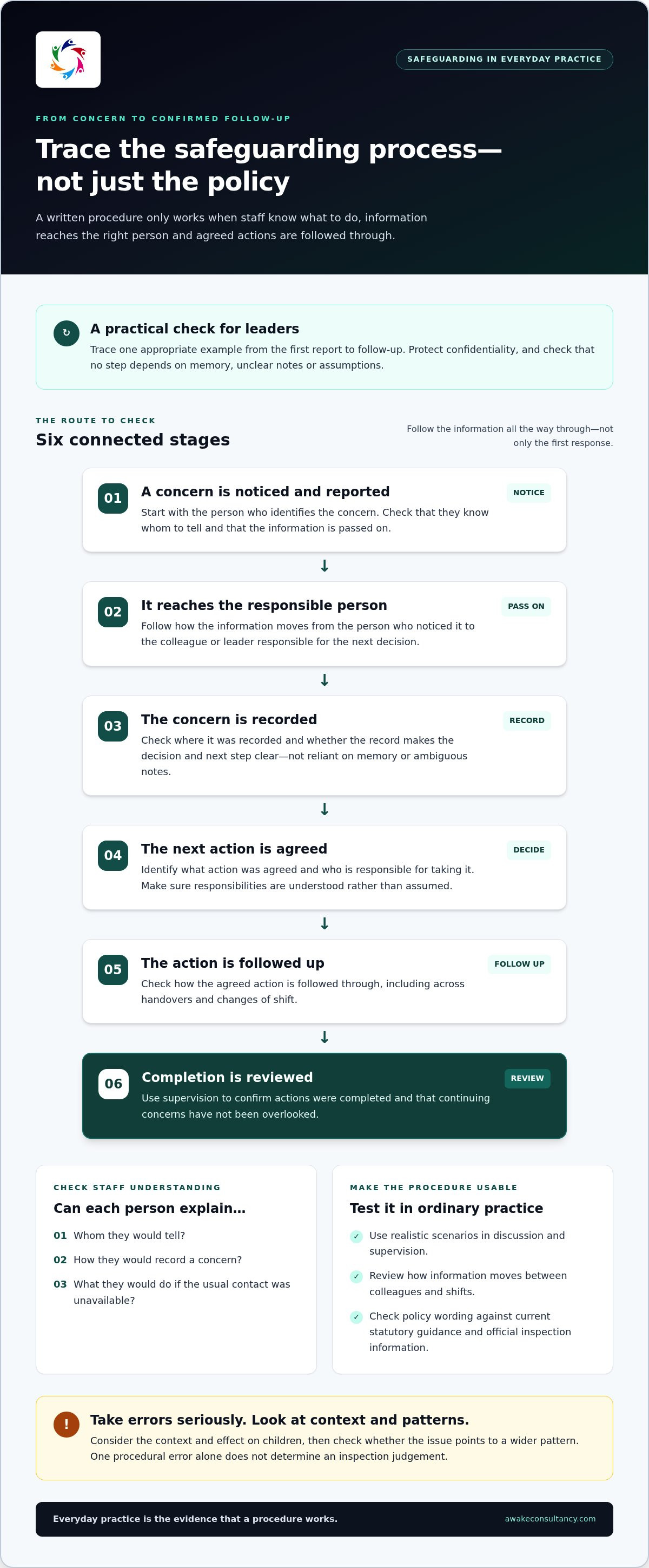
Check understanding through ordinary supervision and discussion, not just by asking staff to confirm they have read a policy. Can each person explain whom they would tell, how they would record a concern and what they should do if the usual contact is unavailable? Use realistic scenarios to explore decisions and responsibilities, without coaching staff to repeat a fixed inspection answer.
Review policy wording against current statutory guidance and official inspection information. The Ofsted Early Years Inspection Handbook is dated September 2023, so use it as a reference alongside current Ofsted guidance and applicable EYFS requirements, rather than assuming it reflects every later update.
Weak handovers, supervision and safeguarding oversight
Information can be lost when handovers rely on memory, unclear notes or assumptions about who has followed something up. Review how concerns move from the person who notices them to the colleague or leader responsible for deciding and recording the next step. Supervision should provide time to check that actions were completed and continuing concerns haven’t been overlooked.
Test the process by tracing an appropriate example from first report to follow-up, while protecting confidentiality. Check each stage: who received the information, where it was recorded, what action was agreed and how completion was reviewed. This practical exercise can reveal weak links before they become routine.
A BBC report described a case where a child was collected by the wrong adult and an inspection identified safeguarding weaknesses; a follow-up inspection later found that requirements were met. This is one reported example, not evidence that such incidents are common or that one mistake automatically decides an outcome. It does show why settings need to examine how procedures operate in practice, not simply whether they are written down.
Awake Early Years Consultancy provides Ofsted preparation and mock inspection support to help settings examine safeguarding arrangements, identify gaps and plan realistic next steps.
Inconsistent nursery practice makes inspection evidence harder to trust
Policies and records can explain what a setting intends to do, but inspectors also need to understand how that intention is reflected in children’s ordinary experiences. If a procedure describes one approach while staff follow another, leaders have a gap to investigate. The issue isn’t whether every practitioner uses identical words; it’s whether they understand the purpose of the process and apply it consistently.
Records are most useful when they support professional understanding by helping staff notice patterns, make decisions and follow up actions. Paperwork created mainly to look complete for inspection can obscure rather than clarify practice. For nursery Ofsted inspection mistakes involving evidence, trace one process across what is written, what staff understand and what happens in the room.
A simple comparison can help leaders identify where those elements align and where a closer look is needed:
| Documented process | Evidence of implementation |
|---|---|
| A written approach explains how key-person observations inform planning. | Staff can describe how they use what they notice about children to shape experiences, and this is reflected in everyday interactions. |
| Records set out how agreed actions are reviewed. | Relevant colleagues know what has happened, what remains outstanding and who will follow it up. |
| A policy describes a shared expectation for routines. | Children experience that expectation consistently across rooms, staff and the day. |
Over-relying on paperwork instead of observable practice
A complete folder cannot, on its own, demonstrate that a process is understood or consistently followed. Choose a policy and trace it: check whether records show how it informs decisions, ask staff to explain the thinking behind it, then consider whether daily routines reflect that approach. The relevant records depend on the process; no single format should be treated as a universal inspection requirement.
This review can expose an important distinction: a document may be present but too vague to guide action, or practice may be sound but poorly recorded. Both warrant attention, but the response should address the actual gap rather than generate more paperwork by default. A nursery mock inspection guide can help leaders examine how evidence connects with daily practice.
Inconsistent explanations across the nursery team
Different wording isn’t automatically a problem. Practitioners may describe the same approach in their own words while showing sound understanding. More substantive differences, such as conflicting accounts of who takes responsibility or what happens next, can point to unclear communication or expectations. Use team discussion to explore the reasoning behind a process and connect it to children’s experiences. Then clarify any shared actions or responsibilities that need strengthening.
Responding poorly to inspection questions can obscure sound practice
A practitioner may understand their role and act appropriately every day, yet struggle to explain that practice under pressure. Rushing, guessing or becoming defensive can make a clear process sound uncertain, while long answers may hide the point. These nursery Ofsted inspection mistakes are avoidable when staff know they can respond honestly rather than perform a rehearsed version of the setting.
Keep the exchange professional and grounded in what the person knows first-hand. A simple sequence can help staff collect their thoughts:
- Listen to the full question before responding.
- Answer directly using clear, relevant language.
- Give an example from actual practice, if it helps explain the answer.
- Acknowledge uncertainty and say when a detail needs checking.
This is a prompt for clear communication, not a script. Staff shouldn’t speculate, claim certainty they don’t have or repeat phrases they’ve been taught to impress an inspector. Genuine professional dialogue helps inspectors understand what happens in the setting and helps leaders see where additional guidance may be useful.
Answering inspectors clearly and honestly
Encourage concise answers based on first-hand knowledge. For example, a practitioner can explain the steps they personally take in a familiar routine, then distinguish that from a detail they don’t know. Saying, “I’m not sure, but I can check with the person responsible,” is more accurate than guessing. A knowledge gap can be addressed through clarification and support; it isn’t the same as deliberately concealing or misrepresenting information.
Leadership responses that shut down reflection
Leaders set the tone for how staff respond to questions and concerns. Blame or defensiveness can discourage practitioners from sharing uncertainty, mistakes or useful observations, making learning harder. Instead, listen carefully, clarify what the question or feedback relates to and consider proportionate next steps. A challenge from an inspector is an opportunity to understand the evidence, not automatic proof of a serious failure.
After an inspection conversation, reflect with the team: Was the practice clear? Did anyone lack information or confidence? Is the issue isolated, or does it suggest that expectations need to be communicated more consistently? Keep the discussion focused on what staff and children experience, rather than on finding someone to blame. This helps distinguish a communication issue from a practice gap and directs attention towards useful action.
Awake Early Years Consultancy offers tailored Ofsted preparation and practitioner development, grounded in the way your setting actually works, to help staff build confident, honest inspection conversations.
Turn nursery Ofsted inspection mistakes into sustained improvement
Findings have lasting value when they lead to changes children and staff can experience, not simply another document in a folder. Use a short improvement cycle: identify the gap, assess its impact, assign responsibility and review progress. This keeps nursery Ofsted inspection mistakes in perspective and helps leaders focus on what needs to change, why it matters and how they’ll know whether the response is working.
Start with children’s safety and everyday experience. Act promptly on a concern requiring immediate attention, separately from longer-term development priorities such as strengthening team communication or refining an approach to curriculum. Make each action realistic: an overloaded plan can stall, while a clear owner and review point create accountability.
Build an action plan from inspection feedback
Translate each finding into a specific action that addresses its cause, not just its visible symptom. Record who is responsible, the timescale and when progress will be reviewed. Keep safeguarding matters distinct from development work so urgent risks receive appropriate attention and wider improvement remains manageable.
At the review point, look beyond whether the action was completed. Has it changed staff understanding or a routine in practice? Can the owner show what is different for children? If the written plan is finished but practice hasn’t shifted, revisit the action, clarify what support is needed and set another review point.
- Identify: describe the gap clearly, using evidence rather than assumptions.
- Assess: consider its effect on children’s safety, learning or experience.
- Assign: name an owner and agree a realistic timescale.
- Review: check the change in practice and decide whether further action is needed.
Keep the plan proportionate. Not every observation needs a separate project, and a small, targeted change may be more effective than a broad action that nobody can easily own. Ask staff what would help them put the agreed approach into practice, then build that support into the review.
Use external review to strengthen readiness
A mock inspection gives leaders a structured opportunity to examine evidence, compare expectations with practice and identify areas for development. Its purpose is reflection and improvement, not prediction: it cannot guarantee a particular Ofsted rating. Use the findings to agree sensible next steps, then check whether those steps become part of daily work.
Awake Early Years Consultancy provides tailored consultancy and mock inspection support to help settings reflect on practice and leadership. If an independent perspective would help you turn findings into a workable plan, discuss Ofsted preparation with Awake.
Make continuous improvement part of everyday practice
Choose one area where greater clarity or consistency would make a meaningful difference for children. Agree how the team will strengthen it, make space to learn from what happens and revisit progress. That steady cycle helps nursery Ofsted inspection mistakes become prompts for thoughtful development rather than sources of short-term pressure.
An outside perspective can help leaders test assumptions and see where practice or systems could be stronger. Awake provides tailored early years consultancy and Ofsted preparation, including mock inspections that support reflection and identify areas for development. This support focuses on strengthening practice, not promising a particular inspection result.
If you’d value a considered perspective on your setting’s next steps, explore tailored Ofsted support with Awake. With clear priorities and shared commitment, improvement can become part of how the nursery works every day.
Frequently Asked Questions
Can one mistake determine a nursery’s Ofsted inspection outcome?
Not automatically. Inspectors consider the evidence they gather in context, including the nature of a concern, its effect on children and whether it points to a wider weakness. A nursery Ofsted inspection mistake should prompt a measured response, not an assumption about the final outcome. Leaders can clarify relevant facts, explain what they’ve done and show how they’ll check that corrective action is effective.
What happens if a nursery identifies a safeguarding mistake before an inspection?
Act promptly to protect children and follow the setting’s current safeguarding procedures. Make sure the appropriate person knows, record what happened accurately and note the actions taken. Then consider whether the issue arose from an individual lapse, unclear guidance or a weakness in the wider process. Address immediate risks first, and review whether staff need further guidance or changes to the way information is managed.
Should nursery staff memorise answers before an Ofsted inspection?
No. Memorised answers can sound unnatural and may not reflect how a practitioner makes decisions in practice. Instead, help staff understand their responsibilities and discuss realistic situations in team meetings or supervision. They should be able to explain what they know in their own words, distinguish first-hand knowledge from information they would need to check, and ask for clarification if a question is unclear.
Can a nursery challenge an Ofsted inspection finding?
A nursery can raise a concern if it believes a finding is inaccurate or has been misunderstood. During the inspection, explain the relevant facts calmly and identify any evidence that may clarify the point. If the concern remains, use Ofsted’s current published complaints or post-inspection process, following its instructions and timescales. Keep the issue specific, distinguish factual errors from differences of professional judgement, and retain relevant records.
How can a nursery tell whether its policies match everyday practice?
Choose one policy and test it against a realistic situation, such as how a routine is managed when the usual staff member is absent. Check whether practitioners can find the relevant guidance, explain what they would do and show how the approach works in practice. Repeat the check with staff in different roles or rooms. Differences may reveal where guidance needs clarification, communication or review.
Does a nursery mock inspection guarantee a good Ofsted rating?
No. A mock inspection can help leaders examine evidence and identify areas for development, but it cannot guarantee a particular Ofsted rating. It is a review at a point in time, not a promise about how an official inspection will assess the setting. Its value lies in using the findings to strengthen practice, assign realistic actions and check progress, rather than treating the outcome as a prediction.


