

A nursery action plan only matters when it changes what happens in the room. Improvement priorities can feel broad, and turning them into manageable actions is not always straightforward. Effective nursery action plan support helps leaders move from a general aim to specific steps staff can use in everyday practice, without letting the plan become another piece of paperwork.
That takes more than listing tasks. Each priority needs a clear owner, a realistic timescale and evidence that shows whether practice is changing. Staff also need time to reflect on progress, raise barriers and keep improvements consistent across the setting.
This article explains how to choose relevant priorities, assign responsibility and review progress. It also explores how a setting health check and tailored early-years consultancy can connect identified needs to practical, reviewable actions, including evidence-informed Ofsted preparation. The aim is a plan that gives leaders clarity and helps the whole team see what is improving, what still needs attention and what to do next.
Key Takeaways
- Understand how a nursery action plan can guide planned improvement, rather than simply record tasks or aspirations.
- Learn what makes a priority focused and workable, so progress can be reviewed against evidence.
- Explore ways to involve practitioners in turning agreed actions into consistent everyday practice.
- Follow a practical process for gathering evidence, setting priorities and reviewing progress over time.
- See how nursery action plan support can help clarify priorities, ownership and next steps through tailored consultancy.
What is a nursery action plan, and when does your setting need one?
A nursery action plan is a working tool for turning an identified area for development into a planned, reviewable change in practice. It gives leaders and practitioners a shared understanding of what needs to improve, what will happen next and how they will recognise progress. Its value lies in guiding improvement, not in completing a particular template.
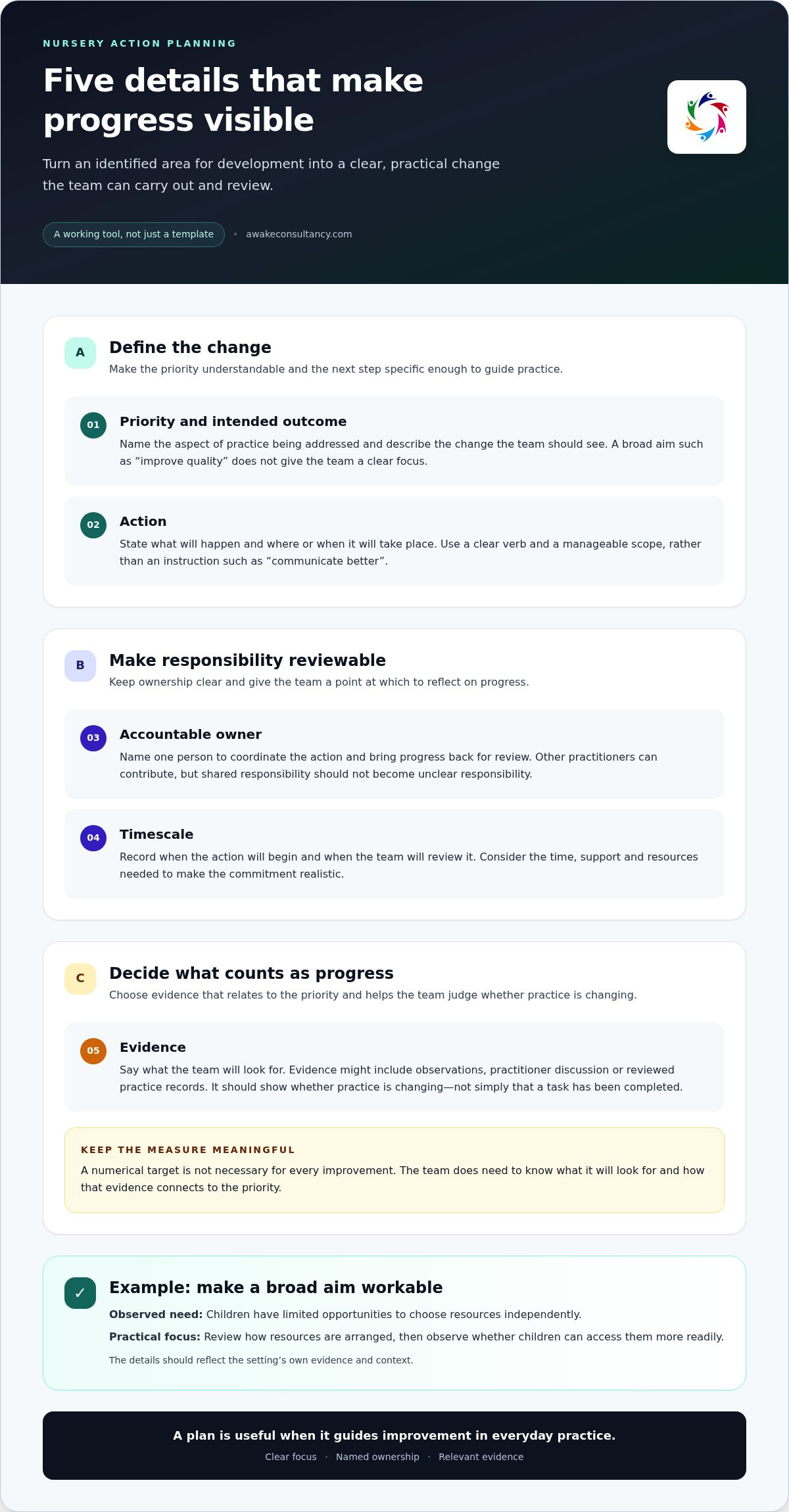
This distinction matters. A list of tasks may record activity without showing how it will strengthen provision. A policy sets out expectations or procedures, whilst a broad aspiration such as “improve quality” describes a direction without making the next steps clear. An action plan connects the priority to purposeful action. For example, if observations show that children have limited opportunities to choose resources independently, the plan might focus on reviewing how resources are arranged and observing whether children can access them more readily. The details should reflect the setting’s own evidence and context.
Nursery practice sits within the wider context of Early Childhood Education Overview, which encompasses children’s learning and development in their early years. An action plan helps a setting consider how everyday practice supports those aims, then work methodically on an area where change is needed.
What should a nursery action plan achieve?
The plan should help the team move from identifying a concern to making a practical change in provision or practice. It should make the intended improvement understandable to the people involved, rather than leaving them to interpret a general instruction in different ways.
It also gives leaders a basis for recognising progress. This might involve observing practice again, gathering relevant feedback or reflecting on whether an agreed approach is being used consistently. The evidence should relate to the priority, not simply show that a task has been completed. A signed-off document is not, by itself, evidence that children’s everyday experience has improved.
When is action planning useful in an early-years setting?
Action planning is useful when a review identifies a specific, meaningful area for development. The starting point could be an observation of practice, feedback from families or practitioners, or internal reflection about how an aspect of the provision is working. A setting health check can also help leaders identify needs and connect them to ongoing development.
Not every observation needs to become a formal priority. A plan is most useful when the team needs a shared focus and a way to sustain attention on it over time. If several concerns emerge, leaders can consider which one most directly affects children’s experience and is realistic to address alongside existing responsibilities.
Inspection preparation may prompt reflection, but action planning need not be driven by an inspection. It supports continuous improvement between inspections too. With nursery action plan support, leaders can clarify what a review has identified and shape it into practical work, whilst keeping the purpose centred on stronger everyday practice.
What makes a nursery action plan clear, realistic and measurable?
A useful plan makes a priority specific enough to guide practice, but flexible enough to fit the setting’s context. There is no single mandatory template: a table, shared document or other format can work, provided the people involved can understand the intended change and review it. Clarity comes from the thinking behind the plan, not its layout.
A measurable action is one that can be recognised through observable evidence of a change in practice. This does not mean every aspect of improvement needs a numerical target. It means the team can identify what they will look for and use that evidence to judge whether the action is helping.
How do you turn a broad priority into a specific action?
Start with what the review showed, then describe the change the setting wants to make. “Improve quality” is too broad to guide a team because it does not identify which part of practice needs attention. A more focused priority might be to strengthen how practitioners support children to take part in conversations during small-group activities.
From there, define an action with a clear verb and scope. For instance, practitioners could review how they use open questions during a particular part of the day, then discuss what they notice in practice. This is more workable than asking everyone to “communicate better”. Keep the commitment within the setting’s influence, and avoid promising a particular effect on children if the team cannot reasonably control or evidence it.
Which details make responsibility and progress visible?
Each action needs enough information to be carried out and reviewed. A practical plan will usually record:
- Priority and intended outcome: What aspect of practice is being addressed, and what change should the team see?
- Action: What will happen, and where or when will it take place?
- Accountable owner: Who will coordinate the action and bring progress back for review?
- Timescale: When will the action begin, and when will the team review it?
- Evidence: What will help the team judge progress, such as observations, practitioner discussion or reviewed practice records?
One person should coordinate each action, even if several practitioners contribute. This avoids shared responsibility becoming unclear responsibility. Note any support, time or resources the action requires, too. A plan is less realistic if it assumes staff can take on work without considering their existing commitments.
Set a review date that gives the action time to influence practice, but does not leave it unattended. At review, consider whether the evidence shows the intended change, whether the action is practical and whether anything needs adjusting. This keeps measurement grounded in what staff can observe, rather than a box marked “complete”.
If priorities or ownership remain unclear, tailored early-years consultancy can help a setting shape practical actions and a review approach suited to its needs. The plan should make progress easier to understand and sustain.
How can leaders make a nursery action plan improve daily practice?
A completed action plan can look orderly without changing what children experience. The difference lies in whether agreed actions become part of the team’s routines, are understood by the people carrying them out and are reviewed against what happens in practice.
Recorded completion shows that an action was done; observable change shows whether practice has shifted. For example, a team might agree to make transitions to outdoor play more consistent. Updating a written procedure is one step, but leaders also need to consider whether staff use the approach during the day and whether it is helping the transition run as intended. Keep the plan focused on that real-world application.
How should nursery teams share responsibility for actions?
Leaders provide oversight: they keep the priority in view, make sure the action remains relevant and create opportunities to review what staff are noticing. The named action owner coordinates the day-to-day work, such as sharing the agreed approach, gathering observations and raising barriers. Other practitioners contribute by applying the action in their roles and feeding back what they see.
Involve the staff whose work is directly affected. Explain why the priority matters, invite their practical insight and make clear what the agreed action asks of them. This helps the team understand the purpose, rather than experience the plan as an instruction added on top of their work. Use existing team meetings or supervision to discuss progress where appropriate, keeping the conversation focused on practice and next steps.
Keep responsibility proportionate. An action should fit the owner’s role, capacity and influence. One person can coordinate without carrying out every part alone. Equally, assigning a task to the whole team without a clear coordinator can leave follow-through uncertain.
How can leaders avoid action-plan overload?
A long plan can divide attention and make review feel like another administrative burden. Focus first on the development needs that matter most to children’s everyday experience. If two actions contribute to the same priority, they may sit together, provided it remains clear who is coordinating each part and what evidence will inform review.
Keep the priority steady, but be prepared to adjust the route. Staff feedback or new observations may show that an action is impractical, too broad or not addressing the issue as expected. At review, leaders can refine the action, change the support around it or agree a different approach, while retaining a clear record of why. Flexibility is not a loss of focus; it allows the plan to respond to what the setting learns.
Actions also need a clear end point. When review shows that the intended change is established, close the action and consider whether the practice needs ongoing attention through normal routines. If priorities shift, reprioritise openly rather than letting unfinished items accumulate. Thoughtful nursery action plan support helps leaders keep that balance: enough structure to sustain improvement, with room to respond to evidence and staff experience.
How to create and review a nursery action plan step by step
A plan becomes easier to use when leaders establish a clear sequence: understand the evidence, agree what needs attention, put the change into practice and return to it. Keep a brief record as you go, so review discussions can focus on what the team has learned rather than reconstructing events from memory.
- Gather relevant evidence. Bring together observations, feedback and internal reflections that relate to the concern. Look for a pattern rather than building a plan around one isolated moment. For example, if transitions seem unsettled, consider what staff have noticed on different occasions and what might be contributing.
- Agree the priority. Discuss what the evidence suggests and choose a specific area the team can influence. Be clear about why it matters to children’s experience and what aspect of practice needs attention. If the evidence points to several concerns, decide which should be addressed first rather than trying to tackle all of them at once.
- Set the action in motion. Agree what practitioners will do differently, who will coordinate the work and when the team will review it. Consider what time, resources or guidance may be needed. Set a review point that gives the approach time to be used, whilst ensuring it will not be forgotten among day-to-day responsibilities.
- Share the plan with the people involved. Explain the agreed approach to the practitioners responsible for putting it into practice. Make space for questions and practical feedback. Staff may identify a barrier or suggest a workable adjustment that leaders had not considered. Address this early so the plan reflects the setting’s daily realities.
- Review and agree the next step. At the review point, look at evidence of practice and discuss what has changed, what remains difficult and what support may help. Decide whether to continue the action, adapt it, close it because the intended change is established, or replace it with a more relevant action.
A simple progress record can keep this process visible without creating unnecessary paperwork. For each action, note the owner, current status, evidence considered and next review date. Add a short summary of what the evidence shows and any support needed. The record should help the team prepare for a focused discussion, not become a substitute for it.
Review findings should guide decisions, not just update a status label. If practitioners have carried out the action but the intended change is not visible, explore what may be getting in the way. The response might be to clarify the approach, provide additional support or reconsider whether the action addresses the original priority. If progress is evident, decide how to maintain the practice and whether further development is needed.
Use tailored nursery action plan support to help turn identified needs into practical actions and a review process that supports ongoing improvement.
How nursery action plan support can help turn priorities into progress
Sometimes a setting knows that something needs to improve but has not yet agreed what to focus on, who should lead the work or how to judge progress. In that situation, nursery action plan support can offer a structured opportunity to examine the evidence, test assumptions and decide on practical next steps. The purpose is not to add another layer of paperwork. It is to help leaders shape improvement around the setting’s needs and daily realities.
An external perspective can be useful when internal discussion has stalled or several possible priorities compete for attention. Through tailored early-years consultancy, Awake Early Years Consultancy helps settings explore their needs and turn identified areas into actions that can be carried out and reviewed. This includes considering how an action fits existing practice, who needs to be involved and what evidence could help the team understand its effect.
When might a nursery benefit from tailored action plan support?
Consider support when a review has raised questions the team is finding difficult to resolve, when ownership is unclear or when actions are not leading to a useful review conversation. A structured discussion can help leaders distinguish an underlying priority from its symptoms, then shape a proportionate response. The aim is a plan that reflects the setting, rather than a generic list of improvements.
Inspection readiness may be one reason to review priorities, but it need not be the only one. Where Ofsted preparation is relevant, improvement planning should remain connected to evidence and everyday practice, not promises about an inspection result. Awake Early Years Consultancy's Ofsted preparation for nurseries guide explores readiness as ongoing work within a setting.
Awake Early Years Consultancy membership offers another route for settings seeking continuing development. It includes resources, EYFS updates, training, a setting health check and action plans. The health check can help a setting examine its needs, whilst the action plans provide a way to connect those findings with ongoing improvement.
What should a setting take into its next planning conversation?
A focused conversation is easier to prepare when leaders bring the context, not just the document. Gather:
- The priority under discussion and the observations or feedback that prompted it.
- Existing improvement actions, including what has already been tried.
- What has helped, what has proved difficult and where ownership or capacity may be unclear.
- The changes the team hopes to see and the evidence that could inform a review.
This gives the discussion a practical starting point. It also helps distinguish a barrier that needs support from an action that needs to be reshaped. If your setting would benefit from a considered, setting-specific route forward, explore Awake Early Years Consultancy's tailored early-years consultancy to translate priorities into purposeful development.
Make your next improvement step count
The next step need not be a complete review of every aspect of practice. Choose one question your team wants to resolve, then use it to open a focused conversation about what would help your setting move forward. A considered starting point can make nursery action plan support more relevant to the people who will put changes into practice.
Awake’s tailored early-years consultancy can support settings to think through their priorities. Awake membership also includes a health check and action plans, providing a starting point for considering development needs and next steps.
You do not need every answer before beginning. Bring the issue that is occupying your team, what you have noticed and what you hope to strengthen. Together, you can consider a practical way forward that reflects your setting and supports steady progress.
Discuss tailored nursery action plan support and take a constructive next step towards stronger practice.
Frequently Asked Questions
What should a nursery action plan include?
A nursery action plan should connect a development need with an intended change and practical follow-through. Include enough context for staff to understand why it matters, who coordinates the work, when it will be revisited and what information will help assess progress. For example, a priority about children’s independence at mealtimes might identify which part of the routine is being reviewed and what practitioners will observe. Keep the record concise and usable.
How many actions should a nursery have in its action plan?
There is no fixed number that suits every nursery. Choose a manageable set that leaders and practitioners can carry out and review alongside their other responsibilities. If the plan has so many actions that owners cannot give them attention, it may be too broad. Consider whether related actions can sit under one priority, but keep the work and accountability clear enough to track. Add further actions as capacity and evidence allow.
Who should be responsible for a nursery action plan?
A leader should oversee the overall plan, while a named person coordinates each action. Practitioners affected by the change should understand their part and have a way to share observations or raise practical difficulties. For example, if an action concerns routines across rooms, the leader might coordinate the review while room practitioners contribute what they notice. This keeps oversight consistent without making one person responsible for every detail of implementation.
How often should a nursery action plan be reviewed?
Review each action at a point that gives staff time to put it into practice, but keeps the work active. The timing will depend on the action’s scope and how often the relevant practice occurs. A change used each day may generate useful observations sooner than a less frequent routine. Agree review dates when setting actions, and bring them forward if new evidence or a practical barrier means the team should reconsider its approach.
Can a nursery action plan help with Ofsted preparation?
Yes. A plan can help leaders organise evidence-informed improvement and explain how the setting is responding to identified development needs. It can support inspection readiness by keeping attention on practice and the reasons for changes, rather than creating paperwork solely for inspection. It does not guarantee an inspection outcome. Nursery action plan support can help leaders connect improvement work to their setting’s context, while keeping the focus on children’s everyday experience.
How do you know whether a nursery action plan is working?
Look for evidence that practice is changing in the intended way, not just confirmation that tasks were completed. Compare observations from before and during the action, and discuss whether practitioners can use the agreed approach consistently. For instance, staff feedback may reveal that a new routine is understood but difficult to carry out at a particular point in the day. Use those findings to decide what to adjust, support or maintain.
What is the difference between a nursery action plan and a quality improvement plan?
The terms can overlap, and settings may use them differently. A quality improvement plan often describes a wider, continuing approach to developing provision, whilst an action plan may record specific pieces of work within it. The useful distinction is practical: can staff see how a particular action contributes to the setting’s broader improvement aims? If both documents cover similar ground, align them so priorities, progress and responsibilities remain easy to follow.


