

What if consistency meant shared principles rather than identical responses? Creating consistent practice in early years settings doesn’t mean every adult must handle every moment in precisely the same way. Children need predictable boundaries and dependable care, alongside adults who notice their cues, circumstances and stage of development.
It’s understandable to be concerned when routines differ between rooms or children receive different responses from one adult to another. Shared expectations can make the day more predictable, but they work best when staff understand the reasons behind them and can adapt thoughtfully to each child.
This guide explains how to agree clear expectations, use reflective routines and strengthen responsive interactions across your team. It also offers practical ways to discuss what’s working, observe everyday practice and identify where further support or practitioner development could help embed a shared approach.
Key Takeaways
- See how predictable relationships can help children anticipate what happens next while still feeling understood by responsive adults.
- Learn to distinguish shared expectations from rigid rules, and consider when an individual response is appropriate.
- Use a practical team sequence to choose a priority, agree an approach, test it and review what you observe.
- Strengthen consistent practice in early years settings by making expectations clear and usable across everyday routines.
- Explore how tailored consultancy and practitioner development can help leaders identify patterns and support constructive team reflection.
What does consistent practice in early years settings mean?
Consistent practice in early years settings means adults share clear principles and respond dependably, while adapting their approach to the child and situation. It doesn’t require identical words or actions every time. Consistency is reliable practice guided by shared principles, not rigid delivery that ignores individual needs.
Children encounter different adults, activities and spaces throughout the day. When the underlying expectations remain recognisable, children have a clearer basis for understanding what adults will do and how to seek support. This depends on the quality of everyday interactions, not simply on having written routines or policies. A policy may describe an expectation; consistent practice is how the team puts it into action.
Which parts of practice need to feel consistent?
Agree the principles that should carry across rooms and shifts, then identify how they should look in everyday moments. An overview of child development helps explain why responses need to reflect children’s changing capacities and circumstances.
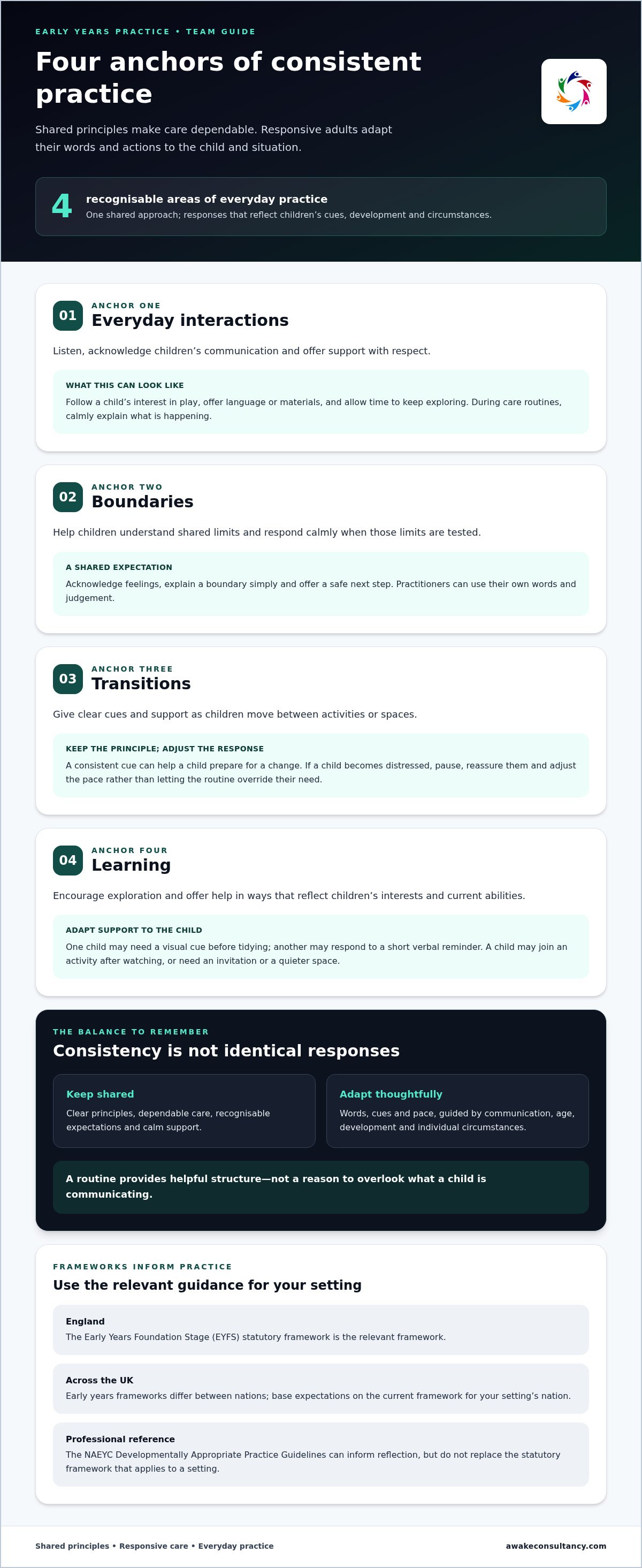
- Everyday interactions: Listen, acknowledge children’s communication and offer support with respect.
- Boundaries: Help children understand shared limits and respond calmly when those limits are tested.
- Transitions: Give children clear cues and support as they move between activities or spaces.
- Learning: Encourage exploration and offer help in ways that reflect children’s interests and current abilities.
The principle can stay the same even when the response differs. One child may need a visual cue before tidying, while another responds to a short verbal reminder. Age, development, communication and individual circumstances all affect what support is useful. Teams can aim for a recognisable approach without expecting every child, or every interaction, to look the same.
What consistency is not
Consistency doesn’t mean asking practitioners to memorise a script or copy one another’s gestures. A shared expectation might be to acknowledge a child’s feelings, explain a boundary simply and offer a safe next step. Adults can use their own words and judgement to respond to the child in front of them.
Nor should a familiar routine take priority over an immediate need. If a child becomes distressed during a usual transition, an adult may need to pause, offer reassurance and adjust the pace. That response can still reflect the setting’s shared principles of care and respect. A routine provides helpful structure, not a reason to overlook what a child is communicating.
Consistency isn’t a display reserved for visitors or inspection days. If agreed practice only appears when someone is observing, it hasn’t become dependable for children. Look at ordinary moments across the day: how adults welcome children, guide behaviour, manage changes and support learning. Those repeated interactions show whether shared principles are part of daily practice.
How child development and predictable relationships shape consistent practice
Children learn about their surroundings through repeated experiences with people as well as routines. When adults respond in recognisable, caring ways, children have a clearer basis for anticipating what may happen next. Predictable relationships matter because they can support children’s sense of belonging and make it easier to take part in everyday experiences. This doesn’t mean every child will feel settled or respond in the same way. It’s a reason to make adult responses dependable and attentive.
Why predictable adult responses matter to children
Familiar responses can help children know that adults will notice and respond to them. During play, a practitioner might follow a child’s interest, offer language or materials, and allow time for the child to keep exploring. During care routines, a calm explanation of what is happening can make the interaction easier to understand. At a transition, a consistent cue may help a child prepare for a change, while an adult remains available if extra support is needed.
These examples involve more than repetition. A predictable approach combines a recognisable principle, such as listening carefully or explaining a change, with attention to the child’s communication and cues. One child may join an activity after watching; another may need an invitation or a quieter space. The team can consistently notice, offer support and adapt, without expecting every child to respond in the same way.
Shared principles within the relevant early years framework
Development is shaped by interacting factors, including children’s experiences, relationships and individual circumstances. The NAEYC Developmentally Appropriate Practice Guidelines offer a professional reference for considering how practice can respond to children’s development and context. They can inform reflection, but they don’t replace the statutory framework that applies to a setting.
For providers in England, the relevant framework is the Early Years Foundation Stage (EYFS) statutory framework. Early years frameworks differ across the UK nations, so leaders should base expectations on the current framework for their setting’s nation. A framework informs the principles a team agrees; it doesn’t prescribe a script for every interaction.
Translate broad expectations into questions practitioners can use in the moment:
- What is the child communicating through words, actions or behaviour?
- What response reflects our shared approach, and what might this child need now?
- Afterwards, what can we notice about whether the support helped the child participate?
These prompts connect professional expectations with decisions made during ordinary practice. If leaders want help turning shared principles into clear, workable approaches, tailored early years consultancy can support team reflection and stronger leadership.
Consistent practice or rigid rules: how to balance shared expectations
Consistency can be mistaken for treating every child in exactly the same way. That can turn a useful shared expectation into a rule that leaves no room for judgement. Instead, agree what matters, such as safety, respect or helping children understand a boundary, then decide how to uphold it in the circumstances in front of you.
Consistent intent can coexist with individualised responses. This distinction helps teams avoid two unhelpful extremes: adults responding in contradictory ways, or following a fixed procedure when a child needs a different form of support.
When should practitioners adapt an agreed approach?
Adapt when the usual way of communicating or supporting a child isn’t working in that moment. If a child doesn’t respond to a spoken instruction, for example, a practitioner might add a gesture or picture. If a child is upset at a transition, an adult could allow time to settle before guiding them onwards. A child who needs additional support may benefit from a familiar object, extra explanation or a quieter approach. These are possibilities, not universal responses; practitioners should consider what the individual child communicates and what support is appropriate.
When an approach changes, explain the reason to colleagues, describe what seemed helpful and agree how to carry the response forward. A concise handover might note that a child needed extra time before moving from play, rather than simply saying the routine changed. This gives colleagues useful context without turning an adaptation into a new rule for every child.
How teams can prevent mixed messages
Differences in practice often call for discussion before judgement. Consider whether expectations are unclear, handovers have missed relevant information, or adults are relying on assumptions that haven’t been discussed. A team may believe, for instance, that everyone understands what “a calm response” means, while practitioners interpret it differently.
Use children’s experiences as the starting point for respectful challenge. Ask what the child encountered, what principle guided the adult’s response and whether another approach might better support them. This keeps the discussion grounded in practice rather than blame. Consistency develops through dialogue, shared reasoning and review, not through scripted interactions. That is the practical test of consistent practice in early years settings: children encounter dependable principles, and adults remain responsive to the individual child.
How to build consistent practice across an early years team
Shared practice is more likely to take hold when the team works on a real, manageable issue instead of trying to change everything at once. Use an existing staff discussion or observation to identify where children’s experiences vary. Agree what adults should aim to do, try the approach and return to it for review. The purpose isn’t to create more paperwork. It’s to make everyday practice clearer for staff and more dependable for children.
Agree a small number of observable shared expectations
Start with a practice area that affects children’s day, such as how adults support tidy-up time or respond when a child needs help joining play. Turn a broad aim like “be supportive” into something observable: adults give a clear cue, allow time for a response and offer help if needed. Agree where practitioners can adapt the approach, so the expectation stays useful rather than becoming a script.
A simple team cycle can keep the work focused:
- Identify a priority. Choose a point in the day where differences in adult responses may affect children’s experience.
- Agree the principle. Describe what adults will do in plain, observable terms, and why it matters.
- Test the approach. Try it in normal practice and note where it fits well or needs adjustment.
- Reflect together. Discuss what children experienced, including any differences between rooms or practitioners.
- Revisit the agreement. Keep, clarify or adapt the expectation, then share the decision with relevant colleagues.
Observe, discuss and strengthen the approach
Focused observation can be brief. Look at one agreed moment, such as how adults prepare children for a change of activity. Notice what children encounter: are cues understandable, is support available, and do adults allow time for different responses? Compare observations to identify patterns, not to score individual practitioners. The useful evidence is what happened in practice and how children experienced it, not whether staff can repeat agreed wording.
Use team discussion to identify what to retain and what to adjust. If an approach works well in one room but not another, explore the context before changing the expectation. A handover may need to clarify how colleagues will apply an agreed principle, particularly across shifts. Set a manageable review point within an existing meeting or supervision conversation, and communicate any changes clearly.
This approach also helps leaders build a grounded picture of ordinary practice. Ofsted preparation for nurseries is strongest when reflection connects expectations with what children experience day to day, rather than becoming a performance for a visit. That is how consistent practice in early years settings becomes part of the working culture.
If your team would benefit from help turning shared expectations into practical routines for discussion and review, explore tailored early years consultancy.
How early years consultancy can help embed consistent practice
Agreeing shared principles is a useful start, but embedding them takes time, discussion and a realistic understanding of how the setting operates. Tailored early years consultancy can help leaders connect an intention, such as supporting children through transitions, with clear approaches practitioners can use and adapt in daily practice. The focus is not on imposing a template. It is on strengthening what works, clarifying what feels uncertain and helping the team sustain improvement.
What tailored practice support can focus on
A fresh perspective can help leaders notice patterns that are difficult to see within the daily routine. Consultancy can support a review of current practice, invite staff to compare children’s experiences across rooms or shifts, and facilitate constructive discussion about what the team wants to strengthen. Advice can be shaped around the setting, its practitioners and the children it serves, rather than relying on a one-size-fits-all solution.
For example, if children experience different approaches during handovers or changes of activity, support can help the team pinpoint where expectations are unclear and agree a practical area for development. Practitioner training and development can then build confidence and shared understanding, giving staff space to explore why an approach matters and how to use it thoughtfully. Learning is most useful when it informs discussion and reflection after training, rather than sitting apart from everyday work.
Tailored support may help a team to:
- Review an area of practice and identify strengths to retain alongside a clear development priority.
- Turn broad expectations into usable guidance that allows for professional judgement and children’s individual needs.
- Build a routine for discussing observations, sharing learning and revisiting agreed approaches.
These steps can strengthen practice without adding unnecessary layers of paperwork. Leaders and practitioners remain central to the work: they bring knowledge of the setting, test ideas in context and decide what is sustainable.
Choosing a realistic next step for your setting
Begin with one recurring inconsistency that affects children’s daily experience. It might appear at a particular transition, in how adults respond to a request for help, or in how information is passed between colleagues. Before deciding what to change, discuss what the team already does well. Recognising effective practice gives you a sound basis for agreeing what to carry forward and where a clearer shared approach could help.
Next, identify what you want children to experience, what practitioners need to make that possible and when the team will review its approach. If an external perspective would help you review practice, strengthen leadership or support practitioner development, discuss tailored early years consultancy as a practical next step. The aim is steady, considered progress that supports better-aligned practice, not a promise of any particular inspection outcome.
Make your next step practical and sustainable
Embedding consistent practice in early years settings is ongoing work, shaped by the children, practitioners and priorities of each setting. Choose one area where greater alignment could improve children’s everyday experience, then consider what support would help the team develop it. Keep the focus on progress practitioners can understand, apply and revisit, rather than change for its own sake.
Awake Early Years Consultancy provides specialist early years consultancy for nurseries, pre-schools and other settings, with tailored advice and practitioner development focused on strengthening practice. This support can help leaders turn shared expectations into approaches that fit their setting and give teams a constructive basis for continued reflection.
Discuss tailored support for consistent practice and identify a considered next step for your team. With a clear priority and the right support, your setting can keep building a dependable, responsive approach for everyday practice.
Frequently Asked Questions
What does consistent practice mean in an early years setting?
Consistent practice means staff apply the setting’s agreed approach reliably in their everyday work. In consistent practice in early years settings, a new colleague should be able to understand shared expectations through clear guidance and discussion, rather than relying on informal habits. For example, staff can agree how to pass on relevant information about a child’s day, while using professional judgement about what details matter in each situation.
Why is consistency important in early years?
Consistency can make children’s experiences easier to understand and help them build relationships with the adults around them. For example, a child who knows that a practitioner will listen when they ask for help may find it easier to seek support during play or care routines. Dependable adult practice also helps families communicate with the setting, because staff can explain the approach they take and how they respond to a child’s needs.
Does consistent practice mean treating every child the same?
No. Fair, consistent practice means applying shared principles while responding to each child’s circumstances, not giving every child an identical response. A practitioner might offer spoken instructions to one child and a visual prompt to another, depending on how each understands information. Teams can maintain continuity by sharing the reason for an adaptation with relevant colleagues, so support remains considered rather than appearing arbitrary or becoming an inflexible rule.
How can a nursery make practice more consistent across staff?
Choose one recurring point in the day and agree a simple shared approach that staff can recognise in practice. For instance, colleagues could agree how they will prepare children for a room change, including who gives the cue and how information is passed to the next adult. Discuss the approach at an existing team meeting, invite staff to raise practical barriers and revisit it after observing how it works across different shifts.
Can routines be consistent whilst still meeting individual needs?
Yes. A routine can keep a familiar sequence while allowing flexibility in timing, communication or support. If a child finds a particular change difficult, a practitioner might give an earlier reminder or offer a visual cue, while keeping the next step clear. Share useful adjustments with colleagues and review whether they still suit the child. The aim is a workable routine, not insisting that every child follows it at the same pace.
How do you know whether practice is consistent across an early years setting?
Look at what children experience across rooms, staff groups and different parts of the day. Compare focused observations with the team’s agreed expectations, noting where practice varies and whether there is a clear reason. Staff reflections and relevant family feedback can add context. If children encounter conflicting approaches or adults are unsure what colleagues expect, use those examples to prompt discussion and clarify the shared approach.
Which early years framework applies across the UK?
There isn’t one early years framework that applies across the whole UK. In England, providers follow the Early Years Foundation Stage (EYFS) statutory framework. Wales, Scotland and Northern Ireland have their own early years frameworks, guidance and requirements. Leaders should use the current official guidance for the nation where their setting operates, as relevant expectations and terminology can differ. Shared practice should reflect those applicable requirements as well as the setting’s agreed approach.


