

What if the best way to build confidence in early years practitioners isn’t simply to ask them to speak up, but to create the conditions for sound judgement? Practitioners may hesitate to share ideas or question their decisions, particularly when feedback feels critical or workloads leave little room to reflect. Confidence grows through everyday experience, not encouragement alone.
Building confidence doesn’t mean lowering expectations or expecting practitioners to feel certain at all times. It means helping them understand what they see, explain their decisions and learn from what happens next. Supportive relationships, purposeful development and consistent leadership all have a part to play.
This article explores what professional confidence looks like in daily practice and how leaders can strengthen it without adding unrealistic demands. You’ll find practical ways to make feedback developmental, create space for practitioners’ ideas and help learning translate into consistent practice. Awake Early Years Consultancy provides tailored consultancy and practitioner training and development to help settings strengthen everyday practice over the long term.
Key Takeaways
- Professional confidence means making considered decisions, reflecting on practice and communicating clearly, not having an instant answer.
- To build confidence in early years practitioners, pair clear expectations with respectful discussion and practical support.
- Identify barriers such as unclear expectations or fear of mistakes, then respond with targeted leadership rather than general reassurance.
- Use a development cycle: recognise a strength, agree a goal, practise, reflect and review progress.
- Consider tailored consultancy or training when internal support alone isn’t addressing the setting’s wider practice and development needs.
What does confidence mean for early years practitioners?
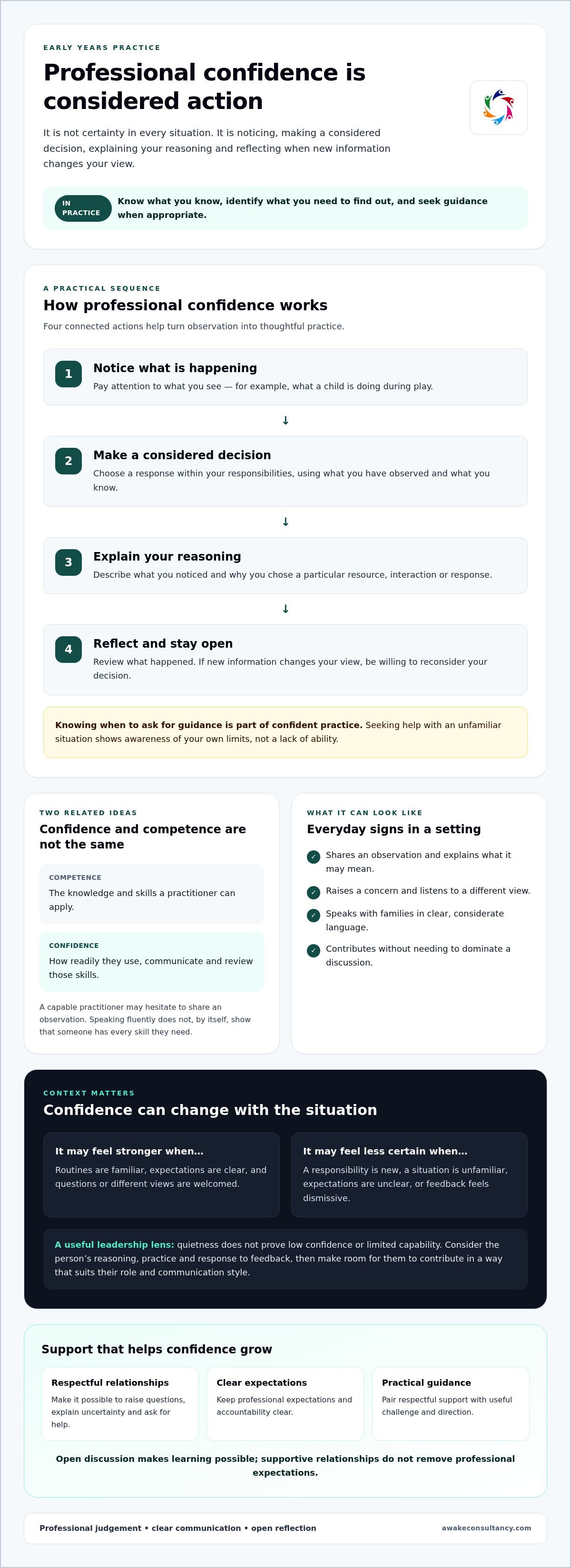
Professional confidence isn’t about being certain in every situation. It is the ability to notice what is happening, make a considered decision within your responsibilities, explain your reasoning and reflect when new information changes your view. Professional confidence is considered action and open reflection, not certainty or unchecked self-assurance. A confident practitioner can recognise what they know, identify what they need to find out and seek guidance when appropriate.
Confidence and competence are connected, but they aren't the same. Competence concerns the knowledge and skills a practitioner can apply; confidence affects how readily they use, communicate and review them. Neither job title nor length of service guarantees confidence, and being outgoing isn’t proof of it. A practitioner may be capable yet hesitate to share an observation, or speak fluently while still needing support to develop a particular skill.
It also helps to distinguish practitioners’ professional confidence from children’s confidence. Children’s sense of security, identity and independence develops through their own experiences, including responsive interactions with adults who listen and respond. Practitioners’ confidence, by contrast, concerns their professional judgement and communication. The wider idea of Understanding Self-Confidence offers useful context, but in an early years setting, confidence must be considered alongside role, responsibility and practice.
What confident practice can look like in a setting
Confidence is often visible in ordinary professional exchanges, rather than a dramatic display of certainty. A practitioner might describe what they observed during a child’s play, explain what they noticed and say why they offered a particular resource or interaction. They can also explain when they are unsure. For example, they may ask a more experienced colleague for guidance before deciding how to respond to an unfamiliar situation. Recognising when to seek guidance shows awareness of their own limits, not a lack of ability.
Respectful communication is another sign. A practitioner can share a concern with a colleague, listen to a different view and speak with a family about what they have observed, using clear and considerate language. They don’t need to dominate a discussion to contribute meaningfully. These actions help teams base decisions on observations and reasoning, rather than assumptions or unspoken uncertainty.
Why confidence can vary between people and situations
Confidence shifts with context. A practitioner may feel assured in familiar routines but less certain when taking on a new responsibility, responding to an unfamiliar situation or working with expectations that haven’t been clearly explained. Experience can help, but previous feedback matters too: specific, respectful guidance can support reflection, whilst comments that feel dismissive may make someone reluctant to contribute next time.
Team relationships shape confidence as well. When colleagues welcome questions and discuss different views respectfully, practitioners have more room to think aloud and ask for help. In a less supportive atmosphere, even an experienced team member may keep an observation to themselves. Don’t treat quietness as evidence of low confidence or limited capability. Consider the person’s reasoning, practice and response to feedback, then create opportunities for them to contribute in ways that suit their role and communication style. This gives leaders a clearer basis for supporting confidence without mistaking volume or certainty for professional ability.
How supportive relationships help practitioners build professional confidence
Professional confidence develops through more than individual knowledge. Practitioners also need relationships in which they can raise questions, explain uncertainty and receive guidance without feeling that one difficult moment defines their ability. Trust doesn’t remove professional expectations; it makes it easier to discuss them honestly and act on them consistently.
Teams where people can raise questions and reflect openly make learning possible, whilst keeping expectations and accountability clear. This balance matters. Reassurance without direction can leave a practitioner unsure what to change, while criticism without practical help can make them less willing to speak openly next time. Leaders can build professional confidence by offering respectful support alongside clear, useful challenge.
Making questions and professional discussion part of daily work
Make space for professional discussion within normal working routines, rather than waiting for a formal review or a problem to arise. A brief conversation might explore what a practitioner observed during play, why they chose a particular response and what they’re still unsure about. Listen carefully before offering direction. Clarifying questions can reveal the reasoning behind a decision and show what support would help.
Keep the focus on practice, not blame. If an interaction didn’t go as intended, the team can consider what was happening, which choices were available and what might be tried next time. This approach doesn’t excuse poor practice or remove the need to act on concerns. It gives colleagues a constructive way to examine decisions, share relevant experience and agree a sound next step.
Giving feedback that strengthens confidence and practice
Useful feedback is specific, timely and tied to something observable. Instead of saying, “You need to be more confident”, a leader could refer to a moment when a practitioner noticed a child’s interest, followed their lead and extended the play with a thoughtful question. Naming the action helps the practitioner understand what worked and why. Feedback about a concern should be just as clear, addressing the behaviour or decision rather than judging the person’s worth or suitability for the role.
Recognise sound reasoning as well as successful outcomes. In early years practice, circumstances beyond one practitioner’s control can affect outcomes; acknowledging careful observation or an appropriate request for guidance reinforces sound professional habits. Then agree a realistic next step together. For instance, a practitioner who feels unsure about contributing in team discussions might prepare one observation to share at the next meeting, with their manager checking in afterwards.
Revisit the agreed step collaboratively. Ask what the practitioner tried, what they noticed and whether further guidance would be useful. This keeps feedback developmental rather than turning it into a one-off judgement. It also helps leaders see whether the obstacle is confidence, unclear expectations, limited experience or a need for additional support.
Where a setting would benefit from structured, tailored support, practitioner training and development can connect leadership, reflection and everyday practice.
What can undermine practitioner confidence, and how should leaders respond?
Hesitation is a signal to investigate, not a verdict on a practitioner’s ability. It may reflect unclear expectations, little chance to practise a task, feedback that has felt personal or uncertainty about whom to approach. If the same difficulty keeps appearing, leaders should look at the support and systems around the role as well as the individual’s learning needs.
Confidence doesn’t mean never needing help or appearing certain. In a setting with clear expectations, asking for guidance can be a responsible decision. Match the response to the need: offer explanation or supported practice where that will help, and address recurring concerns directly when a practitioner needs clearer direction or closer follow-up.
| Possible barrier | Proportionate leadership response |
|---|---|
| Expectations are unclear | Explain the expected practice, why it matters and where the practitioner can find guidance. |
| Fear of making a mistake | Invite early questions, discuss what happened without blame and agree how to seek help next time. |
| Limited opportunity to practise | Arrange a suitable chance to try the task with guidance, then discuss what the practitioner noticed. |
| Feedback feels unhelpful or personal | Refer to a specific example, describe its effect on practice and agree a clear next step. |
Responding to uncertainty, mistakes and unfamiliar responsibilities
Make it straightforward to ask for guidance. Clarify which colleague can help with different questions and how urgent concerns should be raised, following the setting’s procedures. When something goes wrong or feels unfamiliar, review what happened, what the practitioner understood at the time and what they learned. Then identify the support needed for the next attempt, such as a demonstration, a chance to practise or clearer information.
Distinguish an isolated learning need from a recurring concern. One difficult experience may call for explanation and a supported opportunity to try again. If the same issue continues despite guidance, leaders should address it through appropriate supervision and follow-up. Support and accountability can work together.
Addressing fear of speaking up or being judged
Invite differing views and respond with curiosity before correction. A question such as “What led you to that decision?” can clarify the reasoning and surface a misunderstanding without implying blame. Leaders should also make roles, expectations and routes for raising concerns clear, so practitioners aren’t left guessing about how to act or whom to tell.
Inspection pressure can make uncertainty harder to discuss if staff feel they must present a flawless picture. Keep attention on consistent practice and honest reflection, rather than appearance alone. Awake’s Ofsted preparation guidance for nurseries explores how readiness can be part of sustained practice. Identifying barriers early helps leaders support practitioners while maintaining clear standards.
How can leaders build practitioner confidence through everyday development?
Confidence develops through practice with a clear purpose and room for reflection. A one-off training session may introduce useful knowledge, but practitioners also need opportunities to apply learning in their own setting and consider what it means for their role. A simple development cycle helps leaders make this process consistent without turning every conversation into a formal assessment.
Use the following steps as a flexible guide, adapting them to the practitioner’s experience, current responsibilities and chosen focus:
- Identify a strength. Start with an existing capability, such as noticing patterns in children’s play, organising a transition or communicating thoughtfully with families. Naming what already works gives development a sound starting point.
- Agree a focused goal. Choose a practical next step together. A broad aim such as “be more confident” is hard to act on; a specific goal might be to explain the reasoning behind a planned activity to a colleague.
- Practise in context. Find a suitable opportunity in the working day to use the skill. Consider the practitioner’s responsibilities and experience, and provide guidance proportionate to the task.
- Reflect on what happened. Discuss what felt effective, what was difficult and what the practitioner noticed. Use observations and their own account as evidence, without treating each exchange as a judgement.
- Review and agree what comes next. Recognise progress, adjust the goal if circumstances have changed and decide whether further practice or support would be useful.
There’s no need to impose an arbitrary deadline for confidence to develop. Practitioners build it through repeated, supported experience, with opportunities to try, reflect and strengthen their judgement. Progress may show in how clearly someone explains a decision, adapts their approach or identifies when they need further guidance.
Using coaching, modelling and gradual responsibility
For an unfamiliar task, a leader can model an approach and explain the thinking behind it. The practitioner can then try it with suitable support, take on more responsibility as their experience grows and discuss what they would retain or change. Keep each opportunity manageable. A focused review and one agreed next step make learning more useful than broad praise or criticism.
Making professional learning relevant to everyday practice
Connect training to situations practitioners actually encounter. After learning about a topic, allow time to discuss where it may apply, what questions it raises and how the team could use it in practice. Revisit the development goal in supervision or another appropriate discussion, so learning informs daily work rather than sitting apart from it.
Consistent development relies on leadership as well as individual effort. Awake Early Years Consultancy provides tailored practitioner training and development to help settings connect learning with reflective, everyday practice. This support can help strengthen development across a team in a way that reflects the setting’s needs.
When can early years consultancy and training support practitioner confidence?
Internal mentoring may be enough when a development need is clear, a suitable colleague can guide the practitioner and the setting can make time for practice and follow-up. Leaders can agree a focus, provide relevant support and review how it is shaping everyday work. The key is continuity: advice should connect with what the practitioner actually does, not sit separately from their responsibilities.
An external perspective may help when similar needs keep appearing across a team, expectations vary between rooms or existing support hasn’t resolved the underlying difficulty. A repeated pattern doesn’t automatically mean individuals lack ability. It may point to wider questions about leadership, communication, opportunities to practise or how development is organised. Looking at these factors together helps leaders decide where to focus.
Recognising when a setting may need additional support
Review patterns, not isolated moments of doubt. Consider whether practitioners in different roles are receiving consistent guidance, useful feedback and opportunities to practise relevant skills. Keep the review proportionate: identify what’s working, where practice is less consistent and what support would help. The purpose is sustainable improvement, not fault-finding or assessment for its own sake.
A focused discussion can help leaders distinguish an individual learning priority from a setting-wide development need. For example, practitioners may understand an expectation but have few chances to apply it, or leaders may be giving different messages about the same practice. Clarifying the issue first makes the next step more relevant and realistic.
Turning development priorities into practical support
Awake Early Years Consultancy provides tailored early years consultancy and practitioner training and development. This support can bring together a review of everyday practice, leadership approaches and staff development needs, helping a setting identify priorities that fit its context. Training may form part of that work, alongside reflection and opportunities to apply learning; it isn’t a guaranteed outcome or a substitute for consistent leadership.
To build confidence in early years practitioners, connect development with the conditions that help them use their learning: clear expectations, relevant guidance and time to reflect on practice. Start by identifying one recurring development priority and what would help staff address it consistently. Leaders can discuss early years consultancy and practitioner development in relation to their setting’s needs, with a focus on realistic support and sustained improvement.
Make confidence part of everyday practice
Confidence-building is most useful when it becomes part of how a setting works, rather than a separate initiative that fades when pressures rise. Choose one practical priority for your team, then consider what would help practitioners apply learning, ask for guidance and use their judgement consistently. This gives leaders a clear starting point for building confidence while keeping development connected to everyday responsibilities.
Where the need reaches beyond one practitioner, bring practice, leadership and development into the same conversation. Awake Early Years Consultancy tailors support for nurseries, pre-schools and other early years settings, including practitioner training and development and leadership support. The focus is on connecting development priorities with sustainable improvement, not a quick fix or a promised inspection result.
Start with a focused discussion about what your team needs and what practical support could look like. Discuss practical support for your early years team and take a considered next step towards more confident, consistent practice.
Frequently Asked Questions
Can confidence in early years practitioners be developed?
Yes, confidence can develop as practitioners gain knowledge, experience and opportunities to use their judgement. A practitioner who feels unsure about contributing to a planning discussion, for example, might start by sharing a short observation with a trusted colleague before presenting an idea to the wider team. Leaders can build confidence by recognising progress and providing chances to take on appropriate responsibilities, without expecting everyone to develop in the same way.
How can a manager support a practitioner who lacks confidence?
Start by finding out what feels difficult to the practitioner, rather than assuming they need general reassurance. They may be uncertain about a task, unfamiliar with a particular situation or unclear about what is expected. Agree one practical focus, such as explaining an observation during a handover, and arrange suitable guidance. Follow up by asking what helped and what remains difficult. This makes support relevant to the person’s role, rather than treating confidence as a personality issue.
What is the difference between confidence and competence in early years?
Competence is the knowledge and skill a practitioner can demonstrate; confidence is their willingness to apply and communicate their judgement. A practitioner might understand how to support a transition but feel hesitant when routines change unexpectedly. In that situation, consider both factors: does the person need more practice, or clearer guidance about adapting the approach? Looking at evidence of practice alongside the practitioner’s own perspective helps identify an appropriate response.
How can a quiet early years practitioner show professional confidence?
A quiet practitioner can show confidence through careful observation, thoughtful decisions and clear communication in one-to-one conversations or written records. They might notice a change in a child’s interests and explain it to a colleague, or raise a concern privately with a manager. Leaders can offer different ways to contribute, such as inviting views before a meeting or allowing time to prepare. Speaking often or forcefully isn’t the measure of professional capability.
How should leaders respond when a practitioner is afraid of making mistakes?
Ask what the practitioner is worried might happen and what guidance would help them act appropriately. For a new task, explain the relevant steps, identify who can support them and agree how they can build experience within their responsibilities. If an error occurs, address any immediate concern first, then discuss the circumstances and learning. Reassure the practitioner that asking for help is appropriate, while being clear about expectations and any follow-up needed.
Does practitioner confidence affect children’s experiences in an early years setting?
It can influence how consistently practitioners respond to children and communicate with families, though confidence alone doesn’t determine the quality of a child’s experience. For example, a practitioner who feels able to discuss an observation with colleagues may help the team respond more consistently to a child’s changing interests. Leaders should support confidence alongside skill, reflection and shared understanding. The aim is considered, responsive practice, not simply encouraging practitioners to appear more assured.
Can training alone build confidence in early years practitioners?
Training can develop knowledge and introduce approaches, but it may not be enough on its own. Practitioners also need opportunities to relate learning to their responsibilities, try relevant approaches and discuss what they notice afterwards. For example, a session on communication can prompt reflection, whilst a later team discussion helps practitioners consider how particular interactions worked in their setting. Leaders can support this transfer by linking training to ongoing development and everyday expectations.


