

What if recurring nursery leadership challenges are being sustained by the systems around the role, rather than by individual shortcomings? Staffing pressures, competing operational demands and unclear responsibilities can make consistent leadership difficult, even when a team is committed to doing well.
If the same concerns keep returning, quick fixes may ease immediate pressure without addressing what is driving the pattern. Unclear communication can lead to inconsistent decisions, while difficult conversations can affect trust and morale if they are not handled carefully.
This article will help you identify the causes behind recurring challenges and choose responses that fit your setting and team. We’ll look at the pressures shaping leadership, how responsibilities and communication affect day-to-day practice, and ways to address concerns constructively. The aim is to strengthen leadership over time, not add another short-term solution to an already demanding role.
Key Takeaways
- Recognise how leadership pressures show up in everyday decisions, practice and team support.
- Trace recurring nursery leadership challenges to the conditions and patterns behind them, rather than assigning blame.
- Match your response to the issue: some situations need clear direction, while others benefit from shared problem-solving or delegated ownership.
- Use a focused cycle to define the issue, agree an action, assign responsibility and review what changes.
- Consider tailored early years consultancy when persistent patterns or competing priorities need a clearer view.
What nursery leadership challenges look like in everyday practice
Leading a nursery means supporting people, maintaining consistent practice and keeping daily operations moving. These demands often compete for attention. A staffing gap, a parent concern or an urgent operational decision can quickly reshape the day, leaving less time for coaching, planning or clear communication.
A leadership challenge is a recurring barrier to clear decisions, consistent practice or effective team support. The pattern matters. One difficult handover or disagreement may need a timely response, but it does not necessarily point to a wider leadership issue. If the same misunderstanding, delay or gap in follow-through keeps returning, look beyond the immediate event to the conditions that may be sustaining it.
Recurring symptoms are signals, not diagnoses. Investigate what keeps producing them before deciding what needs to change.
How leadership challenges show up across a nursery team
In everyday practice, nursery leadership challenges may appear as repeated questions about who makes a decision, instructions understood differently between rooms, or actions agreed but not completed. A room team might be unclear about expectations, while a deputy feels unable to resolve routine issues without approval. The manager can then become the decision point for too many matters, slowing responses across the setting.
Look for repetition and impact, not isolated friction. People can disagree constructively, and a difficult day may reflect immediate pressures rather than a weakness in leadership. Ask what happened, whether it has happened before, and where expectations or communication broke down. This helps you respond proportionately instead of treating every concern as evidence of a failing team.
Why the effects matter beyond the management team
Leadership decisions shape how confidently staff carry out their roles and how reliably the team works together. If expectations shift between rooms, practitioners may be unsure which approach to follow. If information arrives late or through informal channels, staff can miss context and make different assumptions. Clear communication helps people understand what is expected, who is responsible and when to raise a concern.
That consistency also affects the experience of children and families. Early childhood education encompasses learning, development and care, as outlined in Early Childhood Education: An Overview. Within a nursery, aligned expectations can help practitioners provide a more coherent day-to-day experience, even when different team members are involved. This does not mean every situation should be handled identically. Leaders need to allow for professional judgement while keeping shared expectations clear.
When a concern recurs, record the practical pattern: what is happening, where it appears and who is affected. This gives the team a clearer starting point for examining causes, rather than relying on assumptions about individuals. Next, consider why the pattern persists and choose a response that addresses its source.
What causes nursery leadership challenges to keep recurring?
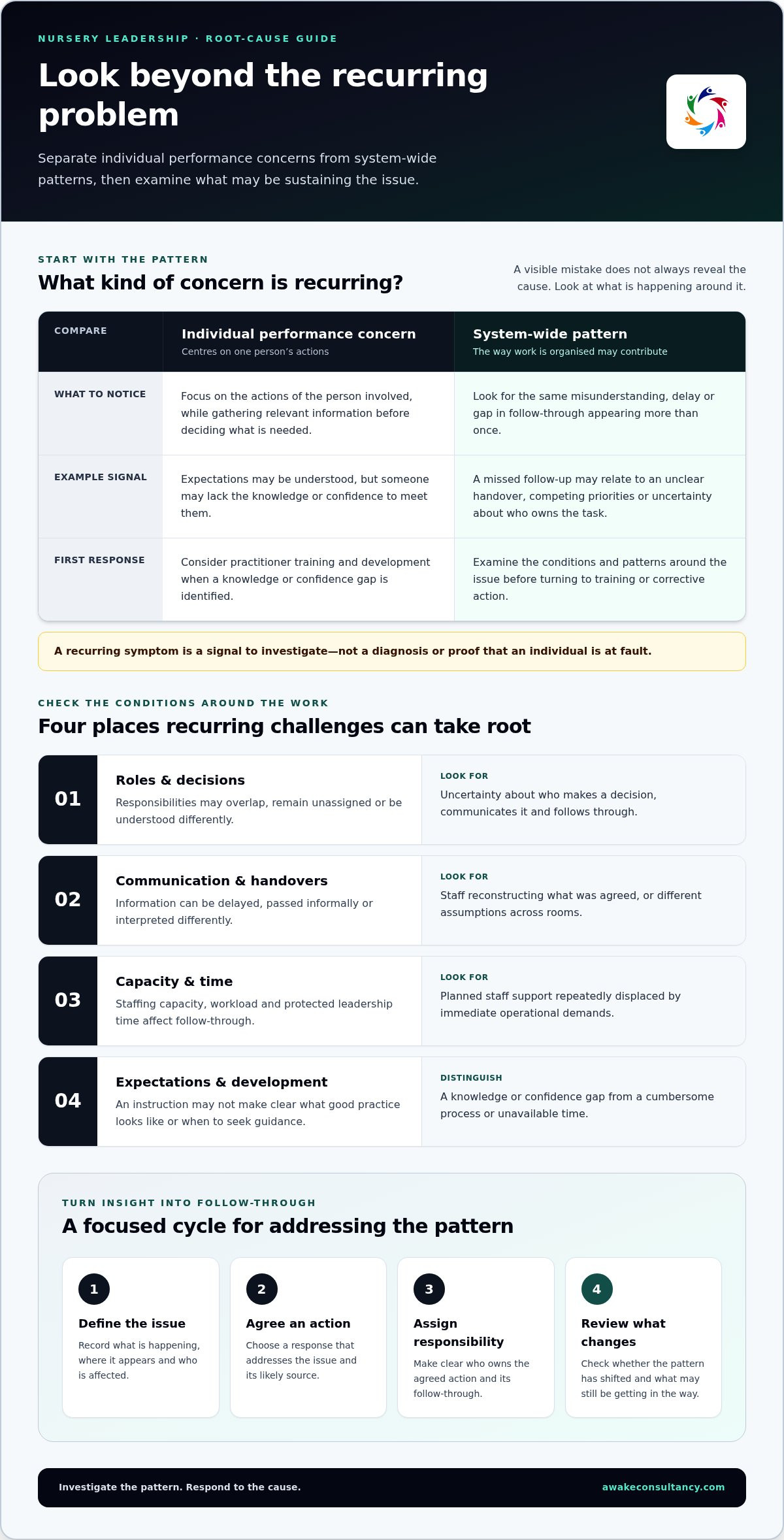
Recurring difficulties rarely have a single cause. Root-cause diagnosis means examining the conditions and patterns around an issue, rather than deciding that one person is to blame. A missed follow-up, for example, might reflect an unclear handover, competing priorities or uncertainty about who owns the task. Addressing only the visible mistake may leave the conditions that produced it unchanged.
An individual performance concern centres on one person’s actions; a system-wide pattern suggests the way work is organised may be contributing to the problem. The distinction matters. It helps leaders respond fairly, gather relevant information and avoid reaching for training or corrective action before understanding what is getting in the way.
Role clarity, decision-making and communication
Start with routine decisions that regularly create uncertainty. Map who makes each decision, who communicates it and who follows through. For example, a change to a daily room routine may involve a manager setting the expectation, a deputy sharing it and room leaders checking how it works in practice. If any part of that chain is assumed rather than agreed, information can be delayed or interpreted differently.
Look for responsibilities that overlap, remain unassigned or are understood differently across roles. Two people may both believe the other is responsible, or a deputy may be expected to take ownership without clear authority to act. A simple responsibility map can make these gaps visible. Agreeing a predictable channel for updates, decisions and follow-up can also reduce the need to reconstruct what was said through informal conversations.
Capacity, expectations and professional development
Even clear responsibilities can be difficult to fulfil when the team has little time to think, discuss or follow through. Consider how staffing capacity, daily workload and protected leadership time affect the work. If a manager’s planned time for staff support is repeatedly absorbed by immediate operational demands, the issue may be capacity or prioritisation, not a lack of commitment.
Then test whether expectations are clear and realistic across roles and rooms. An instruction may make sense to the person giving it but still leave staff unsure what good practice looks like, how to apply it or when to ask for guidance. That points to a communication or process gap. If expectations are understood but someone lacks the knowledge or confidence to meet them, practitioner training and development may be more appropriate. If the process itself is cumbersome or time is unavailable, training alone is unlikely to resolve the cause.
For each recurring concern, compare what the team is expected to do with the authority, time, information and capability available to do it. This gives leaders a balanced basis for action and helps distinguish an individual support need from a wider organisational barrier. When persistent patterns are difficult to untangle, tailored early years consultancy can help examine them in the context of your setting’s needs.
Which leadership response fits the challenge you are facing?
Once you have a clearer picture of what is driving a recurring issue, choose a response that fits its cause. Nursery leadership challenges do not all call for the same approach. A matter involving immediate risk or a decision that sits clearly with a manager may need direct instruction. A process problem affecting several rooms may be better explored with the team. Where responsibilities are understood and staff have the experience to act, delegation can build ownership.
Choose the least disruptive response that addresses the underlying cause. Before deciding, consider the urgency and potential risk, the team’s experience, and who has authority to make the decision. Discussion should not delay action where an immediate response is needed. Delegation should not transfer responsibility without the authority or support to carry it out.
| Challenge pattern | Likely cause to explore | Suitable first response |
|---|---|---|
| Staff interpret an expectation differently | The standard or instruction hasn’t been made clear | Give clear direction, explain the expectation and invite questions about practical barriers. |
| A recurring process causes problems across rooms | The process may not fit day-to-day practice, or staff hold useful information leaders haven’t heard | Use shared problem-solving to understand the issue and agree a workable adjustment. |
| Routine decisions repeatedly return to the manager | Decision authority may be unclear, or staff may lack confidence to act | Clarify what can be decided at each level, then delegate appropriate ownership with a review point. |
When clearer direction is more useful than further discussion
Use clear direction when responsibilities, standards or decision ownership need to be explicit, particularly where delay could affect safe, consistent practice. State what needs to happen, who is responsible and when it should be followed up. Then invite questions, as staff may identify a practical barrier that needs addressing. Firm direction clarifies the immediate expectation; it does not require an authoritarian approach in every situation.
When shared problem-solving can build ownership
A team discussion is useful when the difficulty crosses roles or rooms, or when practitioners understand practical details leaders may not see from their position. Keep the conversation focused: define the problem, hear relevant perspectives, agree a decision and name who will carry it out. Set a review point before closing, so the team can assess whether the response helped rather than leaving the issue open-ended.
Leadership routines also support steady preparation, rather than a last-minute focus on inspection. The Ofsted preparation guide explores how settings can build lasting readiness through consistent practice.
If priorities or responsibilities are difficult to untangle and the right response remains unclear, tailored early years consultancy can offer a perspective shaped around your setting’s needs.
Managing nursery leadership challenges effectively
A practical response does not need to become another project competing for attention. Use a short cycle to turn a recurring concern into a manageable priority, give someone clear ownership and check whether the change made a difference. Focus on one issue at a time, rather than introducing a long list of initiatives that the team may struggle to sustain.
Turn an observation into a specific leadership priority
Begin with what can be observed: describe the pattern, when it occurs and who it affects. Separate confirmed details from assumptions. For example, record that a particular handover regularly lacks a clear account of agreed actions, rather than concluding that staff do not care about follow-through. Then choose a priority the team can influence and that matters to daily practice.
Work through the cycle in order:
- Define the issue. Describe the recurring pattern in plain, specific terms, without attributing motive or blame.
- Agree an action. Choose one proportionate change that addresses the cause you have identified. Make clear what the team will do differently.
- Assign ownership. Name the person responsible for the next step and agree what authority, information or support they need.
- Review what changed. Set a review date and consider whether the pattern has shifted, stayed the same or created a new difficulty.
For instance, if staff leave a team discussion with different understandings of an agreed routine, the priority might be to make the decision and its owner clear in the existing meeting record. That is more focused than adding several new meetings or forms before establishing what is missing.
Assign ownership and review whether the response helped
Ownership should be explicit, but it should not mean leaving someone to manage a barrier alone. Check that the person responsible has the time, authority and support to act. If the task depends on another role, agree how that person will contribute. Record the decision, owner and review date in an existing team process, such as meeting notes or a leadership action record, so follow-up does not rely on memory.
At the review point, look at relevant evidence and invite feedback from the staff involved. Has the agreed action happened? Is the original difficulty occurring less often, or has it simply moved elsewhere? Listen before deciding whether to continue, adjust or stop the response. A review is not a test of whether the original idea was right; it is a chance to learn what the setting needs next.
Use this cycle to make nursery leadership challenges more manageable without adding unnecessary process. If a recurring issue remains difficult to define or resolve, explore tailored early years consultancy shaped around your setting’s needs.
When early years consultancy can support stronger nursery leadership
Sometimes a leadership team has already tried to clarify expectations, adjust routines or share responsibility, yet the same difficulty continues. An independent perspective can help when leaders are too close to a persistent pattern to see what is maintaining it, or when operational demands make it hard to decide which issue should take priority. This does not replace the team’s judgement. It helps examine the challenge in the context of the setting and consider practical next steps.
What tailored leadership support can help a setting examine
Tailored early years consultancy can help leaders look at how responsibilities are understood, how information moves between roles and where follow-through gets stuck. A focused review can bring competing priorities into clearer view and help identify changes that are realistic for the team to work on. The aim is to define useful areas for development, not promise a particular result.
This can be especially helpful when nursery leadership challenges affect several parts of the setting, or when leaders have different views about what is causing them. Awake Early Years Consultancy provides consultancy shaped around a setting’s needs, so the discussion can focus on the particular routines, roles and pressures involved rather than applying a standard answer to every nursery.
The most relevant support depends on what the issue points to:
- Leadership support can help examine responsibilities, communication and decision-making.
- Practitioner training and development can support staff who need to strengthen confidence, knowledge or consistency in practice.
- Recruitment support can help attract, assess and appoint early years practitioners where staffing capacity is affecting the team’s work.
- Ofsted preparation and mock inspections can help a setting review its practice and preparation, without guaranteeing an inspection outcome.
Choose a practical next step for your nursery
Before seeking support, write a short account of the challenge: what you have observed, who or what it affects, and what the team has already tried. Note any constraints that shape the issue, such as limited leadership time or unclear responsibilities. This gives you a useful starting point for deciding whether consultancy, training or recruitment support best matches the need.
Keep the next step manageable. You do not need to resolve every pressure at once; begin with the pattern that most affects everyday practice in the setting. A focused conversation can help you consider what to examine, what support may fit and which priority is realistic for your team.
If you’re ready to explore the issue in your setting, discuss your nursery’s leadership priorities with Awake Early Years Consultancy.
Make your next leadership step sustainable
Lasting progress does not depend on having every answer at once. It begins when leaders make space to notice what is changing in the team, keep useful practices in place and revisit priorities as the setting develops. That steady attention can help nursery leadership challenges become clearer and more manageable over time, without adding unnecessary initiatives to an already demanding role.
If an outside perspective would help you decide where to focus, Awake provides tailored early years consultancy for nurseries and other settings. Support also includes practitioner training and development, alongside Ofsted preparation and mock inspections. These services can help you consider the next area of work in the context of your setting, without promising a particular inspection result.
Choose one practical next step, whether that is strengthening team confidence, examining a persistent leadership pattern or preparing for closer scrutiny. Explore tailored support for your nursery’s leadership priorities and take that step with a clearer sense of direction.
Frequently Asked Questions
Can a nursery manager delegate leadership responsibilities without losing oversight?
Yes. Delegate defined decisions or tasks while retaining visibility of progress and any matters that must be escalated. For example, a room leader might manage a routine resource decision, while the manager remains responsible for the overall budget. Agree what the person can decide independently, what information they should report and which situations need referral. This supports staff development without leaving accountability or important decisions unclear.
How can a nursery leader raise a concern with an owner or senior manager?
Raise it calmly, with specific examples and a clear account of its effect on the setting. Rather than saying “communication is poor”, explain what information was missed, when it happened and what work was affected. State what you need from the discussion, such as a decision, clarification or review of a process. Keep a factual record of agreed actions, particularly if the concern is sensitive or remains unresolved.
Is leadership training useful for an experienced nursery manager?
Yes. Experience provides valuable judgement, but training can help a manager examine established habits, build confidence in unfamiliar situations and strengthen how they support others. Choose a focus linked to a current need, such as giving constructive feedback or developing team leaders. Practitioner training and development can also support shared understanding across a team, so leadership learning is not limited to the person with the most senior role.
What should a deputy manager do when their authority is unclear?
Ask the manager or owner to clarify which decisions sit within the deputy role, which require approval and how urgent issues should be escalated. Bring practical examples, such as whether you can adjust room responsibilities or respond to a routine staff concern. A written role outline or agreed decision boundaries can reduce hesitation and prevent duplicated work. If expectations differ between senior colleagues, request a shared discussion rather than trying to resolve the ambiguity alone.
How can a nursery leader make time for reflective practice?
Make reflection a small, regular part of work already taking place. After a team meeting or a change to a routine, reserve a few minutes to ask what helped, what caused difficulty and what should be carried forward. A brief note can capture learning without creating a separate report. If reflection time is repeatedly displaced, identify what is taking priority and discuss how leadership responsibilities can be organised more realistically.
What happens if staff disagree with a leadership decision?
Disagreement can reveal a practical concern or information that was not considered, so invite staff to explain their reasoning. Listen carefully, distinguish evidence from preference and clarify what can still be adjusted. If the decision stands, explain the rationale and what would prompt a review. For nursery leadership challenges involving immediate safety or welfare concerns, follow the setting’s established procedures and make sure the concern reaches the appropriate person promptly.


