

A written action plan does not, by itself, improve an inspection outcome. In England, a provider receiving an Inadequate Ofsted grade typically must submit an action plan within 30 working days. Ofsted conducts monitoring visits between the initial inspection and the full re-inspection, so leaders need to show that actions are changing everyday practice, not simply being recorded as complete.
It’s understandable to focus on the action plan after an inadequate Ofsted inspection: it sets out how the setting will respond to the findings. But an effective response also depends on clear leadership, staff understanding and evidence that improvements are sustained over time.
This article explains how action plans relate to inspection outcomes, how to check whether changes are embedded, and why staff morale and leaders’ accounts matter. It also covers the evidence that can show progress has become part of everyday practice, rather than a short-term response to inspection.
Key Takeaways
- Treat the improvement plan as a route to better practice, not as proof that the setting has improved.
- Give each action a clear owner, timescale and way to measure whether it is working.
- Look for consistent changes in daily practice, and consider how leadership stability and staff morale affect progress.
- Use leaders’ accounts to add context to the inspection report and shape a focused response.
- Build evidence over time so the setting can demonstrate that improvements are sustained, not simply completed on paper.
1. Does writing an action plan improve the next inspection outcome?
An action plan does not change an Ofsted judgement by itself. Its purpose is to turn inspection findings into improvements staff can apply and leaders can evaluate. An action plan after an inadequate Ofsted inspection should respond directly to the report. For each identified area, state what needs to change, who will lead the work and what evidence will show progress. A list of intentions is not enough: the plan needs to guide practice across the setting.
For a provider graded Requires Improvement, an improvement plan must address the areas identified in the inspection report. Ofsted does not prescribe a format. Keep the plan practical: if supervision is inconsistent, for example, explain how leaders will strengthen it and check whether staff receive useful guidance. Link every action to a finding so leaders can show how the plan responds to the report.
Timing matters. A setting graded Requires Improvement should be re-inspected within 12 months, and Ofsted assesses whether the areas identified at the previous inspection have improved. Ofsted does not typically conduct interim visits for these settings unless specific concerns arise. If leaders make meaningful progress, the setting may be graded Good; without it, another Requires Improvement or an Inadequate grade is possible. Use the period before re-inspection to embed changes, not simply prepare paperwork.
An Inadequate judgement has a separate follow-up process. A provider receiving this grade typically must submit an action plan within 30 working days, and Ofsted conducts monitoring visits before the full re-inspection. These requirements should not be confused with the process following Requires Improvement. In either case, leaders need to respond to the actual findings and maintain evidence that reflects daily practice.
Improvement should also be reflected in children’s learning and experiences. For disadvantaged children and children with special educational needs and disabilities (SEND), identify barriers to participation or progress, then plan support for each child. For example, leaders could check whether agreed strategies are used consistently during routines and play, and record what has changed for the child. This makes the intended outcome visible in practice rather than leaving it as a general ambition.
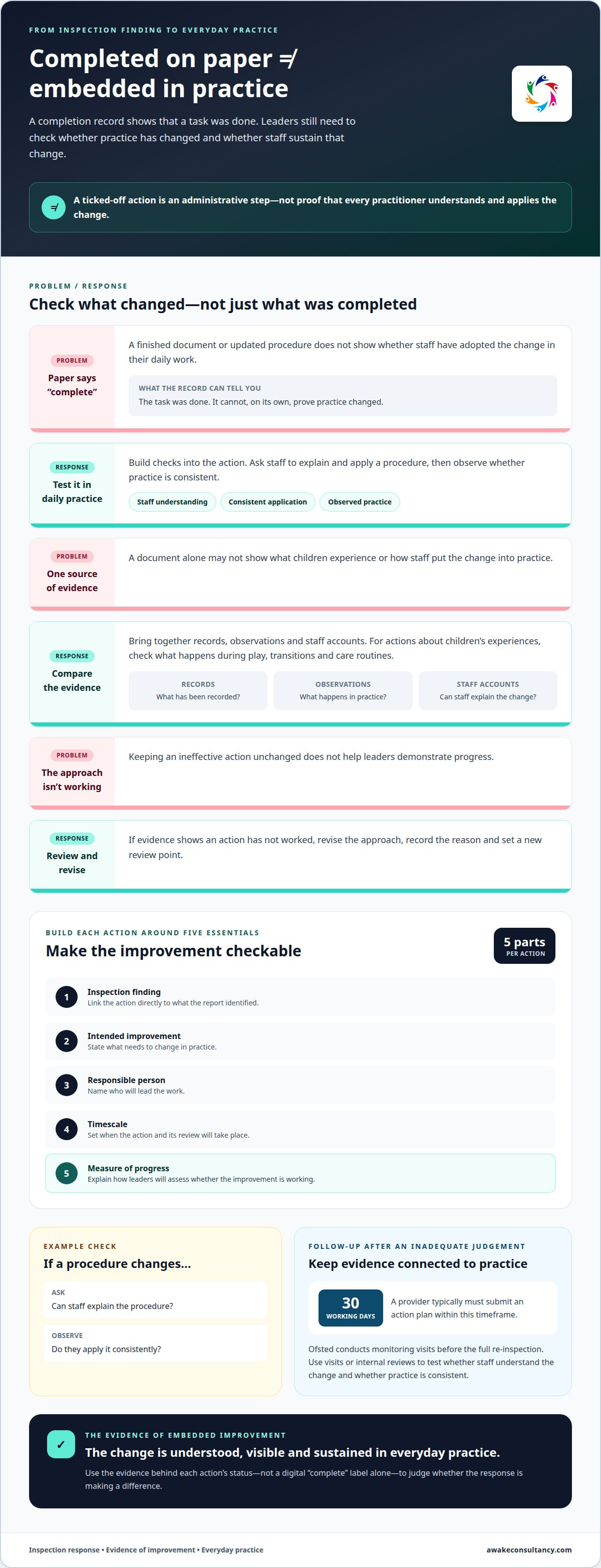
Care management software can help leaders coordinate improvement work. Link each action to an inspection finding, assign a responsible person, set a timescale and update its status. Record evidence of implementation, such as supervision notes or reviews of children’s experiences, and revisit open actions at leadership meetings. Marking an action complete is only an administrative step: leaders still need to check whether staff understand the change and sustain it in daily practice.
2. How can a provider verify an action has genuinely been embedded, not just completed on paper?
A completion record shows that a task was done, but not that practice changed. For each action, record the inspection finding, the intended improvement, who is responsible, the timescale and how leaders will assess its effect. An effective plan explains how progress will be measured, not just when a task can be ticked off.
What must an Ofsted action plan include? It should identify actions, assign responsibility, set timescales and explain how improvement will be measured. For example, if inspection findings identify inconsistent safeguarding practice, an action could set out staff guidance, name the manager responsible and explain how leaders will check practice during daily routines.
Build checks into each action. If a manager updates a procedure, check whether staff can explain and apply it consistently. If an action concerns children’s experiences, review what happens during play, transitions and care routines. Compare records with observations and staff accounts. A completed document is one piece of evidence, not proof that every practitioner has adopted the change.
Schools, nurseries and childminders follow different inspection frameworks. After a failed inspection, a school’s plan addresses how it will meet the Independent School Standards; an early years provider’s actions respond to its own inspection findings. Childminders should focus on the findings and requirements for their setting, rather than copying a school’s plan.
After an Inadequate judgement, an early years provider typically submits an action plan within 30 working days, and Ofsted conducts monitoring visits before full re-inspection. Use each visit or internal review to test whether staff understand the change and whether it is consistent in practice. If evidence shows an action hasn’t worked, revise the approach, record the reason and set a new review point. The purpose is to improve the response, not preserve a plan that isn’t effective.
For safeguarding concerns, separate immediate protective steps from longer-term improvement. Ofsted may issue a welfare requirements notice when an Inadequate grade reflects safeguarding failures. The response should address the notice’s requirements and show how leaders check that safer practice continues. Failure to comply can result in suspension or cancellation of registration, so document decisions, oversight and implementation clearly.
CQC findings call for a related but distinct response. Its well-led domain looks for a learning culture: leaders explain findings, describe their actions and check that improvements are embedded. A care management system can support oversight by assigning each requirement to a responsible person, recording timescales and tracking status. Managers should review the evidence behind each status, rather than treating a digital “complete” label as proof of change.
3. Leadership stability and staff morale
Leadership stability affects whether improvement becomes routine or depends on one person. If a manager leaves during a recovery period, appoint an interim lead, transfer oversight of open actions and tell staff who will make decisions. Record handovers, unresolved concerns and review dates to keep changes on track during the transition.
Staff morale also affects whether new expectations are followed consistently. A team facing repeated changes, unclear priorities or limited time may struggle to apply them in everyday practice. Leaders can use supervision and team meetings to identify barriers, agree practical adjustments and follow up on concerns. For example, if staff are unsure about safeguarding procedures, arrange focused training and check understanding through discussion and observation.
Communication needs to be regular and structured. Explain what the inspection found, what the setting is changing and how each role contributes. A manager might share an update at a staff meeting, give practitioners time to ask questions, then revisit the agreed procedure in supervision. This clarifies why the change matters and helps leaders identify where staff need more guidance.
Training should address the actual improvement priorities. If observations show inconsistent interactions, use a team session to model the expected practice, followed by coaching during play and feedback in supervision. External guidance can help leaders examine a gap they cannot resolve internally. The key is to turn it into a clear action, staff learning and follow-up, not extra paperwork that leaves practice unchanged.
For children’s homes in England, Regulation 33 concerns staff supervision practice. That requirement applies to children’s homes, not early years nurseries. Leaders in a children’s home should use supervision to discuss staff practice, support needs and actions arising from concerns, then maintain records that show follow-through. In an early years setting, supervision can still provide a practical space to clarify expectations and identify training needs.
What support is available from the local authority after an inadequate Ofsted inspection? In England, local authorities have a duty to support early years settings graded Requires Improvement or Inadequate. Leaders can use this support to inform improvement work, clarify priorities and strengthen their response to inspection findings.
A healthy culture allows staff to raise concerns without treating challenge as resistance. Leaders can invite staff to identify an obstacle to an agreed change, record the response and report back at the next meeting. Closing this loop shows that leadership listens, acts and checks whether its decisions help practitioners deliver consistent care and learning.
4. Gathering leaders’ accounts alongside the inspection report
An inspection report records inspectors’ findings, while leaders’ accounts can add context. For a focused response, document what happened, what evidence staff shared and where leaders agree or disagree with the findings. Compare those accounts with the written report, then identify actions that address its specific conclusions. This keeps the response honest and grounded in practice.
When preparing a school action plan, leaders can consider their accounts of the inspection alongside the report. Separate first-hand observations from interpretation: record which lesson, conversation or document is being discussed, and explain its relevance. Use the account to clarify the improvement response, not to replace evidence or dismiss a finding that needs action.
Draft reports also create an opportunity to identify factual errors. Schools have a 5-working-day window to correct genuine factual errors in the draft Ofsted report card. For children’s homes, Ofsted sends the draft report to the registered provider within 18 working days of the inspection ending. The provider then has up to five working days after receiving it to submit factual comments or a formal complaint.
Children’s homes have a defined report sequence. Ofsted sends the final report within 30 working days of the end of the visit, unless a complaint causes delay, and publishes it five working days after sending it to the provider. Record receipt dates and prepare comments promptly; an accurate timeline helps leaders respond within the relevant window rather than lose time locating documents.
Read the report card against the current inspection framework, rather than relying on familiar labels. Under the current framework, single-word grades no longer exist; the equivalent is described through one or more areas graded “needs attention” or placement in a category of concern. Identify each area, the evidence cited and the specific practice leaders need to strengthen.
How can a provider challenge or appeal an Ofsted inspection judgement? For a children’s home, the registered provider may submit factual comments or a formal complaint about the draft report within five working days of receiving it. For schools, the stated draft-stage window allows correction of genuine factual errors. Distinguish those corrections from disagreement with evaluative findings, and keep supporting records together.
Pay close attention to requirements. A requirement following an inspection must name the regulation, explain what the registered person must do and include a date. If an Inadequate judgement reflects safeguarding failures, Ofsted may issue a welfare requirements notice; failure to comply can result in suspension or cancellation of registration. Document the response, evidence of action and leadership oversight so staff can explain how the response is maintained.
For children’s homes, Ofsted considers whether enforcement action, including a compliance notice, is necessary when a provider misses the deadline for an inspection requirement. Link each requirement to relevant evidence and review progress against its stated date. Clear accounts, accurate records and timely factual comments support a more precise improvement response.
5. Action plans and evidence that changes are sustained
A strong action plan connects each inspection finding to evidence of lasting change. For an action plan after inadequate Ofsted inspection, track each action, owner, due date, progress and supporting records in one place. Then review whether the evidence shows a difference in practice, not just a completed task. For example, a revised procedure should be reflected in staff understanding and the way care is delivered.
Keep evidence specific to each improvement. If a finding concerns care planning, retain the updated plan and records showing how staff use it. If it concerns risk assessments, document the review and how agreed controls inform daily decisions. In children’s homes, common action-plan themes include record quality, current care plans and risk assessments, documented supervision and training, and responsible-individual oversight.
Review progress at planned points rather than assembling a file just before a return visit. A children’s home that updates care plans shortly before an Ofsted return visit presents a different record of improvement from one that has reviewed them consistently for three months. A clear review trail shows what leaders checked, what they found and how they addressed gaps.
For a school, record the improvement approach, progress and evidence of success as work proceeds. A midway review can identify actions that have stalled or are ineffective; a final audit can check whether the intended change is in place. Link these reviews directly to the relevant inspection findings so leaders can explain how the evidence demonstrates progress.
Prepare for a return visit by organising evidence around the concerns inspectors will assess. Keep records accessible and current, and ensure the responsible leader can explain what each item demonstrates. Documents without a clear link to a finding can be difficult to interpret. A focused record shows the sequence from identified weakness to action, review and sustained practice.
Use the previous findings to guide internal checks. For every concern, leaders can ask whether the change is visible in records, observed in practice and understood by staff. If the evidence conflicts, document the discrepancy and decide what further action is needed. This avoids treating a successful paper audit as proof that everyday practice has changed.
Before the next inspection, check that evidence is dated, attributable and consistent. A training record can show attendance, while supervision notes or practice observations can help demonstrate how learning is applied. Leaders should also record remaining weaknesses honestly and explain the steps taken to address them. Reviewing an action plan after inadequate Ofsted inspection can help leaders decide what to continue, change or examine more closely.
If leaders need structured support to test whether improvement evidence reflects day-to-day practice, arrange Ofsted Preparation & Mock Inspections to review readiness and identify gaps before the next inspection.
Awake Early Years Consultancy: Ofsted Preparation & Mock Inspections
Awake Early Years Consultancy provides Ofsted Preparation & Mock Inspections for early years settings addressing inspection findings or preparing for a return visit. This support can help leaders review whether actions respond to the report, assess how changes appear in daily practice and identify gaps in the evidence.
Use this support when your plan is in place but you need an objective view of how consistently staff apply changes. A mock inspection can help leaders review practice, records and staff understanding, then focus further improvement. Practitioner Training & Development can also support staff learning where practice needs strengthening.
For practical support with your setting’s improvement work, contact Awake Early Years Consultancy.
Make improvement part of everyday leadership
Make improvement part of how your setting makes decisions, rather than a separate project tied to an inspection date. Build regular reflection into leadership discussions so teams can consider whether changes remain effective as children’s needs and staff responsibilities evolve. This keeps attention on everyday practice and sustains a clear sense of shared purpose.
An action plan after an inadequate Ofsted inspection can remain useful beyond the immediate recovery period. Return to it when setting priorities, welcoming new staff or reviewing how well current approaches serve children. Adapt the work as the setting learns, and keep leadership discussions focused on what should continue, change or receive closer attention.
Where an independent perspective would help you plan the next stage, speak with Awake Early Years Consultancy about Ofsted Preparation & Mock Inspections. Steady, thoughtful improvement can strengthen practice well beyond the next inspection.
Frequently Asked Questions
Does writing an action plan improve the next inspection outcome?
An action plan supports improvement, but writing one does not change an inspection outcome. Its value lies in helping leaders turn findings into practical changes and assess whether those changes benefit children. For example, if an inspection identifies inconsistent support for children with SEND, leaders can set out how practitioners will adapt activities and review children’s participation. Inspectors assess practice and progress, not the existence of a document alone.
How can a provider verify an action has genuinely been embedded, not just completed on paper?
Check for change across records, staff understanding and daily practice. For example, after updating a safeguarding procedure, a manager could review how staff respond to a concern, discuss the process in supervision and examine whether records reflect it. If these sources disagree, the action needs further work. A completed training register or amended policy may show that a task was done, but leaders need evidence that staff apply the learning consistently.
How long after a requires improvement to be good judgement does the next inspection happen?
A setting graded Requires Improvement should be re-inspected within 12 months. The return inspection assesses whether the areas identified previously have improved. Use the time before the visit to address those findings in practice and review progress regularly. Ofsted does not typically conduct interim visits for these settings unless specific concerns arise, so leaders should maintain oversight rather than rely on an interim visit to test changes.
How long do providers typically have to submit an action plan after enforcement action?
For a provider receiving an Inadequate Ofsted grade in England, the typical deadline to submit an action plan is 30 working days. This timeframe relates to the Inadequate grade, not every enforcement action. An inspection requirement for a children’s home must include a date for what the registered person must do; leaders should use that specified date when managing the requirement and its response.
How quickly does Ofsted return after an inadequate judgement?
For an Inadequate early years setting in England, Ofsted conducts monitoring visits between the initial inspection and the full re-inspection. The inspection facts covered here do not specify a fixed number of days for the schedule. Leaders should maintain records and oversight throughout the improvement period, rather than treating a quiet interval as evidence that the response is complete.
What do Ofsted inspectors look for on a return visit?
Inspectors assess whether the areas identified at the previous inspection have improved and whether changes are genuine in practice. For a children’s home, this can include checking current care plans and risk assessments, staff supervision and training records, and responsible-individual oversight. Leaders should connect records to children’s experiences, for example by explaining how a revised risk assessment changes staff decisions during everyday routines.
What does an inadequate Ofsted rating mean for a school or early years provider?
For an early years provider, an Inadequate judgement identifies serious areas requiring improvement and can lead to an action plan and monitoring visits. Schools are inspected under a different framework: under the current framework, single-word grades no longer exist, and concerns are described through areas graded “needs attention” or a category of concern. The practical response depends on the report’s findings and the requirements that apply to the setting.
What actions must a provider take after an inadequate Ofsted inspection?
Start by translating each finding into a specific action, assigning a responsible leader and setting a timescale for review. An early years provider receiving an Inadequate grade typically submits an action plan within 30 working days, while Ofsted conducts monitoring visits before full re-inspection. Schools should prepare a plan showing how they will meet the Independent School Standards. In every setting, keep evidence that demonstrates how actions affect everyday practice.


