

Improving an inadequate Ofsted rating starts with addressing the failures in the inspection report, tackling their underlying causes and embedding stronger practice in daily care and education. In England, Ofsted will re-inspect an early years provider judged inadequate within 6 months of the inspection. Understanding how to improve a nursery’s Ofsted rating from inadequate means acting on the findings, not simply preparing for the next visit.
An inadequate judgement can unsettle families as well as nursery leaders, and parents may want to know how their views are heard. Inspectors speak with parents as part of gathering evidence, alongside observing practice and talking with children and staff. This article explains how parents are involved, what can contribute to an inadequate judgement and what the rating may mean for a nursery.
It also sets out practical priorities for improvement, from reviewing leadership and staff knowledge to strengthening children’s learning and keeping parents involved. The focus is on changes that improve everyday provision and help a setting demonstrate progress when Ofsted returns.
Key Takeaways
- Use the inspection report and the Early Years Inspection Handbook to understand the judgement and the improvements required.
- Look beyond individual shortcomings to identify underlying issues in leadership, teaching and staff knowledge.
- Understand how an inadequate judgement can affect a nursery’s operations, reputation and enforcement position.
- Strengthen daily practice through focused staff development, safeguarding processes and learning shaped around children’s needs.
- Prepare for Ofsted’s return by tracking progress against the report’s required actions and involving parents in children’s learning.
How does the Early Years Inspection Handbook help?
The handbook explains the inspection criteria, while the report identifies where a nursery must improve. Read them together to connect the judgement with practical changes to children’s care and learning.
Understanding inadequate judgements
An inadequate judgement means Ofsted has identified serious weaknesses in a setting’s education or care. England’s four former nursery ratings were Inadequate, Requires Improvement, Good and Outstanding. The judgement matters because it gives the provider a clear account of concerns and required improvements, rather than simply an overall label. Parents can raise concerns with Ofsted, but they don’t appeal the nursery’s judgement; the provider can use Ofsted’s process to challenge the inspection outcome.
Using the handbook and grade descriptors
The Early Years Inspection Handbook sets out how inspectors evaluate early years provision, and its grade descriptors explain what each judgement means in practice. Use the relevant descriptors to review leadership and management, teaching, learning and assessment, personal development, behaviour and welfare, and outcomes for children. Ofsted considers these four areas when rating an early years setting. Comparing everyday practice with each descriptor helps leaders identify gaps that a general review might miss.
Staffing arrangements are also part of safe, effective provision. In England, the EYFS sets staffing ratios and qualification requirements according to children’s ages and staff roles. Review room deployment and staff qualifications against the applicable requirements; there isn’t one ratio for every age group.
Turning report findings into priorities
The inspection report records the weaknesses inspectors identified and the improvements required. Read each finding carefully, then connect it to the practice, leadership decision or staff knowledge that may have contributed. For example, a concern about children’s progress should prompt a review of how practitioners observe, assess and plan learning. This turns the report into focused priorities, rather than a broad instruction to “do better”.
Safeguarding failures involving unmet safeguarding and welfare requirements can lead to further action. UK Government says Ofsted may issue actions for an EYFS failure and may serve a welfare requirements notice when the failure concerns a safeguarding and welfare requirement. The report and any notice identify the specific issue the nursery must address.
Evidence of children’s learning and care
Inspectors gather evidence by observing children at play and watching interactions between children and practitioners. They also speak with children, practitioners and parents, building a picture from what happens in the setting and what people experience. During an inspection, inspectors track the progress of at least two children. That evidence helps them assess whether teaching and care support children’s needs and development.
Parents can share their views during inspection conversations, and their observations form part of the evidence considered. Staffing and qualification requirements matter because they shape how consistently practitioners can support children. Use the report alongside the handbook: identify the evidence behind each finding, then decide which changes will improve children’s everyday experiences.
Identifying root causes in leadership, education and staff knowledge
An inadequate judgement identifies visible weaknesses, but lasting improvement depends on understanding their causes. Review each finding alongside leadership decisions, teaching routines and staff knowledge. Ask what allowed the weakness to persist, who was responsible for addressing it, and what evidence would show that practice has changed. For example, repeated gaps in children’s learning records may point to unclear expectations, limited training or insufficient management oversight. Leaders considering how to improve a nursery Ofsted rating from inadequate should start with these underlying causes, not surface-level fixes.
Nursery leaders can improve teaching, curriculum and children’s progress by connecting observations and assessments to purposeful planning. Check whether activities build on what children already know, reflect their needs and offer suitable challenge. Then observe how practitioners support learning during play and routines. If children repeatedly lose interest or struggle to take part, review the activity, the adult’s approach and the curriculum’s next steps. This gives staff a practical way to adapt education to children’s responses.
Leadership weaknesses often show up in inconsistent routines, unclear accountability or unresolved concerns. Map each report finding to the person responsible, the action required and the evidence that will demonstrate progress. For instance, if safeguarding procedures aren’t followed consistently, clarify staff responsibilities and review how concerns are recorded and escalated. A written action plan helps managers track completion and identify recurring gaps across the setting.
Education quality requires more than a revised planning document. Compare planned learning with what children experience throughout the day, including conversations, play and transitions. Leaders can review examples of children’s work and planning together, then identify whether practitioners extend learning or simply provide activities. If plans don’t respond to children’s interests or development, revise them and discuss the changes during team meetings. Follow up by checking whether the revised approach is helping children engage and make progress.
Gaps in staff knowledge can also contribute to weak practice. Identify where practitioners need clearer guidance or professional development, then connect training to specific findings. For example, a team that struggles to recognise children’s communication needs may benefit from focused development and coaching during practice. Ongoing professional development helps staff apply learning consistently; training about adverse childhood experiences may also be considered where it fits identified needs.
Keep the review focused on causes, not blame. Compare similar findings across rooms and teams to see whether a concern reflects individual practice or a wider system. Then assign actions, review their effect on children and adapt support where progress remains limited. Leaders considering how to improve a nursery’s Ofsted rating after an inadequate judgement can use a mock inspection to test whether changes are evident in daily practice, rather than only in paperwork. A structured Ofsted preparation and mock inspection can help reveal gaps and focus the next stage of improvement.
Impact of a poor Ofsted rating on a nursery
An inadequate judgement has practical consequences for a nursery, its staff and families. The inspection report identifies required improvements, while any further action depends on the failures found. Leaders should read the report alongside any formal notice, record deadlines and responsibilities, then make children’s safety and care the immediate priority. For example, a concern about supervision calls for a clear review of how staff oversee children throughout the day.
Ofsted enforcement action for an inadequate nursery can include required improvements, suspension or cancellation of registration. These outcomes have different consequences for the setting’s ability to operate. A required improvement action calls for the provider to address identified failures; suspension or cancellation can affect whether the nursery continues providing care. Leaders should respond directly to each notice and keep evidence of the steps taken, rather than treating the judgement as a single issue.
Funding arrangements may also matter to families. In England, providers remain eligible to claim government funding for 2-, 3- and 4-year-olds until their local authority removes them from its directory of providers offering free early education places. This means an inadequate rating does not, by itself, immediately remove eligibility. The local authority’s directory status is the deciding factor, so families may want clear information about the setting’s position and any change to funded places.
Parents need accessible information to make decisions about their children’s care. In England, providers must give every parent of a child attending the setting a copy of the final inspection report. Families can use its findings to understand which aspects of provision need attention, then raise practical questions with nursery leaders. For instance, they may ask how staff have changed a routine highlighted in the report or how progress will be communicated.
An inadequate judgement can also put pressure on leadership and staff. Managers must address required improvements while maintaining consistent care and communicating clearly with parents. If the report identifies weaknesses in staff practice, leaders need to explain how expectations are being reinforced and how implementation will be monitored. A specific example, such as updated safeguarding procedures followed in daily practice, gives families a clearer account than general assurances.
For the setting, improvement requires a sustained response across its provision, not a short-lived inspection exercise. Leaders can organise actions by risk and urgency, assign responsibility, and review whether changes work for children. Where resources or management capacity are strained, financial planning can help the nursery direct available funding towards essential improvements. Clear records of decisions and progress also help demonstrate how the setting has responded to the report.
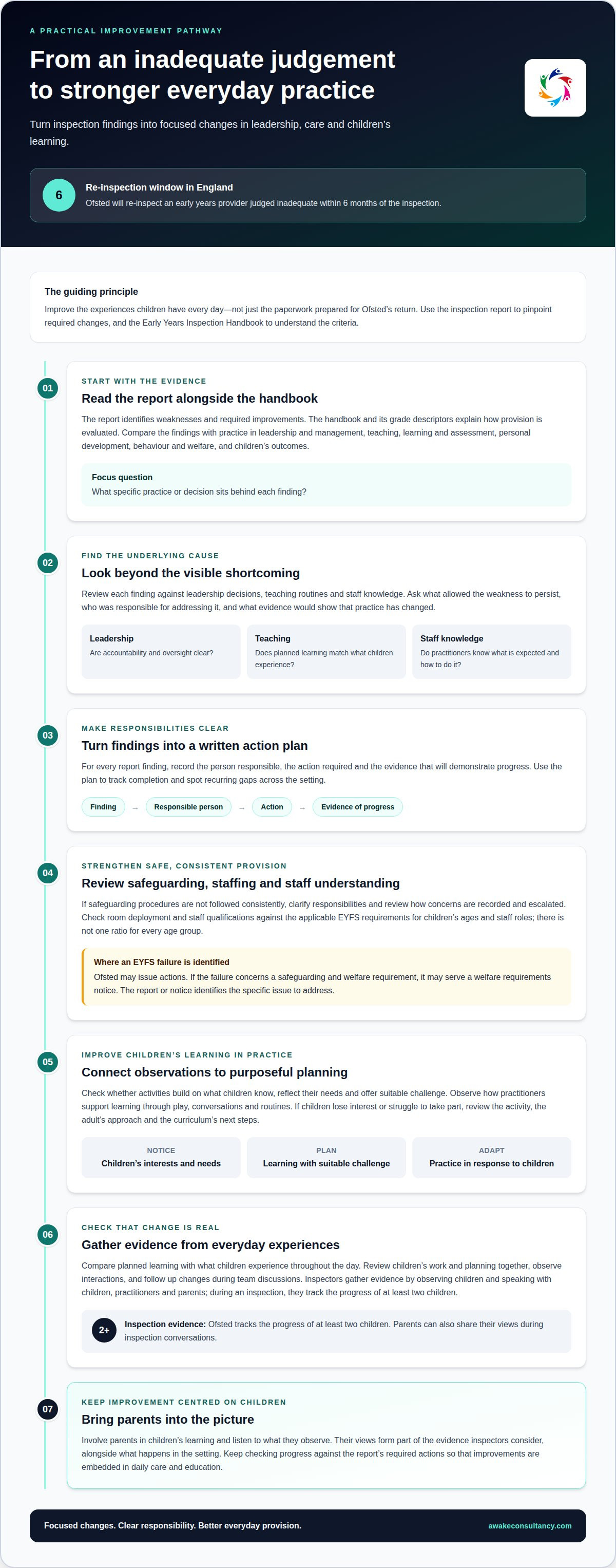
Improvement steps after an inadequate Early Years Register judgement
Start with the inadequate inspection report: it sets out required improvements and deadlines for failed EYFS requirements. Turn each finding into a written action, assign responsibility and record evidence of completion. Then review progress regularly, so leaders can identify delays and respond before they affect children’s care. A focused plan makes the required changes visible in daily early years practice, not just in policies.
To improve safeguarding, staff training and child protection procedures, train staff in safeguarding protocols and maintain a clear process for reporting concerns. Make sure practitioners understand how to record and escalate a concern, and that managers review whether the process works in practice. Use team discussions to clarify responsibilities and address gaps found in the report. Staff should feel confident following the procedure when a concern arises.
Review how observations and assessments inform curriculum planning. Plans should reflect children’s needs, interests and development, rather than rely on activities that remain unchanged. Check that every child has received a progress check at age two, then use relevant findings to shape support. For example, if observations show a child needs more opportunities to practise communication, plan interactions that encourage conversation and review how the child responds.
Staff development should address the specific knowledge gaps identified in the inspection findings. Link training to changes practitioners need to make, then revisit practice through discussion and observation. Ongoing professional development can strengthen consistency across the team. Consider staff wellbeing too: regular opportunities to raise workload concerns can help leaders understand barriers to motivation and commitment, and take practical steps to support the team.
Use nursery funding carefully. Review existing allocations and direct resources towards initiatives or materials that benefit children’s development. A planned purchase should connect to an identified need, such as resources that support children’s learning or participation. Record the purpose and review how the resource is used, so financial decisions contribute to improvement rather than sit apart from educational priorities.
Keep parents involved in children’s learning. Update them about progress, share home-learning activities and invite them to take part in nursery experiences. For example, a simple activity linked to a child’s current interests can help parents continue learning at home. Listening to parents’ observations can also give practitioners useful context when adapting support and planning meaningful next steps.
Finally, test whether improvements are happening consistently. A mock inspection can include auditing samples of records in the same way Ofsted would, alongside observing everyday practice. Compare what staff do with the actions in the improvement plan, and address gaps promptly. This gives leaders a clearer view of whether changes are embedded across the setting, rather than limited to paperwork or a single room.
How soon will Ofsted reinspect a nursery rated inadequate?
In England, Ofsted will re-inspect an early years provider judged inadequate within 6 months of the inspection. Treat that period as a firm preparation window, not a reason to delay action. Start with the report’s required improvements and deadlines, then set internal review points to check progress before inspectors return. The priority is to address the identified failures and make better practice consistent across the setting.
The reinspection follows the original judgement, so the report should guide preparation from the outset. Separate each required action into practical changes, such as revising a procedure, developing staff knowledge or improving curriculum planning. Assign responsibility and keep evidence showing when changes began and how leaders monitor them. If an action depends on several teams, record how managers coordinate the work and follow up outstanding tasks.
Preparation should show what children experience, not only what the nursery has written down. For example, if the report identifies weak support for learning, review planning alongside children’s participation and progress. If it identifies a safeguarding concern, check whether staff understand the relevant procedures and apply them in practice. Compare observations from different rooms to see whether improvement is consistent or limited to one team.
Use regular management reviews to test whether corrective steps are working. Leaders can discuss completed actions, review relevant records and observe everyday practice. Where evidence shows a change has not taken hold, identify the obstacle and adjust the support. This helps avoid a last-minute push focused on documents while daily routines remain unchanged. Keep the improvement plan current as new findings emerge.
A typical nursery inspection in England takes one day. That makes clear, accessible evidence useful: staff should understand the setting’s procedures and be able to explain how they support children. Leaders should ensure records reflect actual practice, rather than create separate inspection paperwork. Parents’ views may also form part of inspection evidence, so consistent communication about the nursery’s response matters.
Ofsted can also carry out unannounced nursery inspections after receiving a complaint or concern. This is another reason to embed improvements in normal practice instead of preparing only for a planned visit. Managers should ensure staff know how to respond to concerns, where records are kept and who is responsible for follow-up. Fire drills can help staff and children practise what to do in an emergency.
Use the time before the return visit to check progress against every relevant finding. A mock inspection can help test whether records and daily practice show the changes clearly. Keep the focus on children’s care, learning and safety, and address unresolved weaknesses promptly. The aim is not simply to be ready on inspection day, but to sustain stronger provision throughout the nursery.
Awake Early Years Consultancy: Early Years Consultancy
Awake Early Years Consultancy supports nurseries working to strengthen practice after an inadequate judgement. Its Early Years Consultancy can help leaders review inspection findings, identify operational priorities and develop practical improvements suited to their setting. For teams needing to build staff knowledge, Practitioner Training & Development can support more consistent practice. Ofsted Preparation & Mock Inspections can help leaders assess whether changes are evident in records and everyday provision before inspectors return. This support is most relevant when a nursery needs structured external guidance to turn findings into sustained changes, rather than a short-term inspection response. To discuss support for your setting, contact Awake Early Years Consultancy.
Build improvement into everyday practice
The next step is to make improvement part of how the nursery operates, not a response reserved for inspection day. If you’re considering how to improve a nursery’s Ofsted rating after an inadequate judgement, focus on changes staff can sustain, explain and evidence through their daily work. A clear plan can help leaders keep priorities visible, support practitioners and communicate honestly with families as practice develops.
Awake Early Years Consultancy supports this work through Early Years Consultancy, Recruitment Support and Practitioner Training & Development. These services can help leaders strengthen their approach, address recruitment challenges or develop staff capability. Choose the support that fits the nursery’s needs and the issues it is working to resolve.
Take the next step by discussing your setting’s priorities with Awake Early Years Consultancy. With focused leadership and consistent effort, a difficult judgement can become a starting point for stronger everyday provision.
Frequently Asked Questions
How are the parents involved in the inspection?
Parents may share their experiences directly with an Ofsted inspector during the inspection. They can describe how the nursery communicates, responds to concerns and supports their child’s needs. For example, a parent might explain whether staff share useful updates about settling in or changes in behaviour. Inspectors consider these views alongside other evidence, so parents should give specific examples rather than rely only on a general impression.
How will an inspector decide their judgements?
Inspectors weigh evidence about leadership and management, teaching, learning and assessment, personal development, behaviour and welfare, and outcomes for children. They observe practice, speak with people at the setting and examine relevant records. For example, a written curriculum plan can be compared with what children actually experience. A judgement reflects the overall strength of this evidence, including whether leaders recognise shortcomings and take effective action.
What does an Ofsted inadequate rating mean for a nursery in England?
An inadequate rating means Ofsted has judged that serious weaknesses affect the nursery’s education or care. The inspection report explains the concerns and required improvements, while any further consequences depend on the findings and action taken. Parents should read the report to understand the issues affecting their child’s setting. A rating alone doesn’t explain every operational consequence, so the report and any formal notices provide important context.
What actions must a nursery take after an Ofsted inadequate inspection?
The nursery must address the requirements and improvement actions set out in its inspection report, including deadlines for failed EYFS requirements. Leaders should translate each finding into a practical action, identify who is responsible and retain evidence of progress. For example, where the report identifies inconsistent record-keeping, managers can clarify expectations, review completed records and follow up gaps. The specific actions depend on the failures identified in that setting.
What evidence should a nursery prepare to demonstrate improvement to Ofsted?
Prepare evidence showing that changes have taken place in practice and benefited children, not just revised paperwork. Useful examples include updated planning linked to observations, records showing how concerns were followed up, and staff development linked to identified needs. Organise evidence by the relevant improvement action, with clear dates and ownership. Inspectors can then follow the connection between the original concern, the response and what children experience now.
How much does it cost to hire an early years consultant to help improve an Ofsted rating?
Consultancy fees depend on the setting, the work required and the level of support involved. Support might focus on reviewing leadership, strengthening practice or preparing for inspection, with the work shaped around the nursery’s needs. Awake Early Years Consultancy provides a clear proposal before work begins. This lets leaders understand the proposed scope and fee before deciding whether the support suits their improvement priorities.
What safeguarding failures commonly lead to an inadequate nursery rating?
Failures to meet safeguarding and welfare requirements can contribute to an inadequate rating. Examples include inconsistent safeguarding procedures, unclear recording or escalation of concerns, and inadequate supervision of children.


