

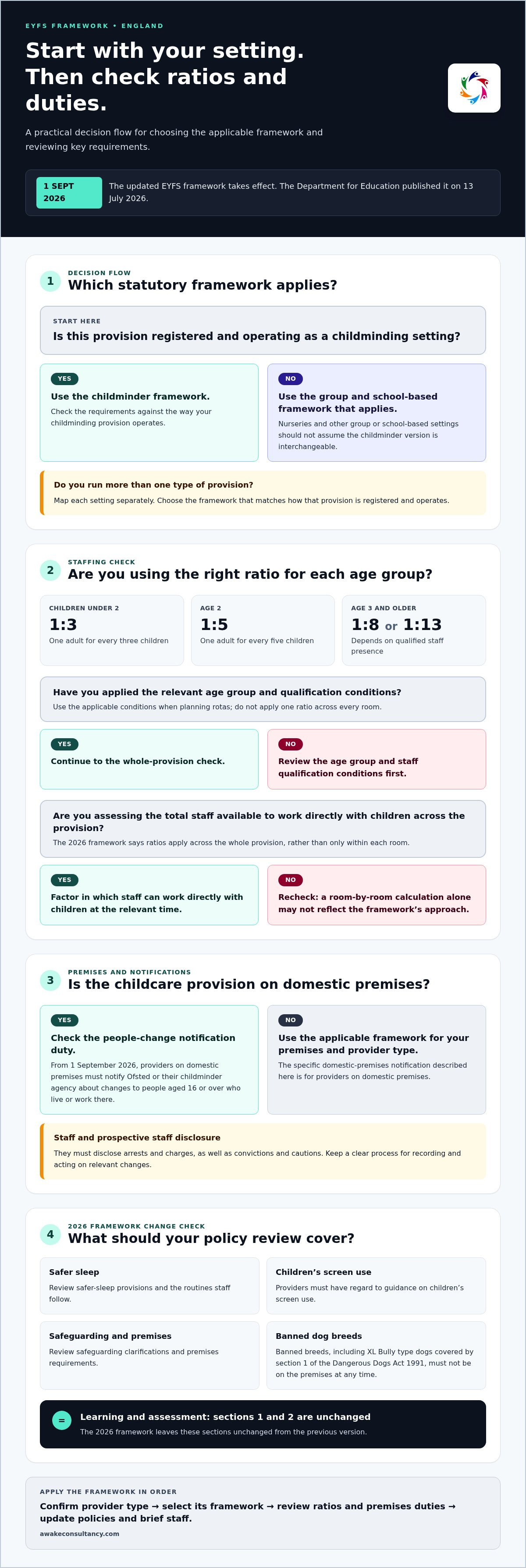
The EYFS updates for nursery providers in England take effect from 1 September 2026, with separate statutory frameworks for childminders and group and school-based providers. The changes include safer-sleep provisions, a requirement to have regard to guidance on children’s screen use, and safeguarding clarifications. According to the Department for Education, the latest framework was published on 13 July 2026.
Keeping track of EYFS updates for nursery providers is only part of the task. Providers also need to know which framework applies to their setting and how its requirements translate into everyday practice. This guide explains the framework’s versions, how they differ by provider type and the responsibilities that shape nursery operations.
It also highlights changes involving safeguarding, supervision and safer recruitment. Use the overview to locate and apply requirements, then review your policies, staffing arrangements and routines against what the current framework expects.
Key Takeaways
- Identify which statutory framework applies to your setting before reviewing policies and practice.
- Trace the main framework changes over time to understand what has changed and what remains in place.
- Use the requirements on learning, assessment and screen use to guide consistent decisions in everyday provision.
- Review staffing, safeguarding and safer recruitment arrangements against the current duties for your provider type.
- Turn the requirements into practical actions for your team, policies and routines rather than treating them as paperwork alone.
How has the EYFS statutory framework changed over time?
The EYFS statutory framework sets requirements for early years provision in England. Introduced in 2008, it replaced Birth to Three Matters, the Foundation Stage and national standards for daycare. Its purpose is consistent, but the detailed requirements have developed through successive revisions.
The September 2021 update changed expectations for learning and assessment. It overhauled the Early Learning Goals and made the Reception Baseline Assessment statutory. For nursery providers, this marked a substantial change to the framework’s learning and assessment content, rather than a simple administrative revision.
A separate change took effect on 4 September 2023 for childminders in England. The statutory minimum ratio for two-year-olds changed from one adult for every four children to one adult for every five children. In specified cases, childminders could also care for more than three young children when caring for siblings of children already in their care, or their own child.
The framework’s structure changed in January 2024, when it was split into separate versions for childminders and group and school-based providers. This means settings must identify the version that matches their provider type, rather than relying on one shared document. In September 2025, safeguarding revisions addressed whistleblowing procedures, child absence monitoring, reference checks and paediatric first-aid requirements.
The 2026 EYFS framework is the version published by the Department for Education on 13 July 2026 and effective from 1 September 2026. Sections 1 and 2, covering learning and development and assessment, remain unchanged from the previous version. Other changes concern safer sleep, screen use, safeguarding and premises. According to the Department for Education, the framework prohibits banned dog breeds, including XL Bully type dogs covered by section 1 of the Dangerous Dogs Act 1991, from being on the premises at any time.
Household and staff notifications are duties to report specified changes or disclosures under the applicable framework. From 1 September 2026, childcare providers on domestic premises must notify Ofsted or their childminder agency about changes to people aged 16 or over who live or work there. Staff and prospective staff must disclose arrests and charges, as well as convictions and cautions. These requirements make it important to review how the setting records and acts on relevant changes.
Review policies and procedures covering safer sleep, screen use, safeguarding, staff disclosures and relevant premises notifications. Update parents about revised routines that affect children, including changes to how staff manage screen use or safer sleep.
To implement the changes, identify the correct provider framework, compare it with current policies, then assign responsibility for each revision. Complete that review ahead of 1 September 2026, when the 2026 framework takes effect, and brief staff on updated procedures before applying them.
EYFS framework versions for childminders and group and school-based providers
A provider-type framework is the statutory EYFS version for a particular kind of provision. In England, childminders use the childminder framework, while nurseries and other group or school-based settings use their applicable version. Choose the framework that matches how your provision is registered and operates, not simply the one that seems closest to your daily routines.
The distinction matters because each version addresses a different operating context. A childminder’s provision is not structured like a nursery with several rooms, a staff team and children attending across the setting. Group and school-based providers should use their applicable framework when reviewing staffing, policies and records. A school-based early years provision should not assume that the childminder version is interchangeable with its own.
First, identify your provider type and the framework that applies. Use that version to guide policies, staff guidance and operational decisions. If your organisation runs more than one type of provision, map each setting separately. This helps managers avoid applying procedures from one context to another, particularly when staffing arrangements or premises differ.
Staff-to-child ratios set the minimum number of adults required in relation to children’s ages and staff qualifications. The EYFS ratios are 1:3 for children under 2, 1:5 for age 2, and 1:8 or 1:13 for age 3 and older, depending on qualified staff presence. Managers should use the relevant age group and qualification conditions when building rotas, not apply one ratio across every room.
The 2026 framework states that ratios apply to the total number of staff available to work directly with children across the whole provision, rather than only within each room. This means a manager should consider the staffing available across the setting when assessing ratios. For example, a room-by-room calculation alone may not reflect the framework’s stated approach. Planning still needs to account for which staff can work directly with children at the relevant time.
Childcare on domestic premises is provision delivered on domestic premises, and its framework includes a notification duty. Providers on domestic premises should keep relevant changes to people living or working there under review and check their applicable framework for any notification duties. Establish a clear process to record relevant changes and ensure the responsible person makes the required notification.
Use a short implementation sequence: confirm the provider type, select its applicable framework, then review ratios and premises-related procedures against that version. Record who monitors staffing arrangements and who handles notifications, so responsibilities are clear in practice. A focused nursery business support review can help leaders connect these operational requirements with their setting’s wider planning.
Framework requirements and provider responsibilities
The EYFS framework sets statutory standards for early years providers caring for children from birth to age 5. The 2026 version connects those standards to practical decisions about learning, safety, assessment and daily care.
A provider responsibility is an action or standard required by the framework. Providers need to put relevant requirements into practice, not just keep a copy of the document. Managers can assign policy ownership, brief staff on procedures and review whether daily routines follow them.
Screen-use guidance is formal advice that providers must have regard to when making decisions about screens. According to the Department for Education, paragraph 3.94 of the 2026 EYFS framework requires providers to have regard to formal guidance on children’s screen use in early years settings. The guidance advises avoiding screen time for children under 2, except in exceptional circumstances such as video calls with parents. For children aged 2 to 5, it recommends a maximum of an hour a day, and less where possible. It also advises that children should not use screens alone.
Paediatric first-aid requirements are the framework’s provisions for first aid arrangements when children go on outings. The 2026 framework cross-refers to these requirements, so providers should include outings in their planning rather than treating first aid arrangements as relevant only inside the setting. A practical review can identify who is responsible, how arrangements are recorded and how staff receive relevant instructions.
Inspection and Compliance Effects
Inspection and compliance involve checking whether the provider meets EYFS requirements in practice. During an Ofsted inspection, screen use may be considered alongside written guidance and daily routines. Managers should be able to explain how the setting has considered formal screen-use guidance and how staff apply its approach. Comparing policies with observed practice helps identify gaps before they become established routines.
Non-Compliance Risks and Penalties
Non-compliance is a failure to meet a requirement that applies to the provider. If a setting ignores the screen-use guidance, for example, its stated policy may not reflect the approach required by paragraph 3.94. The operational risk is a gap between written procedures and what staff do. The framework facts set out here do not establish a specific penalty, so providers should focus on meeting each applicable duty and keeping practice consistent.
To put requirements into practice, identify the relevant policy, assign an owner and brief staff on expectations. Review everyday examples, such as screen use during a planned activity or first-aid arrangements for an outing. Record changes clearly and revisit them when procedures or the applicable framework change.
Which EYFS requirements have changed for group and school-based providers?
The group and school-based framework is the statutory EYFS version for nurseries and comparable provision. Use it to review setting-wide procedures, staff guidance and routines. Do not rely on a childminder framework or an outdated copy.
The 2026 framework keeps Sections 1 and 2, covering learning and development and assessment, unchanged from the previous version. The revisions therefore do not require providers to treat every part of the framework as new. A practical first step is to compare the applicable 2026 document with existing procedures, separating unchanged requirements from amended or clarified ones.
Screen-use expectations are requirements and guidance that shape how settings manage children’s access to screens. The 2026 framework requires providers to have regard to formal guidance on screen use. For a group setting, leaders can translate this into clear staff instructions: identify when screens may be used, consider the activity’s purpose and ensure practice reflects the guidance. Parent communications can explain the setting’s approach, particularly where families ask about screen use.
Safer-sleep provisions are framework requirements concerning sleep arrangements and practice. The 2026 version includes updates on safer sleep, so providers should review the written procedure alongside the routines staff follow. A useful review traces the process from preparing a sleep space to supervising and recording relevant practice. Staff need clear, consistent instructions, rather than separate interpretations in different rooms.
Staff disclosure requirements concern information that staff and prospective staff must provide. From September 2026, the framework requires disclosure of arrests and charges, as well as convictions and cautions. Providers should review recruitment and staff-record procedures so they explain who receives disclosures, how relevant information is recorded and how it is handled. Clear processes help managers apply the requirement consistently to current and prospective staff.
The framework also refers to paediatric first-aid requirements for outings with children. Include trips in operational planning and make sure staff understand the relevant arrangements before leaving the setting. For example, an outing plan can name who is responsible for first-aid arrangements and explain how that information is shared with accompanying staff.
Implementation is the process of converting framework changes into working procedures. Start with the group and school-based version effective from 1 September 2026, then assign each relevant change to a policy owner. Review the wording, brief staff and check that actual routines match the revised procedure. For a multi-room nursery, leaders can compare practice across rooms to identify inconsistent interpretations and address them through shared guidance.
What safeguarding, supervision, and safer recruitment changes affect nurseries?
Safeguarding is the process of protecting children from harm and responding to concerns. EYFS revisions affect how nurseries manage concerns, monitor children’s attendance and assess prospective staff. For managers, the practical task is to connect each requirement with a clear procedure, a responsible person and consistent staff practice. The relevant changes span updates introduced in September 2025 and requirements in the framework effective from September 2026.
The September 2025 safeguarding updates covered whistleblowing procedures, child absence monitoring, reference checks and paediatric first-aid requirements. Whistleblowing procedures explain how staff raise concerns about unsafe practice. Child absence monitoring concerns how the setting notices and follows up a child’s absence. Review each procedure, make responsibilities clear and ensure staff know how to raise or record a concern.
Safer recruitment is the process of checking suitability and managing relevant information before someone works with children. From September 2026, the framework requires relevant volunteers and workers to have an enhanced DBS and barred list check completed before they start. Staff and prospective staff must also disclose arrests and charges, as well as convictions and cautions. Recruitment procedures should explain how these requirements are handled.
A volunteer exception is a limited exemption from the stated DBS check requirement. In England, volunteers helping for fewer than three days in a 30-day period are exempt only if they do not provide overnight care or personal care. The exception depends on both the frequency of volunteering and the duties involved. Record the role and arrangements so the setting can apply the relevant conditions consistently.
Supervision includes the systems used to oversee children’s safety and staff practice. Child absence monitoring was included in the September 2025 safeguarding updates, so attendance procedures should enable staff to identify and follow up absences. Review who records attendance, who responds to an unexplained absence and how relevant information reaches the responsible person. Clear steps reduce the risk of gaps between records and action.
Allegation notification is the duty to inform Ofsted about allegations of harm or abuse. From September 2026, the framework requires providers to notify Ofsted of allegations of harm or abuse, removing the previous qualifier that the harm be serious. Ensure the procedure does not retain that former limitation. Staff should understand how to escalate an allegation promptly through the setting’s established process.
Staff training helps build consistent safeguarding practice across a nursery. The Department for Education and the NSPCC developed free online safeguarding training for early years educators. Providers can use it alongside setting-specific procedures, helping staff understand both general safeguarding principles and local reporting arrangements. Review training, recruitment records, absence procedures and the allegation process together, then address gaps through clear ownership and staff communication.
For practical help reviewing recruitment procedures, explore recruitment support for early years settings.
Awake Early Years Consultancy: Early Years Consultancy
Awake Early Years Consultancy helps settings review practice and strengthen leadership. Consultancy can be a practical next step when your team identifies gaps between EYFS requirements, written procedures and everyday routines.
Use consultancy support to assess how changes affect your setting and set clear action priorities. Recruitment Support can help review recruitment processes, while Practitioner Training & Development supports staff in applying updated procedures. Ofsted Preparation & Mock Inspections can help you assess readiness and identify areas for further work.
Choose support that addresses the issue your setting needs to resolve, whether it is policy implementation, staff understanding or inspection preparation. Contact Awake to discuss a clear proposal tailored to your nursery’s needs.
Make the next review part of everyday practice
Treat EYFS updates for nursery providers as a prompt to turn requirements into consistent practice. Make responsibilities clear: decide who maintains procedures, who supports staff understanding and how leaders identify when practice needs attention. This keeps written expectations connected to decisions made across the setting.
Build a regular review habit rather than waiting for a policy revision to reveal a gap. Encourage staff to raise practical questions, consider whether procedures work in real situations and agree what needs to change. This supports thoughtful improvement without adding unnecessary complexity to daily operations.
If you would value an external perspective on the next steps for your setting, contact Awake Early Years Consultancy to discuss your priorities. A clear starting point can help your team move forward with purpose and confidence.
Frequently Asked Questions
Want to stay up to date with all nursery requirements?
Set a regular review routine: identify the framework that applies to your setting, note relevant changes and assign someone to review procedures. Keeping up with EYFS updates for nursery providers also means considering each change’s effect on staff practice, records and communication with families. A simple change log can record the requirement, the procedure it affects and the action taken, giving managers and staff a shared reference point.
What are the latest EYFS framework updates for nursery providers in England?
The latest EYFS updates for nursery providers in England include changes affecting safer sleep, screen use, staff disclosures, allegations and premises. The 2026 framework leaves learning and development and assessment sections unchanged from the previous version. To organise a review, group each relevant change by operational area, such as recruitment, safeguarding or daily routines. This helps staff focus on the procedures and responsibilities that need attention.
When do the latest EYFS changes take effect?
The 2026 EYFS statutory frameworks take effect from 1 September 2026. The Department for Education published the latest framework on 13 July 2026, giving providers an opportunity to review the relevant version before its start date. Plan the review in sequence: identify the framework for your provider type, assign responsibility for relevant changes, then brief staff before the new version applies. This makes implementation part of operational planning.
What are the updated staff-to-child ratios and qualification requirements?
The stated ratios are 1:3 for children under 2, 1:5 for age 2, and 1:8 or 1:13 for age 3 and older, depending on qualified staff presence. The framework applies ratios to staff available to work directly with children across the whole provision. When preparing a rota, consider children’s age groups, staff qualifications and who is available for direct work. These factors help managers assess staffing arrangements against the relevant ratio.
What are the updated attendance, record-keeping, and information-sharing requirements?
Safeguarding updates introduced in September 2025 covered child absence monitoring, while the 2026 framework adds a notification duty for childcare on domestic premises. From 1 September 2026, providers must notify Ofsted or their childminder agency about changes to people aged 16 or over who live or work there. Set out who records absences, follows them up and manages relevant notifications. Clear responsibilities help staff handle information consistently.


