

Handle a difficult nursery complaint by staying composed, listening without interrupting, clarifying the concern and agreeing practical next steps. A written procedure gives staff and families a clear process: UK Government guidance requires providers to have a written procedure for handling parents’ and carers’ concerns and complaints. Knowing how to handle difficult parent complaints in a nursery means addressing the issue fairly, without reacting defensively or making assumptions.
It’s understandable to feel under pressure when a parent is upset, particularly when the concern involves their child’s safety, wellbeing or progress. A calm response can keep the conversation constructive and help the family feel their concern is being taken seriously.
This guide explains how to listen carefully, ask open questions, respond honestly and agree a shared action plan. It also covers common reasons parents complain, helping you look beyond the tension of the conversation and focus on what needs to happen next.
Key Takeaways
- Pause, listen without interrupting and acknowledge the parent’s perspective before discussing possible solutions.
- Use open questions to clarify what happened, what matters most to the family and what they hope will change.
- Respond honestly and focus on specific facts rather than blame, labels or defensive explanations.
- Agree practical actions, responsibilities and a follow-up, then recap the plan in writing.
- Address recurring concerns by looking for patterns in communication, safety, wellbeing, policies and children’s progress.
Staying calm: How do you respond when a parent is upset?
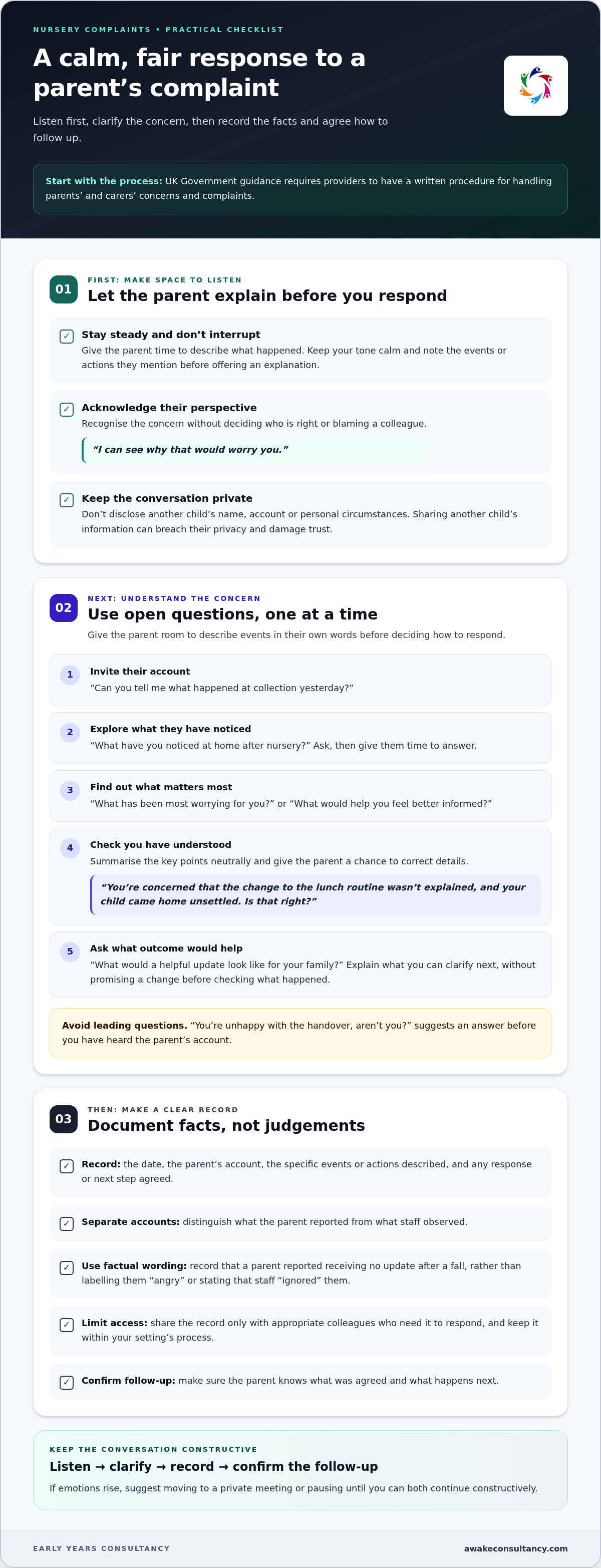
Listen without interrupting, acknowledge the concern, then agree how you’ll establish the facts and respond. UK Government guidance requires providers to have a written procedure for handling parents’ and carers’ concerns and complaints. Keep the conversation private: sharing another child’s information can breach their privacy and damage trust.
-
Listen without defensiveness
Give the parent space to explain before offering an explanation. If they describe a playground incident, avoid interrupting with reasons staff may have acted as they did. Keep your tone steady, let them finish and note the actions or events they mention.
Listen for the concern beneath the detail. A parent who says, “Nobody tells me what happens at pick-up,” may be worried about their child’s wellbeing, not just the handover routine. Acknowledge their feelings without deciding who is right: “I can see why that would worry you.” Avoid blaming a colleague or correcting the parent before you understand their account.
-
Respond with curiosity and empathy
Ask a calm, open question to understand the parent’s perspective. For example, “Can you talk me through what happened from your point of view?” invites more detail than “You’re not happy with the handover, are you?” Follow up to clarify what they saw, when it happened and what they expected.
Reflect the key point back: “You expected an update about the fall before collection, and you didn’t receive one. Have I understood?” This active listening can clear up misunderstandings before they shape your response. Thank the parent for raising the issue, even if you need to check information before answering. If emotions rise, suggest moving to a private meeting or pausing until you can both continue constructively.
-
Document the complaint
Record the concern in line with your setting’s written procedure. Note the date, the parent’s account, the specific events or actions they described, and any response or next step agreed. Distinguish what the parent reported from what staff observed to keep the record factual rather than judgemental.
For example, record that a parent reported receiving no update after their child fell, rather than labelling them “angry” or stating that staff “ignored” them. Share the record only with appropriate colleagues who need it to respond. Don’t disclose another child’s name, account or personal circumstances when explaining what happened. Confirm the agreed follow-up with the parent and keep the record within your setting’s process.
Asking open-ended questions
Use open questions to understand the parent’s experience before deciding how to respond. Asking about a specific nursery situation can uncover details that a yes-or-no question might miss.
- Start with a question that invites the parent to describe events in their own words. For example, “Can you tell me what happened at collection yesterday?” gives them room to explain and identify what matters most. Avoid opening with “You’re unhappy with the handover, aren’t you?” It suggests an answer and may increase frustration before you understand the concern.
- Ask one question at a time, then give the parent space to answer. If they’re concerned about their child settling, try, “What have you noticed at home after nursery?” Their response may reveal a pattern, such as difficulty sleeping after a change in routine. Don’t rush to fill a pause or suggest strategies before hearing the full account.
- Explore the impact of the issue, not just the event. Ask, “What has been most worrying for you?” or “What would help you feel better informed?” These questions recognise emotions without assuming what the parent feels. A parent frustrated about daily updates may be looking for a clear communication routine, rather than criticising an individual staff member.
- Check your understanding by summarising the parent’s key points neutrally. For example, “You’re concerned that the change to the lunch routine wasn’t explained, and your child came home unsettled. Is that right?” This gives the parent a chance to correct details and separates what they observed from what they believe caused it, helping staff explore the concern fairly.
- Finish by asking what outcome the parent hopes for, then explain what you can clarify next. “What would a helpful update look like for your family?” can lead to a practical agreement, such as discussing the child’s day at pick-up. Keep your response positive but realistic: don’t promise a change before checking what happened. A review of your setting’s communication approach can help staff use these strategies consistently.
Open-ended questions help educators understand a family’s perspective. Repeat the key points to check that everyone understands one another. This keeps the conversation focused on the family’s account and gives them a chance to clarify anything that has been misunderstood.
Avoiding defensive responses
Keep your language factual and respectful, even when a parent questions your judgement. Taking responsibility where appropriate keeps the discussion focused on the child and on what can be learned to improve practice.
- Pause before replying to criticism, especially if it names a staff member or a decision you made. Take a breath and identify the specific concern before speaking. If a parent says, “You never tell me anything,” avoid answering, “That’s not true.” Ask which update they expected and explain how you’ll look into that example.
- Separate the parent’s experience from your intention. You may have followed the usual handover routine, but the family may still have felt uninformed. Say, “I understand that you didn’t receive the information you needed,” rather than, “We were only following procedure.” This acknowledges the impact without claiming facts you haven’t checked.
- Be honest about what you know and what still needs reviewing. If a parent raises a concern about a playground incident, don’t guess or hide relevant information. Explain which details you can share, what you’ll check with the staff involved and when you’ll return with a clearer response.
- Take responsibility and apologise when the setting’s actions have caused an avoidable problem. For example, if a promised update was missed, say, “We didn’t send the update we agreed, and I’m sorry.” Avoid adding “but” straight afterwards. A qualification can make the apology sound defensive rather than like a direct acknowledgement.
- Focus on observable actions, not personal labels. If a parent says a practitioner was “careless”, don’t defend or condemn that colleague before reviewing what happened. Ask what the parent saw, record the specific concern and explain how the setting will consider it. This helps keep the process fair to everyone involved.
- If you disagree with part of the account, explain your understanding calmly and invite correction. For example, “Our record says the conversation happened at collection, but you remember it differently. Let’s clarify the timing.” Don’t argue over every detail or use dismissive language. A respectful exchange makes it easier to discuss learning and practical changes.
Creating a shared action plan
Turn the conversation into a clear agreement that addresses the problem and supports the child. Set out who will act, what happens next and how the family will receive updates.
-
Agree a shared action plan
Agree on the goal with the parent before assigning actions. If a family is concerned about daily handovers, for example, the goal might be clearer information about their child’s day. Set out what the nursery will do, what the parent can contribute and how you’ll recognise progress. Keep each action practical and within the person’s control.
Check that the plan addresses the parent’s concern rather than simply defending the existing routine. If the issue involves a child’s behaviour, describe the support staff will provide and invite the family to share relevant observations from home. Avoid promising an outcome. Instead, agree on specific actions and how you’ll review them.
- Before the meeting ends, write down responsibilities and timing. For example, a key person might share a brief update at collection, while the parent notes whether the same concern appears at home. Clarify who will coordinate the actions and who should receive updates. A plan works better when families and staff understand their respective roles.
-
Set a response timeframe and follow up
Tell the parent when they can expect your next response, even if you’re still gathering information. Teachers should follow up with parents by phone or email within 24-48 hours after they raise a concern. Explain what you’ve established, what remains under review and the next contact point.
Use follow-up to check whether agreed actions are helping the child, not just to close the conversation. For a behaviour support plan, arrange another discussion to review what has changed. If progress is unclear, adjust the actions with the family and agree a further review point.
- Send a written summary after the meeting. Include the shared goal, each action, the person responsible and the agreed follow-up details. For example, confirm that staff will provide an update at collection and that the parent will share relevant changes noticed at home. A written record helps prevent different understandings of the agreement.
- Share progress in a way that suits the concern and the family. If a parent prefers a brief phone call, agree on that approach rather than relying on an update they may miss. Record whether the action was completed and what the family reports. If the plan isn’t working, discuss the specific difficulty and revise the next step together.
Common causes of nursery parent complaints
Parents commonly raise concerns about children’s progress, discipline, communication, setting policies, safety and wellbeing. For a U.S. nursery, maintain a written complaint procedure and train staff to listen, record concerns and escalate appropriately. According to the UK Government, providers must have a written procedure for handling parents’ and carers’ concerns and complaints. Escalate to the director or owner when attempts to resolve a conflict have failed, the issue exceeds your authority, or it involves unethical conduct. For safety, injury or suspected neglect concerns, prioritise the child’s immediate wellbeing, record reported facts and follow the setting’s safeguarding and reporting procedures.
- Check communication and handover routines. A parent may complain because they hear about a bump only at collection or receive different accounts from staff. Review what information was shared, when it was shared and who was responsible. A recurring gap may point to an unclear handover process, not just a difficult conversation.
- Clarify concerns about safety and wellbeing. Ask what the parent observed, when it happened and what they were told. If a child has an injury, follow the setting’s procedure for care, recording and informing the family. Keep accounts factual, protect other children’s confidential information and involve the designated lead if the concern suggests immediate risk or possible neglect.
- Explore concerns about progress or behaviour. Parents may be worried about a child’s development, friendships or how staff respond to challenging behaviour. Use specific observations, such as a change during settling or a pattern at mealtimes, rather than labels. Invite the family to share what they notice at home, then agree how nursery and family observations will inform next steps.
- Explain policies through examples. Disagreements may involve fees, attendance, collection arrangements or how a policy is applied. Refer to the relevant written policy and explain how it applies to the situation. If staff give inconsistent explanations, review the wording and make sure the team understands the process before responding to families.
- Build staff capability and escalate fairly. Practise complaint conversations through staff training: role-play a parent questioning a playground incident, then review whether the response stayed calm, factual and respectful. A director should take over when the matter remains unresolved or exceeds a practitioner’s authority. Strengthen staff complaint-handling practice with structured practitioner development.
Awake Early Years Consultancy: Early Years Consultancy
Awake Early Years Consultancy provides Early Years Consultancy for settings seeking to strengthen leadership, practice and day-to-day complaint handling. Turn to this support when parent concerns recur, staff responses vary or your approach needs a more consistent structure. Advice can help you review how concerns are received, recorded and resolved, then identify practical improvements suited to your setting.
When staff need support with challenging conversations, Practitioner Training & Development can build confidence in listening, responding and following agreed procedures. Ofsted Preparation & Mock Inspections can also help settings review how well their processes are embedded in practice.
For tailored support with your nursery’s approach, contact Awake Early Years Consultancy.
Build a more consistent approach from here
How a nursery responds to concerns can shape whether families feel able to raise issues early. Make the next step a team conversation: identify where staff need clearer guidance, practise realistic scenarios and review whether agreed actions are followed through. A consistent approach to how to handle difficult parent complaints in a nursery can strengthen trust while keeping children’s needs central.
Awake Early Years Consultancy supports settings through Early Years Consultancy and Practitioner Training & Development. Recruitment Support can also help nurseries strengthen their teams, an important foundation for consistent communication with families.
Choose one improvement to put into practice, then discuss how it is working with your team. For tailored support, contact Awake Early Years Consultancy. Clear processes develop through steady practice, and each constructive conversation can help your setting build stronger partnerships with families.
Frequently Asked Questions
Asking for the family’s perspective: Why does it matter?
It helps staff understand what the family has observed and what outcome they need. A parent may describe a child refusing to enter nursery, while staff see them settle shortly after drop-off. Both accounts matter. Ask what happens before and after the difficult moment, then compare observations respectfully. This can reveal a transition issue that neither the parent nor practitioner could identify from one perspective alone.
How do you start a difficult conversation with a family in child care?
Open by explaining why you’re meeting and inviting the family’s account. You might say, “I’d like us to discuss what happened at lunch and understand your concerns.” Choose a private setting, use plain language and avoid opening with a judgement about the child or parent. If you need to raise an observation, describe the specific incident first, then ask what the family has noticed at home.
In-person meetings: When is one needed for difficult parent conversations?
Arrange an in-person meeting or video call when a sensitive issue depends on tone, context or detailed discussion. A concern about a child’s safety, repeated distress at drop-off or disagreement about staff conduct can be difficult to resolve through brief messages. Meet privately, include the appropriate staff member and prepare relevant records. Use written communication for a clear recap, not as a substitute for a conversation that needs discussion.
What should you do if a family becomes angry during a meeting?
Stay composed, lower your voice and avoid matching the parent’s volume. If the discussion becomes difficult to continue, suggest a pause or moving to a private space. You could say, “I want to understand this properly. Shall we take a moment, then continue?” If anyone feels unsafe, end the meeting and follow the setting’s procedure. Record what happened and involve a manager where needed.
What are the best steps for responding to a difficult parent complaint in a nursery?
To handle difficult parent complaints in a nursery, first identify the exact issue and any immediate concern for the child. Ask for the family’s perspective, establish which staff or records can clarify events, then decide who should respond. Keep the family informed about the next stage, even while the review is ongoing. Once the matter is resolved, consider whether a routine, handover or staff practice needs to change.
What should nursery staff say when a parent is angry or confrontational?
Use calm, direct wording that acknowledges the concern without accepting unverified claims. For example: “I can hear how concerned you are. I’d like to understand what happened and look into it.” If the parent makes a personal accusation, bring the exchange back to the specific event: “Let’s focus on what you noticed at collection.” Avoid sarcasm, blame or promises about what the review will find.
What are common causes of parent complaints in nurseries, and how should each be handled?
Concerns often involve communication, safety, wellbeing, children’s progress, discipline or nursery policies. For missed updates, review how information is shared; for an injury, follow the setting’s recording and safeguarding procedures. When parents question progress or behaviour, discuss observable examples rather than labels. If a policy causes confusion, explain how it applies to the situation and check that staff communicate it consistently.


