

A name on a public record does not, by itself, explain what a nominee may do. In a nominated person consultancy arrangement, the agreement between the business owner and nominee usually sets out the nominee’s authority and obligations. It may require them to follow instructions, vote as directed or pass profits to the owner. The nominee represents the owner on public documents using their name and information.
The distinction between representing an owner and controlling a business matters. If the agreement leaves authority unclear, a disagreement can be costly to resolve. If a nominee dies or disappears, the owner may also have to deal with the nominee’s heirs.
This article explains what a nominee agreement can cover, how it can define authority and responsibilities, and where disputes or misconduct create risks. It also clarifies who may act as a nominee, helping you assess the practical implications before relying on the arrangement.
Key Takeaways
- Define the nominee’s authority, instructions and obligations in a written agreement, rather than relying on an informal understanding.
- Consider how the arrangement would work if the nominee acts against the owner’s interests, becomes unavailable or dies.
- Assess a potential nominee’s judgement, reliability and understanding of the responsibilities they are taking on.
- Distinguish a nominee’s role from the separate responsibilities of a director, consultant and beneficial owner.
- For early-years settings, seek consultancy support when you need to strengthen practice, leadership or readiness for inspection.
Contracts and nominee authority
A nominee arrangement is usually governed by an agreement between the business owner and nominee. It can define what the nominee may do, which instructions they must follow and how the arrangement ends.
Role distinctions
A nominated person’s role depends on the authority granted by the arrangement, not the title alone. A director holds a formal business role; a consultant provides advice or services; a beneficial owner holds an economic interest. These roles can overlap, but they are not interchangeable. For example, appearing by name on a public document does not, by itself, establish beneficial ownership.
Nominee eligibility
A nominee may be a family member, friend, lawyer or representative of a nominee services company. Their category alone does not establish suitability for a particular arrangement. Consider whether they understand the proposed duties, can follow agreed instructions and will communicate reliably. A family member may know the owner’s priorities, while a lawyer may bring relevant professional understanding.
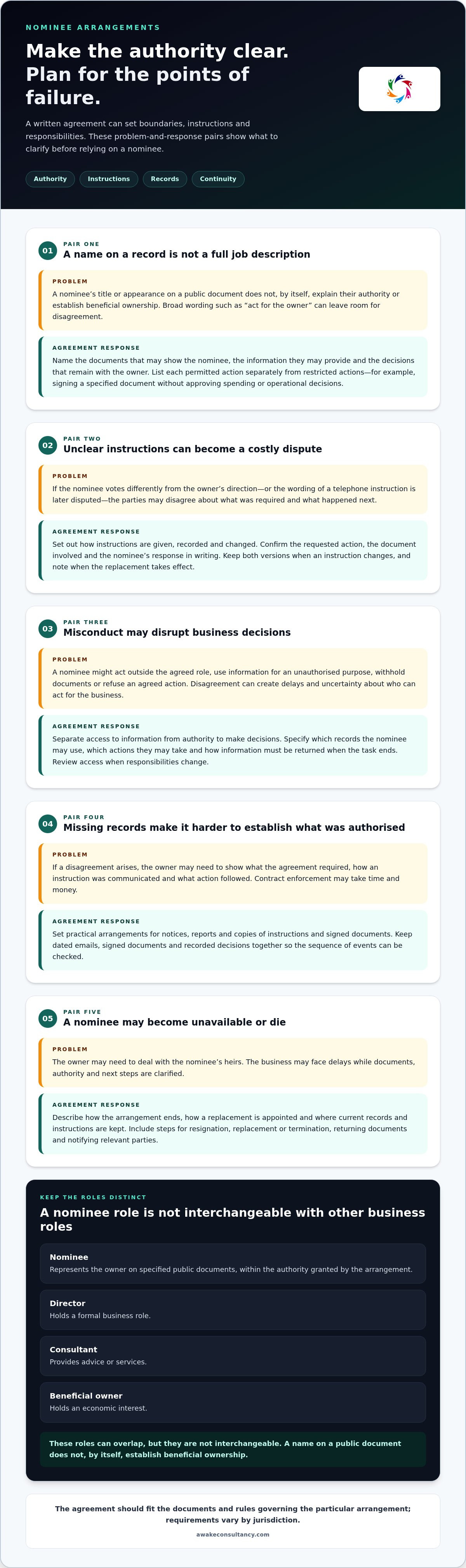
A nominated person consultancy agreement should identify the parties and define the arrangement’s scope. It can clarify which documents may name the nominee, what information they may provide and which decisions remain with the owner. Clear boundaries help prevent a name on a record from being mistaken for broader authority to manage the business.
Set out instructions in practical terms. The agreement may require the nominee to vote as directed or pass profits to the owner. It should explain how instructions are given, recorded and changed, and what happens if the nominee believes a request falls outside their agreed role. A written process gives both parties a reference point when circumstances change.
Separate permitted actions from restricted ones. For example, an agreement might allow a nominee to sign a specified document but not approve spending or make operational decisions. Listing each permission is clearer than relying on broad phrases such as “act for the owner”. The owner and nominee can then compare a proposed action with the agreed authority.
Set practical arrangements for communication and record-keeping. Specify where notices should be sent, how the nominee reports completed actions and how each party keeps copies of instructions and signed documents. These details can help establish what was authorised if a disagreement arises. Review the terms when the business, documents or nominee’s responsibilities change.
Finally, describe how the arrangement ends and how records are updated afterwards. Set out the steps for resignation, replacement or termination, including returning documents and notifying relevant parties. Explain how unresolved disagreements will be handled. Requirements vary by jurisdiction, so the agreement must fit the documents and rules governing the particular arrangement.
Risks of disputes and nominee misconduct
A nominee dispute arises when the owner and nominee disagree about authority, instructions or obligations. Misconduct occurs when a nominee acts against the owner’s interests or outside the agreed role. Practical risks include enforcement costs, delays and uncertainty about who can act for the business.
Disagreement and enforcement
Contract enforcement means asking a court to uphold an agreement. If a nominee acts against the owner’s interests, the owner may need to go to court to enforce the contract. This can take time and money while a disputed document or decision remains unresolved.
Consider a nominee who votes differently from the owner’s instruction. The owner may need to show what the agreement required, how the instruction was communicated and what action followed. Dated emails, signed documents and recorded decisions can help establish the sequence. Keeping those records together makes it easier to pinpoint the disagreement.
Disputes can also arise from unclear or changing directions. An owner might give an instruction by telephone and later dispute its wording. Written confirmation can reduce ambiguity: record the requested action, the document involved and the nominee’s response. If an instruction changes, preserve both versions and note when the replacement took effect.
Misconduct and practical exposure
Nominee misconduct is conduct that conflicts with the authority or duties agreed between nominee and owner. A nominee might use information for an unauthorised purpose, withhold documents or refuse an agreed action. Such conduct can disrupt decisions even before the owner establishes whether it breaches the contract.
Separate access from authority. A nominee who receives business records to complete a defined task does not automatically need broader access or decision-making power. List the records they may use, the actions they may take and how they must return information when the task ends. Review access when responsibilities change.
Death or disappearance
Succession risk is the difficulty an owner faces if a nominee dies or cannot be contacted. The owner may then have to deal with the nominee’s heirs, and the business may face delays while documents, authority and next steps are clarified.
Plan for that possibility in the arrangement. Identify a process for ending the role, appointing a replacement and locating records. Keep current copies of relevant documents and instructions in an accessible business file. A nominated person consultancy review can help an early-years setting clarify responsibilities; explore specialist nominee support.
Who can be nominated as a person for a consultancy business?
A nominee is a person named to represent a business owner on specified public documents. A consultancy business may nominate a family member, friend, lawyer or person provided by a nominee services company. The right choice depends on the role involved, the information shared and the nominee’s ability to carry out agreed responsibilities.
Family member or friend
A family member or friend already has a personal relationship with the business owner. Familiarity may make communication straightforward, but it does not automatically make the person suitable for a formal role. An owner might consider whether a sibling understands the documents, can keep business information confidential and will follow agreed instructions. Personal trust and practical capability are separate considerations.
Lawyer
A lawyer is a legal professional who may be nominated to represent an owner in an arrangement. Their professional background can help them understand formal documents and communicate precisely. However, the proposed role still needs clear boundaries. Before naming a lawyer, identify the documents involved, the actions expected and any connection between the lawyer’s existing work and the nominee duties.
Nominee services company representative
A nominee services company representative is someone provided through a business offering nominee services. This arrangement may involve defined services rather than a personal relationship. Read the terms carefully: identify the individual who will be named, how instructions will be handled and what happens if that person leaves or becomes unavailable. The company name alone does not explain the individual’s authority.
Assessing a candidate
Eligibility and suitability are different questions. First, identify what the relevant document requires and what the nominee must do. Then assess each candidate against the actual responsibilities, rather than choosing solely because they are available or familiar.
- Understanding: Ask the candidate to explain the proposed role in their own words.
- Communication: Consider how they will receive instructions and report completed actions.
- Confidentiality: Clarify which business records or personal details they may see.
- Capacity: Establish whether they can carry out the expected tasks alongside other commitments.
- Continuity: Discuss how they would notify the owner if they could no longer act.
A friend who can handle documents but cannot reliably respond to instructions may not suit a role requiring regular communication. A lawyer may understand the paperwork but still need a clearly limited mandate. Compare candidates against the same duties, then record the chosen person’s responsibilities and limits in the agreement. This makes the decision reasoned, specific and easier to revisit if the business’s needs change.
What qualifications or experience must a nominated person have?
A qualification is a formal credential showing that someone has completed a course or assessment. The governing documents and applicable rules determine whether a particular credential is required. A nominee’s title alone does not establish a qualification standard. Before selecting someone, identify the documents involved, the authority they will exercise and any criteria attached to the appointment.
Relevant experience is practical knowledge that helps a nominee carry out agreed responsibilities. Its value depends on the task, not simply on seniority or time in business. Someone handling formal records, for example, should understand their purpose and how to follow written instructions. A person expected to assess specialist information needs experience relevant to that subject.
Start by matching each responsibility to a capability. If the nominee will sign or submit documents, assess whether they can identify the correct version and follow the required process. If they will communicate decisions, consider whether they can record instructions accurately and explain the action taken. A professional title may be relevant, but it does not replace evidence of competence for the specific duties.
A subject matter expert has specialist industry knowledge or a specific role and may be consulted for information or strategic input. That expertise can help when an appointment involves specialist material. Someone familiar with a technical report may understand its terminology, for instance, but that knowledge does not automatically give them authority to approve a business decision. Keep expertise and decision-making power distinct.
Use a structured assessment before appointment:
- Define the task: Write down the documents, decisions or communications involved.
- Identify required knowledge: Separate technical understanding from administrative ability.
- Review evidence: Discuss relevant work, training or professional responsibilities using examples.
- Test the process: Ask how the candidate would handle an unclear instruction or an incorrect document.
- Record limits: Specify which tasks require the owner’s approval.
A candidate may have strong finance experience but limited familiarity with a specialist filing process. The owner can identify the gap, provide clear procedures and restrict the nominee’s authority to tasks they can perform reliably. If the task requires independent judgement, relevant experience and sound reasoning matter more than familiarity with the owner.
Keep the assessment proportionate to the appointment. A nominee handling a narrow administrative task may need different capabilities from someone working with complex business documents. Record the selection rationale, training provided and any boundaries in the agreement, and review them when responsibilities change. This turns qualifications and experience into practical selection criteria, rather than assumptions based on a person’s relationship, title or confidence.
How does a nominated person differ from a director, consultant, or beneficial owner?
A nominated person may represent a business owner in certain documents. That role alone does not establish ownership, management authority or responsibility for business advice. Someone named on a document may have a limited role, while the owner retains control of decisions and economic interests.
A director is appointed to a formal management role within a company and makes decisions within the responsibilities attached to that position. A nominee, by contrast, may only represent an owner on public documents. If one person holds both roles, distinguish each capacity in the relevant records and agreements. A signature as director should not automatically be treated as an action taken as nominee.
A consultant is a professional engaged to advise or help an organisation with a defined business problem. Management consultants, for example, can help improve efficiency, performance and growth opportunities. Their work centres on advice or project delivery, not representing an owner on public records. A consultant might recommend a new process, but that does not make them a nominee or give them authority to implement it.
A beneficial owner is the person who ultimately owns or benefits economically from a business. A nominee may appear by name on public documents in place of that owner, but this does not itself transfer the underlying interest. A nominee’s name on a record alone does not show who receives profits or makes business decisions.
One individual can hold more than one role, so assess the capacity attached to each action. Someone might advise on a business project and also be named as a nominee. In that case, keep the consultancy engagement separate from the nominee agreement. Record what advice they provide, which documents they represent the owner on and which decisions remain with the owner.
Use these distinctions when reviewing a document or proposed appointment:
- Representation: Identify whether the person’s name appears for the owner on a public document.
- Management: Establish whether the person holds a director role and makes company decisions.
- Advice: Clarify whether their work is consultancy, such as analysing performance or recommending changes.
- Economic interest: Identify who owns or benefits from the business, rather than assuming the named person does.
For an early-years business, separating these roles can clarify who advises on operations, who manages the organisation and who appears on documents. Discuss nominated person responsibilities when you need specialist support to define those boundaries.
Awake Early Years Consultancy: Early Years Consultancy
Awake Early Years Consultancy provides Early Years Consultancy for settings seeking to strengthen practice, leadership and operational clarity. Turn to this support when nominee responsibilities sit alongside broader questions about organising and managing your early-years setting. Clarifying roles on paper matters, but sound leadership also depends on consistent practice across the setting.
Support can also include Practitioner Training & Development, Recruitment Support, and Ofsted Preparation & Mock Inspections. These services address different needs, from developing staff practice to preparing for inspection. The approach is practical: identify the issue, understand what needs attention and build a workable plan for the setting.
If you’d like to discuss your setting’s needs, contact Awake Early Years Consultancy.
Turn clear responsibilities into stronger practice
Use the decisions in this article as a starting point for reviewing how responsibilities work in your setting. A nominated person consultancy discussion can connect formal roles with day-to-day leadership, so agreements support consistent practice rather than sitting apart from it.
For an early-years organisation, consider how staff capability, recruitment and operational expectations fit together. Awake Early Years Consultancy offers Early Years Consultancy, Recruitment Support and Practitioner Training & Development. This support can help you examine the wider organisational context around a nominated person’s responsibilities and identify practical areas to strengthen.
Bring your questions and the challenges your setting is working through. Contact Awake Early Years Consultancy to discuss a constructive next step for your organisation.
Frequently Asked Questions
What does “nominated person” mean in a consultancy agreement?
In a consultancy agreement, a nominated person is someone named to perform a defined representative role for the business owner. The term does not, by itself, make that person a consultant or give them general management powers. An agreement might authorise someone to represent an owner on a specified record, while a separate consultancy engagement covers advice on business operations.
What are the responsibilities of a nominated person in a consultancy?
Responsibilities are the specific tasks assigned to the person, such as providing information, communicating an instruction or completing an agreed administrative action. Match each task with the required approval and record. For example, the nominee can acknowledge receipt of a document while the owner retains responsibility for approving its contents before submission.
How do you appoint or change a nominated person?
To appoint or replace a nominee, review the governing documents, agree the new person’s role and record the change through the relevant process. First identify which records refer to the current nominee. Then document the incoming nominee’s authority and responsibilities, end the outgoing person’s access and update affected business records. Keep copies of notices and approvals to maintain a clear administrative record.
What documents are required to nominate a person for a consultancy?
The required documents depend on the jurisdiction, business structure and purpose of the nomination. Records may include a written agreement describing the role, an authorisation from the owner and forms required for the relevant public record. A change to a company record, for example, may involve different paperwork from an internal consultancy appointment. Identify the specific record being changed before preparing documents.
What are the risks of using a nominee in a consultancy business?
Risks include confusion about who may approve actions, unauthorised access to confidential material and inconsistencies between internal records and public filings. Staff may mistake a named representative for the person who approves operational decisions. Reduce that risk by keeping authority records current, limiting access to information needed for the role and telling relevant staff who holds each decision-making responsibility.


