

A nursery can start with a strong idea and still face difficult decisions about how to make it work. Nursery start-up consultancy helps owners plan staffing, budgets, fees, financial management and enrolment before day-to-day pressures take hold. The aim is a practical business plan that supports both immediate needs and long-term sustainability.
Starting a childcare business means balancing quality care with the realities of running an organisation. Staffing plans affect costs, fees shape income, and enrolment depends on clear planning rather than hope alone.
This article explains how consultancy can support these connected decisions, what the process may involve and which factors shape the right approach. You’ll also find guidance on choosing a consultant and recognising when specialist support can help turn an early idea into a considered plan.
Key Takeaways
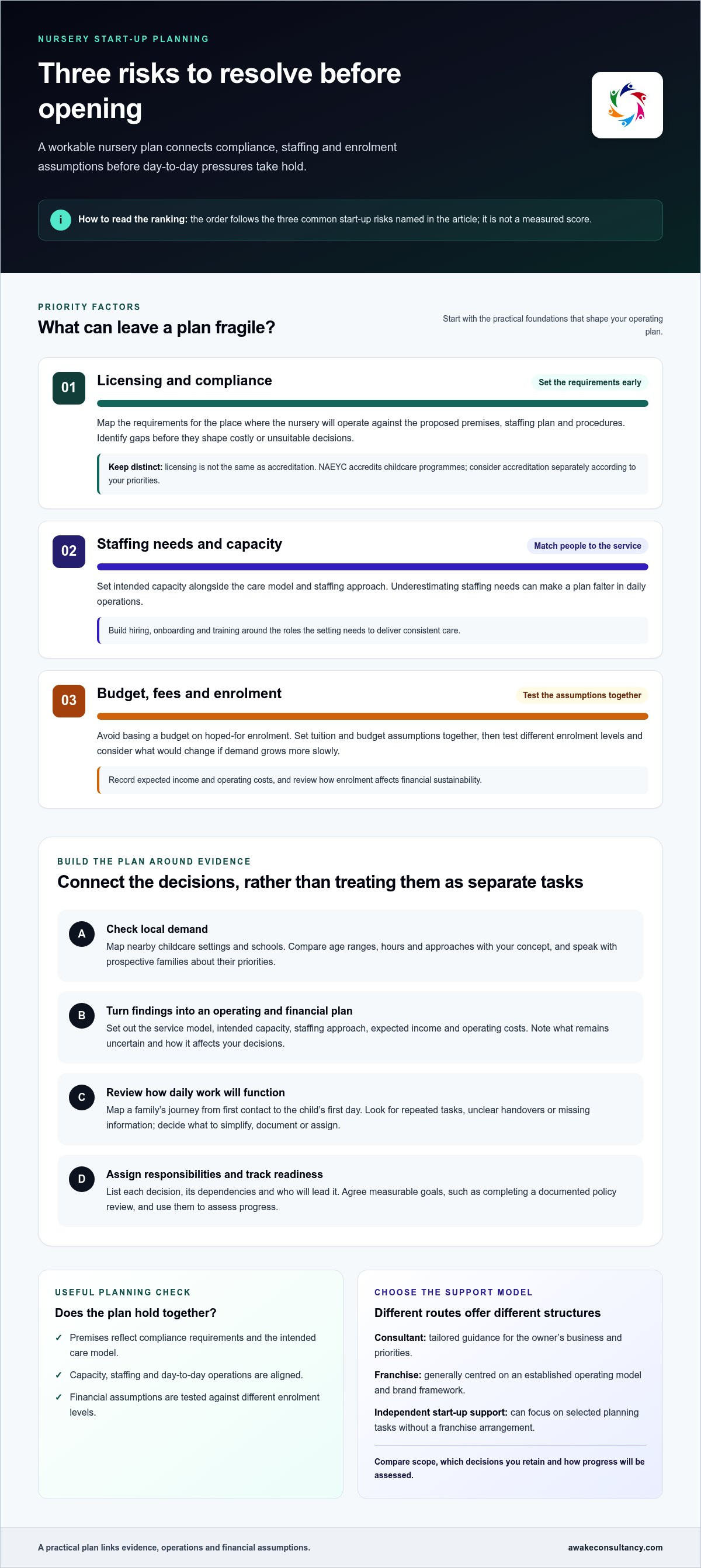
- Map licensing and compliance considerations early so they inform your operating plan from the outset.
- Turn your start-up idea into a practical plan by aligning capacity, staffing needs and day-to-day operations.
- Build hiring, onboarding and training around the roles your setting needs to deliver consistent care.
- Set tuition and budget assumptions together, then review how enrolment levels affect financial sustainability.
- Use financial management and enrolment planning to identify pressure points and make informed adjustments as your business develops.
How can a consultant help my business?
A consultant can help owners turn a nursery idea into an operational plan. Support may cover compliance, start-up decisions, funding routes and peer learning.
Compliance and licensing guidance
Childcare consultants can help settings understand and meet the licensing, health and safety requirements that apply where they operate. They can map relevant requirements against your proposed premises, staffing plan and procedures, then identify gaps to address. Because rules vary by jurisdiction, base your plan on the requirements for the place where the nursery will operate.
Accreditation is separate from licensing. The National Association for the Education of Young Children (NAEYC) accredits childcare programmes. A consultant can help you consider whether accreditation suits your priorities and organise evidence of practice. At the start of an engagement, agree specific, measurable goals, such as completing a documented policy review, and use them to assess progress.
Start-up support and common pitfalls
Start-up support can help owners organise key decisions before opening, including the service model, intended capacity, operating procedures and preparation timeline. Begin by listing each decision, its dependencies and who will lead it. For example, premises planning should reflect compliance requirements and the intended care model, rather than being treated as a separate task.
Common risks include overlooking licensing requirements, underestimating staffing needs and basing a budget on hoped-for enrolment. These can leave owners with plans that look workable on paper but falter in daily operations. A consultant can challenge assumptions, identify gaps and help set priorities. Grants and scholarships may also be relevant funding routes; support can include identifying potential opportunities and organising application information around each fund’s criteria.
Independent owners can gain perspective by discussing operating challenges with other nursery leaders. Use these conversations to compare assumptions, share approaches and identify questions that need a tailored review. Peer discussion can broaden your view, while a consultant can help turn useful lessons into actions for your setting.
Consultants, franchises and independent support
A consultant tailors advice to the owner’s business and priorities. A franchise may offer a structured operating model and brand framework, while independent start-up support can focus on selected planning tasks without a franchise arrangement. The right route depends on how much autonomy, structure and ongoing guidance you want.
How do nursery consultants compare with franchises and independent start-up support? Consultants provide tailored guidance; franchises generally centre on an established model, while independent support can focus on specific start-up needs. Compare the scope of support, which decisions you retain and how progress will be assessed.
Before engaging a consultant, define the problem and the outcome you want. For example, set a measurable goal of completing a licensing-readiness review, then use its findings to prioritise next steps. Clear objectives make the work easier to evaluate and keep advice connected to opening and operating your nursery.
Startup consulting for daycare and preschool businesses
Start-up advice helps owners connect the business model with practical decisions. Work can move from testing demand to designing operations and reviewing progress.
Market research and business plans
Market research should test whether families in your intended area need the proposed service. Map nearby childcare settings and schools, then compare their age ranges, hours and approaches with your concept. Speak with prospective families to understand their priorities. Record what the findings support, what remains uncertain and how each point affects your plan.
A business plan turns that evidence into decisions. Set out the service model, intended capacity, staffing approach, expected income and operating costs. Test different enrolment assumptions and note what you would change if demand grows more slowly. A consultant can review how these elements fit together, so the plan guides decisions rather than simply describing the idea.
Operational efficiency and business strategy
Operational planning examines how daily work will function, from enquiries and enrolment to staff responsibilities and parent communication. Map a family’s journey from first contact to the child’s first day. This can reveal repeated tasks, unclear handovers or missing information. Review each process against your service model, then decide what to simplify, document or assign.
Strategy also involves deciding what the setting will prioritise. You might focus on a particular age group, a defined programme or a specific community need. Compare that choice with local research, available premises and your team’s capabilities. A consultant can help turn your direction into practical objectives and measures, then review whether operations remain aligned.
Business Angels and entrepreneurship networks may offer advice, connections or investment discussions. Prepare a concise explanation of your childcare model, the evidence behind expected demand and the decisions where you still need support. Use each conversation to test assumptions, not to treat interest as committed funding. An adviser can help assess whether a potential source fits your business plan and preferred level of independence.
Business creation guidance can follow the project’s stages. First, clarify the service and research its local context. Next, develop the operating and financial plans, consider premises and organise the work needed before opening. Finally, review readiness, assign responsibilities and track progress against agreed objectives. Record decisions and outstanding tasks at each stage to create a workable sequence instead of a collection of disconnected ideas.
For owners who need help turning a concept into a structured plan, start-up planning support can help connect research, strategy and implementation.
Choose a childcare consultant with a degree in education, child development, psychology, business or a related field, and significant experience in childcare or education.
Staff hiring, onboarding, training, and retention
A staffing plan should connect the service you intend to provide with the people needed to deliver it. Describe each role, its responsibilities and the experience required. For example, distinguish leadership duties from room-based practice, administration and family communication. This makes recruitment more focused and helps you identify capability gaps before opening.
During recruitment, use consistent criteria rather than relying on an informal impression. Compare applicants’ experience, approach to children’s learning and communication with families. Ask candidates to discuss a relevant workplace scenario, such as supporting a child with additional needs. Clear questions help you assess their thinking, while a documented process makes decisions easier to explain.
Onboarding should help new colleagues develop confident, consistent practice. Plan an introduction to the setting’s routines, policies, communication methods and responsibilities. Pair written guidance with time to observe experienced practitioners. A checklist can track completed introductions, follow-up questions and outstanding training. Review it with each employee so important details aren’t lost during a busy opening period.
Training should reflect the work staff actually do. Identify development priorities through supervision, observation and team discussions. A practitioner new to the setting may need support with its curriculum approach, while an experienced colleague may benefit from developing leadership or mentoring skills. Link each learning activity to a practical change, then revisit that change in supervision or team planning.
Workplace culture also affects retention. Set clear expectations for communication, feedback and shared responsibilities before disagreements arise. For example, agree how staff raise concerns, record decisions and hand over information between rooms. Regular, purposeful check-ins can help managers notice workload pressures and recognise good practice. Make training and development part of an ongoing plan, not just a one-off induction task.
Relate staffing decisions to occupancy, fees and funding assumptions. Build a schedule showing which roles support each operating period, then compare planned capacity with likely enrolment. If occupancy is expected to grow gradually, a recruitment timeline can help match hiring to demand without treating projected places as guaranteed income. Review how changes in attendance, staffing costs or funding affect the budget, and revisit the plan when enrolment patterns shift.
Use this review to identify the next practical action, whether refining role descriptions, organising induction or planning staff development. Connecting recruitment, learning and retention helps the team work towards consistent practice as the setting develops.
If you need outside help with recruitment, onboarding or workforce planning, include the cost of that support in your budget. A childcare consultant’s rates can vary by consultant, project and location, so clarify whether fees are hourly or project-based and whether additional charges apply. Ask how the proposed fee structure relates to the work you need and what the agreed scope includes before deciding whether to proceed.
Clear cost information helps you compare support with your staffing priorities and available budget. Focus the discussion on the service you need rather than assuming consultants charge in the same way.
Budgeting, capacity, and tuition planning
A sound financial plan links opening costs, available places and fee income. Separate one-off set-up spending from recurring operating costs. For example, premises preparation belongs in the opening budget, while payroll and learning materials need ongoing budget lines. This distinction shows when money will leave the business and what income must cover regular operations.
How much start-up funding and working capital does a nursery need? Calculate the amount from set-up costs, operating expenses and the timing of expected income. Working capital must cover ongoing commitments until tuition receipts and other income can reliably meet them.
Build your budget from documented assumptions, not a single optimistic forecast. List premises, equipment, insurance, utilities, recruitment, training and administration as separate cost categories. Record when each expense is due and whether it continues after opening. A cash-flow forecast can show how enrolment timing affects your ability to meet payroll, supplier invoices and other operating commitments.
Capacity planning should connect the intended service with usable space, staffing and the age groups served. Sketch how rooms will function throughout the day, including arrival, meals, rest and learning activities. Compare planned places with the team and facilities available. A place that appears available on a floor plan may not suit the programme or operating model you intend to deliver.
Set fees by working back from the business plan. Identify the income needed to support planned costs, then compare it with the service families will receive and your local market research. Consider how attendance patterns, session lengths and funded places affect income. Keep assumptions visible so you can explain how the fee structure fits the nursery’s operating model.
Test the plan against different enrolment patterns before relying on projected income. For example, model a slower start alongside the expected opening pattern, then identify which costs are fixed and which can change. This shows how a gap between planned and actual occupancy may affect cash flow. It also helps you decide which spending should depend on a clear trigger, such as confirmed enrolments.
Review the forecast regularly against actual income, expenditure and occupancy. If enrolment differs from the plan, update the cash-flow forecast and reconsider recruitment timing, purchasing or fee assumptions. Record each change and its reason. This makes budgeting a working management tool rather than a document prepared once and left untouched.
Financial management, tuition-setting, and enrollment
Financial management turns records into decisions. Track income, expenses, invoices and payments consistently, then reconcile them regularly. Separate tuition income from other receipts and group spending by purpose, such as payroll, premises, supplies and administration. This makes it easier to see which costs are rising and whether enrolment income supports the nursery’s operating plan.
Build a routine for reviewing cash flow. Compare expected receipts with actual payments and note when families’ fees are due. If an invoice remains unpaid, record the balance, follow the setting’s agreed payment process and update the forecast. A clear view of incoming and outgoing funds helps you plan commitments, respond to delays and distinguish a timing issue from wider financial pressure.
Set fees using a documented method. Start with operating costs and the income needed to sustain the service, then consider the sessions offered, expected attendance and local demand. Compare the proposed fee structure with the value and pattern of care families will use. Record how discounts, funded places or different session lengths affect the calculation, so every decision has a clear rationale.
Enrolment management starts before a family accepts a place. Record enquiries, visits, follow-up conversations and decisions in one organised process. For example, note which session a family needs, what information they still require and who will contact them next. This helps the team see where prospective families pause, respond consistently and understand which enquiries may lead to attendance.
Once a place is accepted, connect enrolment records with billing and attendance. Check that agreed sessions match the invoice, and update records when a child’s schedule changes. Reviewing attendance alongside fee receipts can reveal differences between planned and actual use. You can then investigate the cause, such as a booking pattern, a communication gap or a mismatch between available sessions and family needs.
Use regular management reviews to bring these records together. Compare income with expenditure, enrolment with available places, and outstanding fees with payment expectations. If income falls short, identify the cause before changing fees or cutting spending. A documented review helps distinguish a temporary fluctuation from a pattern that requires action, giving your next decision a clear evidence base.
For structured guidance with financial records, forecasts and tuition decisions, explore nursery business and financial support.
Awake Early Years Consultancy: Early Years Consultancy
Awake Early Years Consultancy helps owners turn a start-up plan into sound early-years practice. Its Early Years Consultancy supports settings seeking to strengthen leadership, operations and quality as they prepare to open or develop. Recruitment Support helps owners address recruitment processes, while Practitioner Training & Development supports staff learning and capability. Ofsted Preparation & Mock Inspections helps settings review readiness and identify areas for further work. These services are useful when you have specific questions to resolve, such as aligning practice with your operating model or preparing leaders and practitioners for their responsibilities. Contact Awake Early Years Consultancy to discuss the support that fits your nursery’s next steps.
Make your next decision with purpose
Before taking another step, decide which unresolved issue could most affect your opening plan. Write it down, identify the evidence you need and set a clear outcome. Nursery start-up consultancy can help turn that priority into focused work, rather than adding advice without a practical purpose.
Awake Early Years Consultancy offers Early Years Consultancy, Recruitment Support and Practitioner Training & Development. These services can help owners strengthen operational planning, recruitment or team capability as their plans develop. Start with the decision that needs attention now, then identify the information and support that would help you move it forward.
Contact Awake Early Years Consultancy to discuss a practical next step for your setting. With a clear priority and considered advice, you can build your plans with greater purpose and confidence.
Frequently Asked Questions
What does a childcare consultant do?
A childcare consultant helps owners examine a business challenge and decide on practical next steps. For example, if responsibilities overlap between a manager and room leaders, a consultant can help clarify roles and agree how decisions will be recorded. The work may also involve reviewing plans, identifying gaps and setting measurable objectives. This gives owners a structured way to assess whether the advice has addressed the original issue.
What services does a nursery start-up consultant provide?
A nursery start-up consultant can help shape an operating plan, review business assumptions and strengthen leadership preparation. Support may also cover recruitment processes, staff development and inspection preparation. For example, a consultant might help an owner turn a broad staffing concern into clear role requirements and a development plan. Awake Early Years Consultancy provides tailored early-years advice, recruitment support and practitioner development for these needs.
What are the steps to start a nursery or childcare centre from business plan to opening?
Move from a tested concept to an opening plan through clear decision points. Define the service and intended families, then use local research to shape the business plan. Develop the operating model, premises plan and staffing approach, then organise the preparation and records needed for opening. Before launch, review each task against its owner, dependencies and evidence of completion. This sequence makes outstanding decisions visible without mistaking a draft plan for operational readiness.
How do you choose a reputable childcare centre start-up consultant?
Choose a consultant whose early-years knowledge and proposed work match the decisions you need to make. Set specific, measurable goals at the beginning, such as producing a reviewed staffing structure or assessing inspection readiness. Agree the scope, expected outputs and how progress will be evaluated. Awake Early Years Consultancy provides tailored consultancy and mock inspections, giving settings a structured way to work on practice, leadership and preparation.


