

A nursery business consultancy can bring planning, finances, management systems, staff development and Ofsted readiness into one practical review. The work should identify what is affecting your setting, clarify priorities and turn them into actions that fit day-to-day operations. Ofsted preparation is most useful when it strengthens practice and leadership, not just inspection paperwork.
Running a nursery means balancing quality of care with the financial and operational decisions that keep the setting sustainable. This article explains how consultancy can support funding and business planning, improve management systems, develop staff and prepare a setting for Ofsted scrutiny. It also shows how an audit or mock inspection can help owners and leaders decide where to focus next.
Key Takeaways
- Map funding needs and operational requirements before committing to a nursery business plan.
- Assess demand, cash flow, staffing and quality together to understand whether the setting is financially sustainable.
- Clarify responsibilities and strengthen management systems so essential tasks are handled consistently.
- Use staff development to build capability and embed stronger practice across the setting.
- Prepare for Ofsted by reviewing everyday practice, identifying gaps and turning mock inspection findings into clear actions.
Funding, business registration, permits, and insurance
The cost of starting and operating a daycare nursery depends on its premises, capacity, fit-out, staffing and working capital. Ongoing costs are shaped by payroll, rent or mortgage commitments, supplies, maintenance, and the balance between parent fees and government funding.
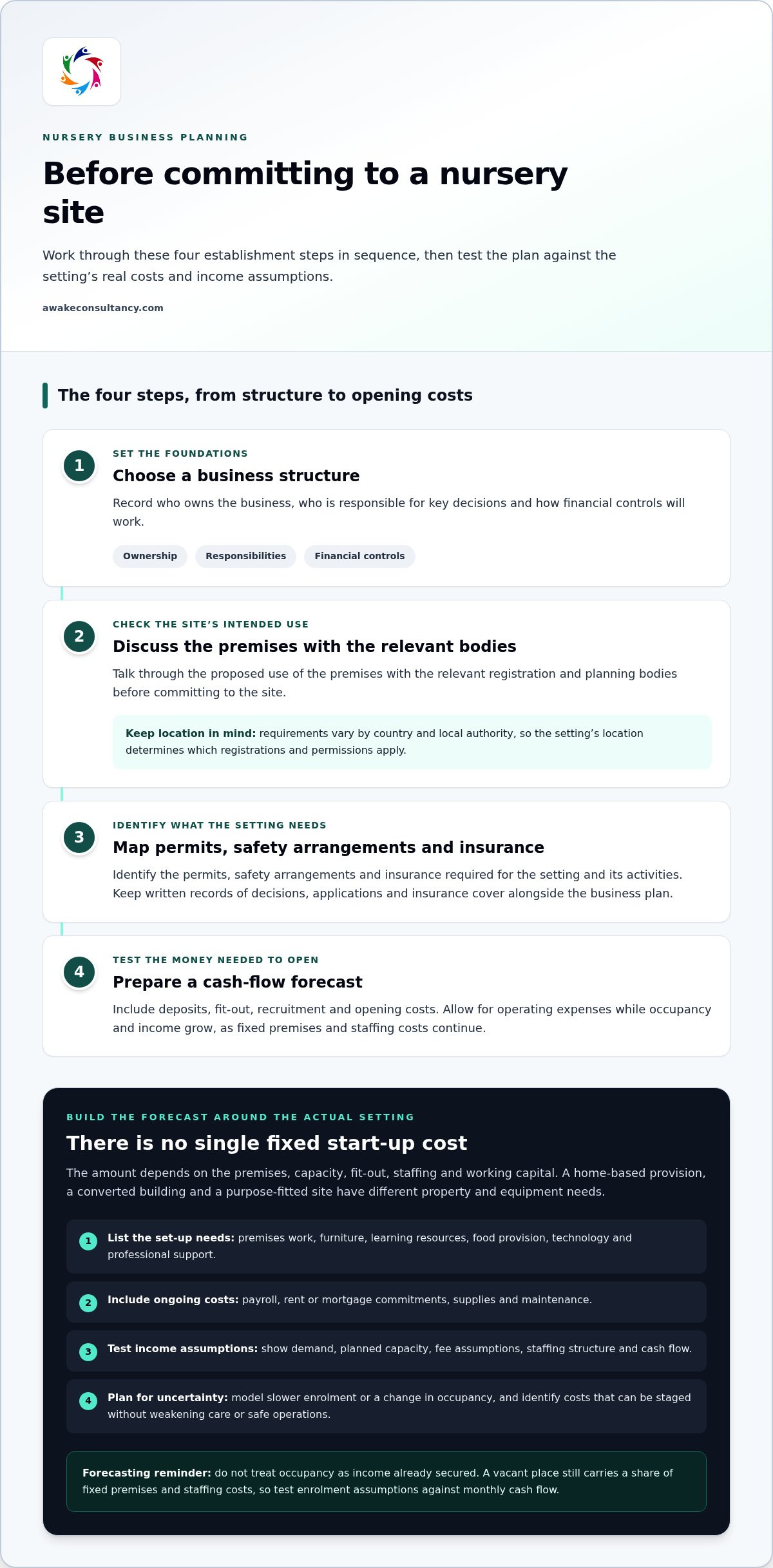
Build a start-up plan around the actual setting, not a generic nursery estimate. A home-based provision, a converted building and a purpose-fitted site have different property and equipment needs. List the premises work, furniture, learning resources, food provision, technology and professional support required before estimating the cash needed to open. Then allow for operating expenses while occupancy and income grow.
For funding, show how the setting will generate income and meet costs. A lender or investor needs a clear account of demand, planned capacity, fee assumptions, staffing structure and cash flow. Prepare scenarios for slower enrolment or a change in occupancy, and identify which costs can be staged without weakening care or safe operations. A funding plan is easier to manage when each request is linked to a defined expense and a realistic repayment approach.
Government funding can form part of the income mix where the setting and families qualify under the relevant scheme. Its effect on profitability depends on payment arrangements, eligible attendance, administration and the difference between funded income and the cost of delivering each place. Model funded hours separately from privately paid sessions. Compare the income with staff time, meals, resources and other provision, then review whether the overall mix supports sustainable delivery.
Set nursery fees by examining costs, local demand, opening patterns and the value of the service offered. A fee model might distinguish full-day attendance from shorter sessions, while keeping funded provision and additional paid services clear in forecasts. Avoid treating occupancy as income already secured. A vacant place still carries a share of fixed premises and staffing costs, so test enrolment assumptions against monthly cash flow.
Before committing to a site, work through the establishment steps in sequence:
- Choose a business structure and record ownership, responsibilities and financial controls.
- Discuss the proposed use of the premises with the relevant registration and planning bodies.
- Identify the permits, safety arrangements and insurance required for the setting and its activities.
- Prepare a cash-flow forecast that includes deposits, fit-out, recruitment and opening costs.
Requirements vary by country and local authority, so the location determines which registrations and permissions apply. Keep written records of decisions, applications and insurance cover alongside the business plan. Nursery Business & Financial Support or Startup Support can help owners assess funding needs, test assumptions and structure a viable launch plan.
There is no single fixed cost. The amount depends on the premises, capacity, fit-out, staffing and working capital. Include a cash-flow allowance for the period when occupancy and income are still developing, while fixed premises and staffing costs continue.
Nursery business mentoring, training and support
Support can be project-based, ongoing or focused on a specific operational challenge. The right arrangement depends on the setting’s priorities, available leadership capacity and need for practical follow-through.
Project and ongoing consultancy support
Project support addresses a defined task, such as reviewing a management process or preparing a new setting to open. Ongoing consultancy provides continuity as leaders apply changes, review progress and adjust their approach. Nursery business consultancy may include business reviews, prioritised action plans and coaching. A useful scope sets out the issue, expected work, responsibilities and how progress will be assessed.
A nursery business consultant can review business operations, leadership, staffing needs and quality practice. Look for support that connects findings to clear actions, rather than leaving managers with observations alone.
Start-up support and consultant choice
Start-up support helps owners work through the steps between an idea and an operating setting. This can include shaping a business plan, considering management systems and identifying the capabilities needed across the team. Agree which decisions the consultant will help you assess and which remain with the owner or leadership team.
Choose a consultant with relevant early-years understanding, a clear method and experience addressing your priorities. A childcare business consultant focuses on nursery operations and early-years practice; a franchise consultant focuses on the franchise model, including its structure and the relationship between franchisor and franchisee.
On-site support and staff training
On-site support lets an adviser observe routines, discuss challenges with managers and see how agreed systems work in practice. Staff training can then address a specific development need, such as consistent communication, clearer responsibilities or stronger team practice. Useful sessions connect learning to real tasks rather than relying on general discussion alone.
Agree the purpose of a visit in advance. For example, if a team is struggling with handovers, review the current routine, practise a consistent approach and decide how managers will reinforce it afterwards.
Peer support can also help owners compare approaches and reflect on decisions with people facing similar responsibilities. Keep discussions focused on transferable practice: how leaders organise supervision, share workloads or respond to recurring operational issues. Each setting still needs to adapt ideas to its own team, families and priorities.
For effective business development, turn advice into manageable actions. Record the decision, assign responsibility and review whether the change has improved the intended process. A written report with prioritised actions can separate urgent work from improvements that can wait, helping leaders protect time for implementation.
Business planning and financial viability
A sound plan connects the nursery’s purpose with its operating model and financial decisions. Owners should test whether demand, staffing, quality and cash flow support the same direction.
Business plans and financial projections
A business plan should explain who the setting serves, how it will operate and what will sustain it. Build projections from clear assumptions about occupancy, fees, funded places, staffing, premises and operating costs. Show how income and expenditure change as attendance rises or falls. Keep assumptions visible so owners can challenge them and update the plan when circumstances change.
Use scenarios to test the plan rather than relying on a single forecast. Compare expected enrolment with a slower intake, for example, then consider how each affects staffing decisions and cash available for regular costs. A focused plan identifies which assumptions have the greatest effect on viability. It also records the evidence behind each assumption, such as enquiries, current enrolment patterns or known operating commitments.
Financial analysis and business audits
Financial analysis examines how the nursery earns and spends money, then connects those figures to operational performance. Review income streams alongside payroll, premises, supplies and maintenance. Compare forecasts with actual results, investigate significant differences and record the decisions that follow. A business audit can widen the review to demand, people, operations, quality, risk and the setting’s direction.
Look beyond the headline surplus. A month with stronger income may still conceal pressure from late payments, vacancies or costs falling due at different times. A practical audit traces these patterns, identifies their causes and prioritises action. Owners might examine whether session patterns match family demand or whether staffing arrangements align with attendance. The purpose is to clarify the decisions behind the figures.
Use the findings to build a management rhythm. Set a regular review point for income, expenditure, occupancy and key operational risks. Assign an owner to each action and note what evidence will show progress. If a projection repeatedly differs from actual performance, revisit its assumptions rather than carrying the same estimate forward. This keeps planning connected to the setting’s real activity.
A focused financial review should also consider quality. Reducing expenditure without understanding its effect on staffing, resources or practice can weaken the service the plan is meant to sustain. Assess each proposed change against its financial purpose and operational consequences. A clear audit helps owners distinguish avoidable inefficiency from spending that supports consistent provision.
Finally, make the plan usable for the people who manage the setting. Summarise the main assumptions, current priorities and decisions required, then keep supporting calculations available for review. Nursery Business & Financial Support can help owners assess financial viability and turn business information into practical planning decisions.
Delegation, management, and time-saving systems
Clear roles and repeatable routines help nursery owners manage daily work without making every decision themselves. Practical systems should support enrolment, staffing, finances and the setting’s longer-term development.
Nursery operations and time-saving systems
Map a regular operating day, from opening checks through handovers and closing tasks. Identify where managers repeat information, wait for approvals or rely on memory. A shared action log can record the task, responsible person and due date. Review it at team meetings, then simplify forms or routines that create work without helping staff make sound decisions.
Enrolment, staffing and financial management
Awake Early Years Consultancy can help managers examine enquiry-to-enrolment steps, staffing patterns and financial information together. For example, compare expected attendance with planned staff deployment, then review how changes affect payroll and income. This helps leaders spot gaps between demand and available capacity. Keep enrolment records, recruitment priorities and financial reviews connected so decisions reflect the setting’s current position rather than separate assumptions.
Risks and common mistakes
Common risks include relying on one manager for essential knowledge, delaying recruitment decisions and overlooking routine cost changes. Owners should identify critical tasks, name a deputy and keep instructions accessible to relevant staff. A short risk register can record each issue, its likely operational effect and the person responsible for action. Review it when staffing, enrolment or premises plans change.
Inventory systems also support smoother operations. Track learning resources, cleaning supplies and food stocks by recording what is held, what is used and when replenishment is needed. If outdoor play equipment or natural resources are part of the setting, include their supplier, expected delivery and maintenance responsibilities. Consistent records help avoid duplicate orders and make purchasing decisions easier to explain.
Building work needs clear coordination between the owner, contractors and setting leadership. Before work begins, define the scope, decision-making responsibilities, access arrangements and how updates will be recorded. Keep a schedule of agreed tasks and outstanding issues. A change to a room’s use, for example, may affect furniture orders, staff routines and the planned reopening sequence.
Delegation works when authority matches responsibility. Assign each recurring task to a named role, explain what decisions that person can make and set a review point. A manager responsible for recruitment, for instance, needs a clear process for escalating staffing gaps. These practical boundaries reduce repeated approvals while keeping owners informed about significant operational decisions.
Delegation should also leave room for owners to check whether the business can sustain its plans. Nursery businesses often incur losses during their first one to two years because building occupancy takes time, so cash-flow reviews and realistic expectations matter. Quality leadership helps ensure that operational challenges do not make nursery ownership feel lonely and overwhelming. A comprehensive Nursery Business Health Check reviews demand, finances, people, operations, quality, risk and business direction together to keep your early years setting on track.
Ofsted advice, audits, and mock inspections
Ofsted preparation is strongest when it reflects daily practice, not a temporary inspection routine. Advice, audits and mock inspections can help leaders identify gaps and make improvement part of normal operations.
Ofsted advice
Useful advice helps leaders understand how their setting’s routines, leadership and practice can be reviewed. It should connect questions about quality to what children and staff experience each day. Leaders can examine, for example, how planning, staff discussions and observations inform decisions. Keep the focus on understanding and strengthening practice, rather than rehearsing polished answers that staff cannot consistently support.
Nursery audits
A nursery audit offers a structured review of operational practice and the evidence behind it. It can examine leadership oversight, staff understanding, record-keeping and how managers respond to identified concerns. Its value lies in clear findings: what is working, what needs attention and which actions should take priority. Assign an owner to each action and record how leaders will review progress.
Mock inspections
A mock inspection gives leaders and practitioners an opportunity to reflect on the setting under review conditions. It can include discussions with staff, observation of routines and examination of relevant records. Afterwards, compare observations with the setting’s own understanding of its strengths and development needs. A useful report explains the evidence behind its findings and turns them into practical next steps.
Before an audit or mock inspection, agree its scope with the leadership team. Identify the areas to examine, who will participate and how feedback will be shared. This helps staff understand the purpose and reduces the risk of treating the exercise as a performance. Leaders can then use the findings to plan focused development, clarify responsibilities and strengthen oversight.
Follow-through matters. Record each priority, assign responsibility and set a review point within the setting’s management process. If an audit highlights inconsistent communication, for instance, leaders can agree on a shared approach, discuss it with staff and observe whether it becomes routine. Review the evidence after implementation rather than assuming a written action has changed practice.
Marketing should also reflect the service families experience. Check that descriptions of the setting align with its everyday provision, staff communication and current priorities. Clear, accurate information supports families’ understanding; it should not substitute for improving operational practice or explaining how leaders monitor quality.
For structured preparation and feedback, explore Ofsted preparation and mock inspections and consider how the findings can inform ongoing improvement.
External examples can help leaders understand how review findings relate to improvement, while keeping attention on the evidence and circumstances of each setting. A nursery client reported achieving a Good outcome on re-inspection in May 2023. Pennies Hockers Lane was judged Outstanding by Ofsted on 5 September 2011. These outcomes are specific to those settings and should not be treated as a prediction of another nursery’s result.
For leaders considering support, the Initial Business Audit includes five hours of remote business review. A review can help clarify priorities and identify where further evidence or follow-up may be useful. Whatever approach is chosen, the aim is to support consistent practice and informed oversight, with actions reviewed in the context of the setting’s day-to-day work.
Awake Early Years Consultancy: Early Years Consultancy
Awake Early Years Consultancy supports nurseries and other early-years settings with practical advice to strengthen leadership and practice. Turn to its Early Years Consultancy when you need a clearer view of operational priorities or your team needs help translating improvement goals into day-to-day work.
For inspection preparation, Ofsted Preparation & Mock Inspections can help leaders review practice and identify areas for development. Practitioner Training & Development supports staff capability, while Recruitment Support can assist with recruitment needs. The right focus depends on the challenges facing your setting and the support your team needs to move forward.
To discuss support for your setting, contact Awake Early Years Consultancy.
Set a clear direction for your next steps
Choose one priority that would make a meaningful difference to your setting, then agree who will lead the work and how progress will be reviewed. A nursery business consultancy should fit the decisions you need to make, not add another layer of activity for managers to maintain. Focus on changes that can become part of everyday practice.
Awake Early Years Consultancy offers Early Years Consultancy, Recruitment Support and Practitioner Training & Development. These services can help leaders strengthen their approach, address recruitment needs or build staff capability. Begin with the issue that matters most and explain how it affects your team and setting. Sharing relevant context can help establish a practical starting point.
For a discussion about support for your setting, contact Awake Early Years Consultancy. A clear next step can help you move forward with purpose and build lasting improvement.
Frequently Asked Questions
What are the steps to create a nursery business plan?
Create a nursery business plan by first defining its purpose and service model. Then identify the families you aim to serve and gather local evidence from enquiries, waiting lists and family feedback. Describe the daily offer, leadership structure and approach to quality. Set out key assumptions, test alternative scenarios and identify the decisions that depend on them. Finish with milestones, named responsibilities and a review routine so the plan guides action rather than sitting unused.
How much does it cost to start and operate a daycare nursery?
There is no single fixed cost. It depends on the premises, capacity, fit-out, staffing and working capital. Also allow for costs while occupancy and income are still developing.


