

A full register doesn’t, by itself, make a childcare business financially sustainable. Sound childcare business financial planning tests whether income from enrolment can cover staffing and operating costs, while accounting for grants and changes in occupancy. A business plan should include financial forecasts for the first three to five years, so decisions about opening or expanding rest on more than a best-case estimate.
It’s understandable to focus first on filled places and secured funding. The harder task is understanding how fees, staffing patterns, grant income and ongoing costs interact, especially when assumptions change. This article explains how to build a practical financial model, budget for operating expenses and use forecasts to assess start-up or expansion decisions. It also shows why realistic enrolment assumptions and contingency planning matter as much as projected income.
Key Takeaways
- Project income from realistic enrolment patterns and fees, while allowing for seasonal dips and unpaid charges.
- Assess grants as funding with eligibility and reporting conditions, and support applications with a clear budget and evidence of community impact.
- Break down staffing and operating expenses, then plan staff schedules around licensing ratios and the needs of the setting.
- Use forecasts to test how changes in occupancy, costs or funding could affect cash flow and long-term sustainability.
- For a start-up or expansion, build a financial model that brings income, set-up costs, ongoing expenses and financing assumptions together.
1. Revenue from full-time, part-time, and drop-in enrollment
Start with the places your programme can legally and safely fill, then forecast revenue by attendance pattern. Full-time, part-time and drop-in places can generate different income because fees and attendance vary. Aim to maintain enrolment, collect fees in full and on time, and ensure revenue covers the cost of care per child. Treat these as connected measures, not separate targets.
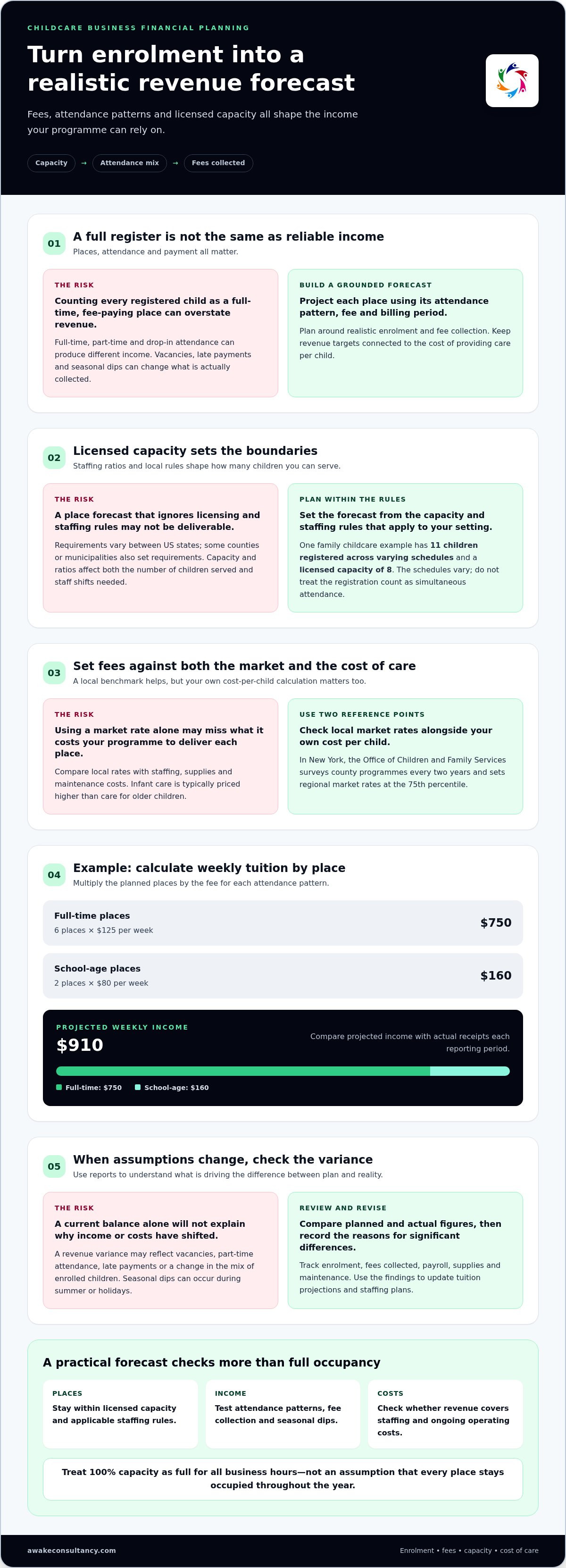
State childcare licensing rules affect staffing ratios and the maximum number of children a programme can accommodate. In the United States, licensing is administered by state governments, and requirements vary between states; some counties or municipalities also set requirements. Build projections around the applicable capacity and staffing rules, because they determine how many children you can serve and how many staff shifts you need. A family childcare example has 11 children registered across varying schedules, despite a licensed capacity of 8.
What tuition and enrollment rates should a childcare business charge? Set rates by comparing local market rates with the cost of delivering each place, including staffing, supplies and maintenance. Infant care is typically priced higher than care for older children. In New York, the Office of Children and Family Services surveys county programmes every two years and sets regional market rates at the 75th percentile. Use local benchmarks alongside your own cost-per-child calculation.
For a clear tuition projection, multiply each planned place by its fee and billing period, then total the results. One example budget charges $125 per week for 6 full-time places and $80 per week for 2 school-age places, producing $910 per week. Compare that projected income with actual receipts each reporting period. A variance may reflect vacancies, part-time attendance, late payments or a change in the mix of enrolled children.
Review financial reports for revenue and expense trends, not just the current balance. Compare planned and actual enrolment, fees collected, payroll, supplies and maintenance, then record the reasons for significant differences. This helps distinguish seasonal income dips, such as during summer or holidays, from rising recurring expenses. Use the findings to revise tuition projections and staffing plans.
Cost control and revenue diversification should support, not undermine, safe care. A programme might combine full-time, part-time and drop-in places where its operating model and licensed capacity allow, while keeping each fee schedule clear. Avoid projecting every place as occupied throughout the year: 100% capacity means the programme is full for all business hours. Test a seasonal dip, track waitlist interest and adjust projected income before committing to recurring expenses.
2. Grant funding for child care businesses
Grant funding can help a child care business meet defined start-up or expansion needs without adding loan repayments. A grant does not have to be repaid, but recipients may need to satisfy eligibility, application and reporting requirements. Treat potential funding as conditional in your cash-flow plan until you understand those requirements and the timing of payments. Keep family tuition and grant income separate in your projections, since they come from different sources and may follow different schedules.
Use grants for costs tied to a clear purpose, such as start-up expenses, renovations, supplies, materials or playground equipment. For each proposed use, explain how it supports the care programme and its community. A strong application links the need, planned activity and expected benefit, with a budget showing how each requested amount supports the activity. This also separates one-off investment from recurring costs, such as wages or maintenance, which require reliable ongoing income.
Start by looking for local and state opportunities, then ask a local Child Care Resource and Referral agency about relevant grant programmes. Providers can also consider federal, state and local grants for early childhood education or small businesses. The U.S. Small Business Administration shares information about grants and financing opportunities for small businesses. For each opportunity, record eligibility conditions, deadlines, permitted spending and reporting duties. These details determine whether a grant suits your project and how it fits your business plan.
Public funding can form part of the wider funding picture. According to the Child Care and Development Fund, it allocated $9.7 billion in federal funds to states in 2022. The Child Care and Development Block Grant is the authorising law for that fund. This national allocation is not a guarantee of funding for an individual care business; build projections around opportunities available to your programme and the requirements attached to them. Keep public funding distinct from tuition and family payments in financial reports.
Match each start-up funding source to its purpose. A grant may suit eligible project costs, while a business loan adds repayments that belong in your forecasts. Family tuition can support routine operations, but projections should reflect realistic enrolment and collection patterns. Avoid using a one-off grant to make permanent staffing costs appear affordable. Assess whether ongoing income can sustain those costs after the grant period or funded project ends.
Before applying, prepare a detailed budget, evidence of need and a clear account of community impact. Link each budget item to the proposal, and track spending and reporting dates separately. This makes childcare business financial planning a practical funding tool: you can assess whether support advances a sustainable start-up or expansion, rather than merely filling a short-term cash gap.
3. Operating costs and staffing expenses
A useful operating budget separates recurring expenses from costs that change with activity. List payroll, rent, utilities, food, learning materials, cleaning, maintenance and insurance as distinct items. Note when each expense is due, then compare total outgoings with expected income. This helps reveal whether a shortfall comes from a permanent cost or a temporary change in spending.
Staffing needs close attention because they affect both service delivery and financial stability. Most child care providers spend at least 60% of revenue on employee wages. Build payroll projections from planned staff hours and the roles needed to run the programme, then include employer taxes and benefits. A schedule should meet licensing ratios whilst avoiding unnecessary overlap between shifts.
What insurance, taxes and payroll costs should childcare businesses budget for? Include recurring insurance premiums, payroll, employee taxes and benefits, alongside applicable federal and state business taxes. In the United States, childcare business owners must comply with federal and state tax regulations; centre owners must also meet employee tax and benefit requirements. Insurance costs depend on the cover and operational risks included in the business’s arrangements.
Use a working budget to test how each expense affects the owner’s income. One example gives a provider’s monthly salary as $1760, contingency savings as $1000, and the business share of supplies as $880. These are example budget figures, not general rates. The same example uses a sixty-hour work week to estimate an hourly wage of $11, showing why owners should account for their own working hours.
Financial reports make cost changes easier to spot. Each reporting period, compare actual and planned payroll, supply purchases and maintenance expenses. If supply costs rise, identify whether enrolment, purchasing prices or waste explains the change before revising the budget. Providers can reduce supply costs by negotiating with suppliers and buying in bulk, but savings should not compromise materials required for the programme.
Some care programmes can use shared services to manage recurring expenses. Payroll, curriculum coordination, maintenance and human resources are examples. Compare the cost and practical fit of each arrangement with managing it internally, and record the result in the budget. Review income and expenses together so that cost reductions do not hide weakening revenue or create pressure elsewhere.
Finally, separate essential operating costs from discretionary spending. Protect payroll, licensing-related expenses and routine maintenance in the core budget, then assess optional purchases against available income. Reviewing these categories regularly helps owners adjust spending deliberately and maintain a clear view of the programme’s financial position.
4. Financial forecasting and risk management
Build forecasts for the first three to five years, then test whether income can cover recurring expenses under different enrollment conditions. Family child care providers are advised to budget for 85% of full capacity, leaving room for vacancies and unexpected costs. This is a planning approach, not a substitute for checking cash flow against actual receipts, payroll and supply purchases. Revisit assumptions when enrolment, staffing or operating costs change.
How do financial plans differ for home-based daycare, childcare centres and preschools? A home-based plan should reflect household resources, business-use costs and the provider’s own working time; 87% of US providers are home-based or family child care providers with no employees. A centre must model payroll and facility expenses alongside capacity, whilst a preschool should connect its income and costs to its own operating schedule and programme.
Risk planning works best when it turns a possible shortfall into a practical response. Identify critical costs, such as staffing, rent and supplies, then consider what happens if income falls or an urgent repair is needed. Saving $5 per week for a year produces $260; setting aside $1 per child per week for 8 children produces $416 in a year. These examples show how regular reserves can build, though the required contingency depends on the programme’s costs.
Childcare management software can bring financial and operational records into a more consistent system. Depending on its functions, it may support enrolment and waitlists, attendance, electronic payments, invoicing, classroom ratio monitoring, staff records, payroll and family communication. Compare systems with your operational needs and budget. Accurate attendance and payment records help identify revenue patterns, while staff and payroll records connect schedules with labour costs.
A reliable financial management system also needs a regular review process. Set a schedule to compare forecast and actual income and expenses, record reasons for significant differences, and update projections. Use reports to see whether changes stem from vacancies, late payments, staffing patterns or unexpected maintenance. Then decide whether to adjust spending, strengthen collections or revise assumptions before committing to new costs.
Profitability remains a material risk: most child care providers operate with less than 1% profit margins. Review whether planned investments, such as equipment or facility improvements, support safe operations and fit the forecast. The U.S. Small Business Administration provides information on small-business grants and financing opportunities, which can inform funding research. Keep any potential funding separate from core operating income until its conditions and timing are reflected in the plan.
5. Business plans and financial models for start-ups or expansions
A business plan should show how a childcare centre moves from start-up costs to sustainable operations. Build a model that separates one-off investment from recurring expenses, then link each cost to a funding source. Include enrolment assumptions, tuition income, staffing, rent, supplies and maintenance. This helps owners understand what drives cash flow, when additional funding may be needed and what enrolment level supports a profit.
What local market research is needed to estimate childcare demand, competition and pricing? Map the families and age groups your programme aims to serve, then assess nearby centres, their care options, operating hours and published tuition rates. Compare this picture with parent enquiries, waiting-list interest and licensing capacity. Together, these factors help estimate likely demand and set fees that reflect local conditions and the cost of delivering care.
A practical example shows how a financial model makes assumptions visible. These lines clarify where initial capital goes, but they do not show on their own whether ongoing operations can support the investment.
Enter each funding source in the model, including its timing and repayment assumptions. Then assess how loan repayments affect the cash available for payroll, supplies and other operating needs as enrolment grows.
For an expansion, model additional places separately from the existing programme. Estimate the added staffing, classroom resources and facility needs, then test whether projected income covers those costs. Keep assumptions for current and expanded operations distinct. This helps reveal whether the change strengthens the overall business or relies on optimistic enrolment, delayed expenses or funding that may not continue.
A useful model should make the decision clear: proceed, revise the plan or delay investment. Present the assumptions alongside the results, so a parent-facing service plan and its financial commitments remain aligned. To develop your start-up or expansion assumptions, discuss your nursery business finances.
Awake Early Years Consultancy: Early Years Consultancy
Awake Early Years Consultancy can help nursery leaders connect financial plans with the realities of running an early-years setting. Its Nursery Business & Financial Support is relevant when you’re assessing a start-up, planning an expansion or reviewing income and costs that are putting pressure on operations. Clear financial assumptions matter, but they must also align with staffing, leadership and the quality of provision.
Turn to consultancy support when you need to review forecasts, understand the financial implications of operational decisions or develop a more sustainable plan. Tailored advice can help you assess priorities and identify practical next steps, while keeping a spreadsheet in its proper place: as a tool, not a substitute for sound day-to-day management.
Contact Awake Early Years Consultancy to discuss your nursery’s financial planning needs.
Build a financial approach that supports the next stage
The key decision is not simply whether the figures balance today, but whether the operating model can support consistent care as priorities change. Effective childcare business financial planning should help leaders make practical choices, not become a document that sits untouched after approval. Connecting financial decisions with the people and practice behind delivery keeps plans grounded in the setting’s day-to-day needs.
Awake Early Years Consultancy offers Early Years Consultancy, Recruitment Support and Practitioner Training & Development. These services can help leaders consider how staffing capability and practitioner development fit their wider operational plans, alongside financial support. Reviewing these connections helps owners set priorities and sequence changes clearly.
If you’re ready to consider the next step for your setting, contact Awake Early Years Consultancy to discuss your financial and operational priorities. A considered approach can give your team a steadier foundation for what comes next.
Frequently Asked Questions
How much revenue and profit can a daycare center or home daycare typically expect?
Expected revenue depends on the places a setting can operate, attendance patterns and fees collected. Profit is what remains after costs. A home-based provider and a centre need separate projections, not a borrowed industry average. Estimate weekly income by care type, then deduct staffing, premises, food, supplies and tax obligations. Check the result against realistic occupancy and payment timing to understand what the business could retain.
What are the main monthly operating expenses for a childcare business?
Monthly expenses commonly include payroll and employer costs, premises, utilities, food, cleaning, insurance, learning materials, software, repairs and professional services. Separate fixed bills, such as rent, from costs that change with attendance, such as meals and consumables. If enrolment rises but food spending does not, review ordering, waste and attendance records before changing the budget. Record due dates as well as amounts to anticipate cash-flow pressure.
What funding, grants, loans, or tax credits are available for childcare businesses?
Childcare businesses can explore grants, loans, public funding and tax credits, each with different conditions and cash-flow effects. Grants may support eligible start-up, renovation, equipment or supply costs. They generally do not have to be repaid, although eligibility, application and reporting requirements may apply. Loans require repayments, which belong in cash forecasts. Tax credits depend on applicable jurisdiction and eligibility rules, so assess qualifying activities and claim processes before including them in projections.
How can a childcare business create a cash flow forecast and break-even analysis?
Build a cash-flow forecast by period: enter opening cash and expected tuition and other receipts, then schedule payroll, rent, supplier, tax and debt payments by due date. To estimate break-even enrolment, divide fixed costs by each enrolled child’s contribution after variable costs. This estimates how many children are needed to cover operating expenses, not simply how many places are available. Update childcare business financial planning assumptions against actual collections and spending each month.
What financial risks and contingency reserves should childcare businesses plan for?
Plan for enrolment drops, late family payments, staff absences, repairs, cost increases and delayed grant payments. To set a reserve, list essential cash outflows and consider which risks could interrupt operations. Then test how long available cash would cover those payments in a downside scenario. Keep reserve funds separate from money committed to routine bills, and review the reserve after significant changes to staffing, premises or enrolment.


