

A nursery purchase is not ready to proceed just because the accounts and occupancy look sound. Nursery acquisition support should also examine how the setting safeguards children at risk of abuse or neglect and applies its age-eligibility criteria. These checks help show whether written procedures match everyday practice and admissions align with the setting’s stated age range.
It’s understandable to focus on finances and continuity of care during a transaction, but safeguarding and eligibility decisions affect children, families and the operation a new owner will take on. This article explains what to review, how to assess safeguarding arrangements and what to look for in age criteria, while recognising that local requirements and funding arrangements differ. It also explains how specialist acquisition and integration advice can organise the review and support a practical transition.
Key Takeaways
- Review safeguarding policies alongside how staff apply them in daily practice, including how concerns about a child are recorded and escalated.
- Check the nursery’s stated age range and compare it with admissions, attendance records and the criteria used to assess eligibility.
- Assess the business through its income, occupancy, staffing, premises and operational liabilities, rather than relying on headline figures alone.
- Plan the acquisition in stages, from initial review and due diligence through to handover, so that responsibilities and continuity of care are addressed.
- Use specialist early years advice when you need to evaluate practice, strengthen staff capability or prepare for the operational transition.
What services do nursery acquisition consultants provide?
Nursery acquisition support connects the commercial decision with the realities of running an early-years setting. A consultant can help buyers assess whether an opportunity fits their plans, identify operational issues and prepare for handover. This goes beyond reviewing headline income. It considers how leadership, staffing, safeguarding, admissions and family relationships work together.
At the early assessment stage, the consultant helps define the buyer’s priorities. These might include the nursery’s age range, operating model, local reputation or capacity for future development. The consultant can then structure a review around those priorities, separating essential conditions from matters that can be addressed after completion. This creates a consistent basis for discussion with the seller and other professional advisers.
During operational review, examine how written procedures translate into daily routines. For example, look at how staff record concerns about a child, pass information to the appropriate lead and maintain confidentiality. Review how the nursery explains age eligibility, assesses applications and records decisions, too. The aim is to identify gaps between stated processes and actual practice, not merely collect policies.
- Operational assessment: Map leadership responsibilities, staffing arrangements, room use and day-to-day routines against the buyer’s proposed operating plan.
- Safeguarding review: Examine reporting pathways, staff understanding and record-keeping, using a sample concern scenario to test how responsibilities work in practice.
- Admissions and age criteria: Compare the published age range with enrolment records, eligibility decisions and the information shared with families.
- Integration planning: Set out who will communicate changes, preserve effective routines and address identified issues after the ownership transition.
Acquisition advice can also help shape the transition plan. The Den Nursery Group retained 100% of staff after acquiring Chuckle Bunnies Day Nursery in Swadlincote. That acquisition maintained continuity of care for 54 children and 30 families. These figures illustrate why integration planning should account for staff, children and families, rather than treating the transaction as a change in ownership alone.
Coordinate operational findings with legal, financial and property advice, while keeping each professional’s role distinct. Translate observations into clear actions: what needs attention before completion, who will own each task, and what should be monitored during integration. Buyers can then make decisions using a structured picture of the setting’s strengths, risks and practical priorities.
Transition planning should also clarify which customer relationships and services are expected to continue, rather than assuming established arrangements will disappear when ownership changes. Customers of Willoway Nurseries and Decker’s Nursery are expected to retain access to the products, service and relationships they trust during the transition. Superior Street Partners said Riverbend's core operations and focus on quality production and customer service would remain unchanged after the acquisition. These examples show why continuity is a practical consideration. Consultants can help clarify expected continuity and how it fits with operational issues identified during the review. This helps buyers plan the handover alongside their responsibilities to staff, children and families.
What due diligence should buyers perform when acquiring a nursery?
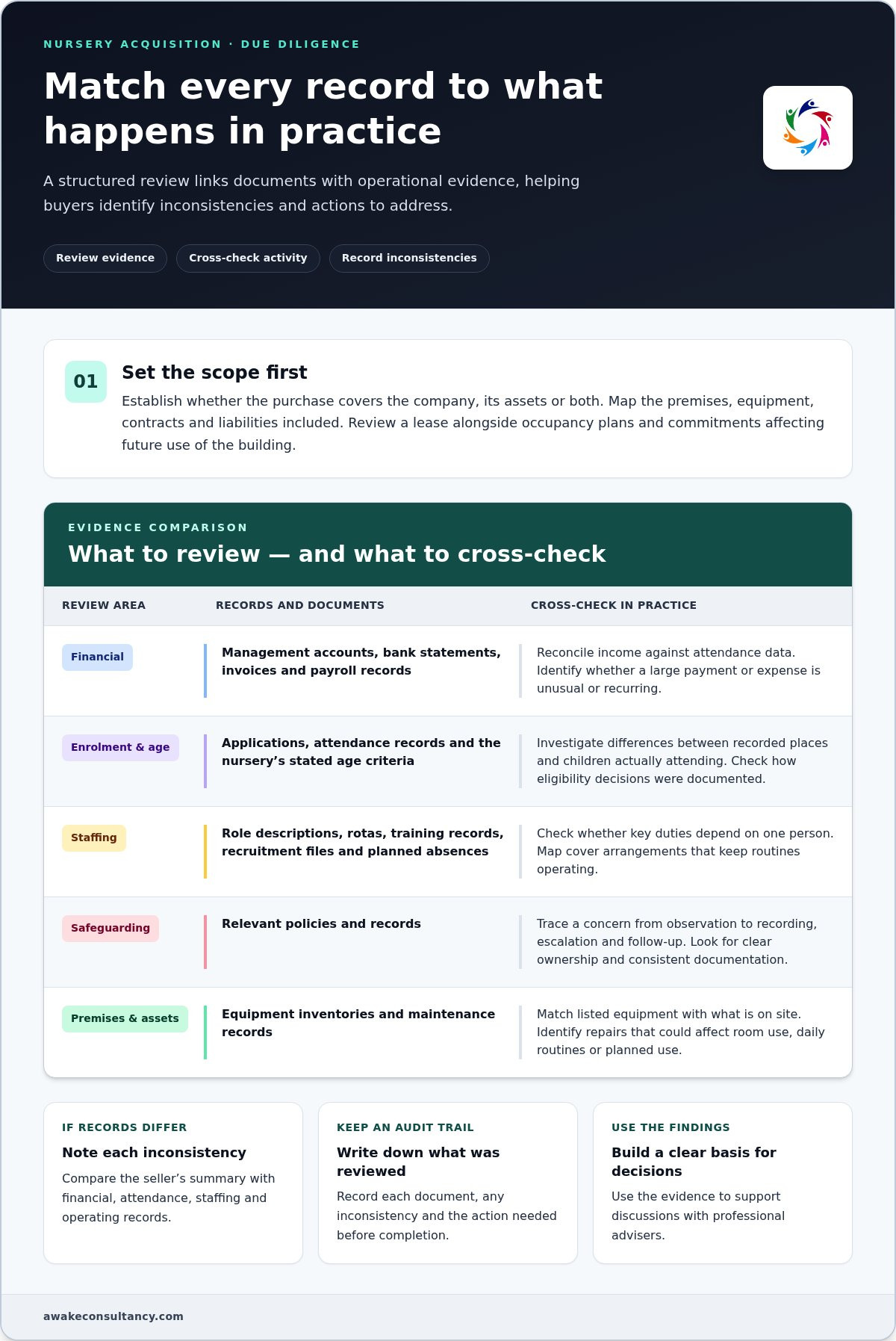
Build due diligence around evidence, not just the seller’s summary. Compare financial records with attendance, staffing and operating records to see whether reported performance reflects daily activity. Keep a written record of each document reviewed, any inconsistency and the action needed before completion. This gives the buyer a clear basis for decisions and discussions with professional advisers.
Start by defining the transaction’s scope. Establish whether the purchase covers the company, its assets or both, then map the premises, equipment, contracts and liabilities included. This distinction affects which records need reviewing and which obligations may continue after handover. Read a lease, for example, alongside occupancy plans and commitments affecting future use of the building.
Use a structured review to connect documents with operational evidence:
- Financial records: Compare management accounts, bank statements, invoices and payroll records. Reconcile income against attendance data, and identify whether a large payment or expense is unusual or recurring.
- Enrolment and age eligibility: Compare application records, attendance and the nursery’s stated age criteria. For example, investigate differences between recorded places and children actually attending, including how eligibility decisions were documented.
- Staffing: Review role descriptions, rotas, training records, recruitment files and planned absences. Check whether key duties depend on one person, and map the cover arrangements that keep routines operating.
- Safeguarding practice: Sample relevant policies and records, then trace how a concern moves from observation to recording, escalation and follow-up. Look for clear ownership and consistent documentation.
- Premises and assets: Match equipment inventories with what is present on site. Review maintenance records and identify repairs that could affect room use, daily routines or planned investment.
- Contracts and relationships: List supplier agreements, family communications and outstanding disputes. Note renewal dates and commitments that could alter operations after ownership changes.
Rank findings by their effect on safe, stable operation. A missing record may need clarification; a recurring staffing gap may require a transition plan. Separate issues to resolve before completion from improvements that can be scheduled afterwards. Give each action an owner, a deadline tied to the transaction plan and evidence of completion.
Keep the review joined up. Financial findings may change the buyer’s assumptions, while operational findings can reveal investment or continuity needs. Awake Early Years Consultancy's Nursery Business & Financial Support helps buyers organise the commercial and operational picture into practical transaction priorities.
How do buyers value a nursery or childcare business
Value a nursery by testing the income it can sustain, the assets included and the work needed after purchase. A headline figure alone cannot show whether earnings depend on temporary occupancy, unusually low staffing costs or the owner’s unpaid work. If the proprietor manages the setting without a recorded salary, for example, adjust the operating picture to reflect the cost of replacing those duties.
Begin with maintainable earnings. Review accounts alongside occupancy, fee income, payroll, rent, utilities and recurring maintenance. Separate ordinary operating costs from one-off items, then check whether the pattern holds across different trading periods. A single busy period should not define the forecast. Compare booked places with attendance and assess how vacancies, fee changes or staffing needs could affect future income.
Use more than one valuation method, then explain why the results differ:
- Earnings approach: Estimate sustainable operating earnings after realistic management, staffing and premises costs. Test the result against changes in occupancy or essential expenditure.
- Asset approach: Identify equipment, furnishings and other assets transferred with the business. Consider their condition and replacement needs, rather than relying only on an inventory’s recorded values.
- Comparable transactions: Use relevant nursery sales as context, not as an automatic price formula. Differences in location, premises, capacity, performance and transaction structure can make headline comparisons misleading.
Next, define what the proposed price covers. A nursery in leased premises differs from one where the property is included. Separate property value from the operating business, and record how equipment, working capital, deposits and outstanding liabilities are treated. For example, distinguish a functioning kitchen from repairs needed before it can support normal operations.
Test the forecast against practical constraints. A projected increase in places has little value if the room layout, staffing capacity or nursery’s stated age range cannot support it. Assess projected fee income against current enrolment, family retention and the setting’s local position, too. Record each assumption, its evidence and its effect on the buyer’s assessment.
Finally, turn the valuation into a decision range and negotiation plan. Identify which assumptions could change the buyer’s view, such as a lease condition, staffing requirement or maintenance work. Keep these items visible rather than burying them in a single figure. Awake’s Nursery Business & Financial Support can help organise financial assumptions and operational priorities into a clearer acquisition assessment.
Keep the range tied to evidence and identify the conditions that could shift it, including lease terms, asset condition, staffing requirements and the reliability of maintainable earnings. The Den Nursery Group reported 33% business growth following its expansion through the nursery acquisition. That example can be a reminder that expansion may affect performance, but it does not establish a transferable benchmark for another setting. Buyers should assess whether growth depended on capacity, local demand, integration or investment, and whether similar conditions are realistically available to the business being valued.
What are the steps to acquire a nursery business
A nursery purchase involves connected decisions, from defining the opportunity to integrating the setting. Keep a record at each stage: the buyer’s criteria, evidence reviewed, agreed terms and actions required after handover. For example, a decision to retain the existing age range should inform both the operational review and transition plan.
- Set the acquisition brief. Define the location, type of setting, age range and operating model that fit your plans. Decide which conditions are essential, such as suitable premises or an established leadership structure. This brief gives you a consistent way to assess opportunities rather than reacting to one attractive feature.
- Review the opportunity. Gather the nursery’s overview, accounts, occupancy information and premises details. Compare the seller’s description with evidence, noting questions that need a fuller response. If a proposed expansion depends on using another room, for example, establish whether its layout and staffing arrangements support that plan.
- Agree the proposed transaction. Clarify whether the discussion concerns the company, selected business assets, or a structure involving the premises. Record the proposed scope, key assumptions and matters still under discussion. Bring appropriate legal and financial advisers into this stage so they can assess the transaction documents and implications.
- Complete due diligence. Organise financial, operational, staffing, premises and safeguarding reviews. Link each finding to evidence and an action. If attendance records differ from reported occupancy, resolve the discrepancy before relying on those figures in forecasts or negotiations.
- Set the valuation and terms. Base your assessment on sustainable income, assets transferred and required investment. Make assumptions visible, including management costs and maintenance needs. Use the findings to shape the offer and clarify how outstanding liabilities, equipment and working capital will be treated.
- Prepare completion and handover. Agree who will manage each operational task, from access to records through to communication with staff and families. Map critical routines, key contacts and decisions that cannot wait. A written handover plan reduces the chance that essential information sits with one person.
- Manage integration. Set priorities for the early operating period, assign owners and schedule progress reviews. Preserve effective routines whilst addressing agreed improvements. For example, review staff understanding of reporting pathways after ownership changes, rather than assuming a transferred policy ensures consistent practice.
Keep the sequence flexible enough to respond to findings, but don’t skip a stage to meet an attractive timetable. A concern identified during due diligence may affect the valuation, transaction terms or handover plan. Record the decision and its rationale so the buyer, advisers and incoming leaders share the same understanding.
Completion is not the final operational milestone. The new owner still needs to turn the agreed plan into clear responsibilities, stable routines and sustained oversight. Treat integration as part of the acquisition process, with practical actions that can be reviewed and adjusted as the setting settles under new ownership.
What are the risks of buying an existing nursery?
An established nursery brings existing routines and relationships, but may also have inherited weaknesses. Recorded processes might differ from daily practice, or projected income may depend on conditions unlikely to continue. For example, strong occupancy can conceal reliance on a small number of large family bookings. Before deciding how to address each risk, identify its potential effect on children, staff, families and the operation.
Consider risks together. A financial issue can create operational pressure, while a staffing change may affect continuity and family confidence.
- Safeguarding gaps: A written procedure may not explain who acts when a concern arises during a busy session. Test a practical scenario, such as a staff member observing a change in a child’s behaviour, and trace the steps for recording and escalating it.
- Unclear age eligibility: Inconsistent admissions decisions can create confusion for families and affect planning. Compare the nursery’s stated age criteria with a sample application and the explanation given to that family.
- Dependence on key people: If one manager holds essential information about routines, family needs or supplier arrangements, their departure can disrupt operations. Map critical tasks to named roles and identify where knowledge needs to be shared.
- Fragile income assumptions: A forecast may rely on full rooms, stable fees or costs that have not been adjusted for the incoming owner’s plan. Test a scenario where a planned place remains vacant or an essential expense rises.
- Premises constraints: A room that appears suitable during a visit may not support the intended operating plan without changes. Compare the proposed use with the layout, equipment and routines observed on site.
- Transition strain: Changes to leadership or established routines can unsettle staff and families. Identify which practices should remain stable at handover and who will explain any necessary changes.
For each finding, record its likely operational effect, supporting evidence and required action. Separate immediate safeguards from longer-term improvements. An unclear reporting route, for example, needs clear ownership before handover, while a planned room redesign may belong in a phased investment plan. This distinction helps prevent important concerns from disappearing into a general task list.
Unresolved issues can affect the transaction itself. A buyer may need to revisit assumptions, adjust proposed terms or pause a decision until a material concern is addressed. Keep a decision log showing who assessed each issue and how it affects the integration plan. This gives incoming leaders a clear starting point, rather than leaving them to rediscover risks after completion.
If you’re assessing operational exposure before a purchase, discuss nursery acquisition risks and how to turn findings into practical priorities.
Awake Early Years Consultancy: Early Years Consultancy
Awake Early Years Consultancy helps buyers turn acquisition findings into practical priorities. Its Early Years Consultancy supports nurseries and pre-schools to review practice, leadership and operational needs as ownership changes. This is useful when due diligence identifies gaps between written procedures and daily routines, or incoming leaders need a structured plan to strengthen practice.
If the transition highlights staff development needs, Awake’s Practitioner Training & Development can build team capability, while Recruitment Support can assist with recruitment planning. Ofsted Preparation & Mock Inspections can help the setting review its readiness and identify areas for further work. These services support preparation and improvement, not a promised inspection outcome.
Contact Awake Early Years Consultancy to discuss your acquisition and integration priorities, or visit awakeconsultancy.com.
Build a considered path into ownership
Ownership gives you the opportunity to shape a setting’s next stage, but decisions during the transition influence how confidently that work can begin. Treat nursery acquisition support as a way to turn priorities into a workable plan, with clear responsibilities and a shared understanding of what comes next. This helps new leadership focus on sustainable practice rather than making changes before understanding how the setting operates.
Awake Early Years Consultancy supports this work through Early Years Consultancy, Recruitment Support and Practitioner Training & Development. These services are relevant when you’re planning leadership changes, strengthening staff capability or establishing consistent expectations across the team. The right focus depends on the needs identified for the setting.
Take the next step by discussing your priorities with Awake Early Years Consultancy. A considered conversation can help you identify where specialist support fits and what to address first. With a clear direction and practical support, you can move into the next stage with purpose.
Frequently Asked Questions
What does nursery acquisition support include?
Nursery acquisition support can cover due diligence, transition planning and post-acquisition integration. Awake Early Years Consultancy provides Acquisition & Integration Support tailored to the setting and the work required. If you’re concerned about safeguarding or age eligibility, the support can help frame these as operational review priorities and connect findings to practical next steps. The aim is to help the incoming owner establish clear responsibilities and a workable plan.
How does buying a nursery compare with starting one from scratch?
Buying an existing nursery means taking on established staff, routines, admissions, family relationships, premises and contracts, as well as any operational liabilities. Verify these through due diligence and plan the handover to protect continuity of care.


