

Opening an English-language nursery or kindergarten abroad involves more than adapting a curriculum. International EYFS consultancy can help school leaders shape an approach for their setting, strengthen leadership practice and turn improvement priorities into workable actions. The focus is on sound decisions that can be carried through in everyday provision.
Leaders often need to balance an educational vision with the practical demands of launching or improving a setting. This article explains how consultancy can support that work, what to expect and what to consider when choosing a consultant. It also explores how leadership review, staff development and improvement planning connect with the realities of an international early-years environment.
Key Takeaways
- Turn leadership priorities into a focused improvement plan with clear actions, ownership and review points.
- Map the decisions involved in launching an English-language nursery or kindergarten, from educational vision to daily practice.
- Assess whether a consultant’s early-years knowledge, leadership experience and international perspective fit your setting.
- Use practical guidance to translate the EYFS framework into consistent routines, teaching practice and assessment.
- Identify when targeted consultancy, practitioner development or inspection preparation could help your team strengthen provision.
International leadership support and improvement planning
International school leaders need a plan that connects educational priorities with local context. Effective support turns review findings into clear actions, assigned responsibilities and ways to track progress.
EYFS and International Curriculum Comparisons
EYFS and other international early-years curricula can differ in their principles, learning goals, assessment approaches and expectations for play. Compare what each framework asks practitioners to teach, observe and record, then identify where the approaches align or diverge. EYFS is an English framework; consider it alongside the curriculum and requirements relevant to the school’s country, rather than as a universal template.
Strategic advice can help senior leaders use these comparisons to guide improvement. Begin by reviewing curriculum plans, staff practice and children’s learning experiences. Then agree which priorities need attention, who will lead each action and how its effect will be reviewed. For example, if observations rarely inform planning, the improvement plan could focus on staff discussion, recording practice and follow-up reviews. This makes the plan a practical leadership tool, not just a document for presentation.
Consultant Qualifications and Experience
Choose a consultant with substantial early-years knowledge, practical leadership experience and the ability to explain how advice applies in your setting. Helen Tate has worked in education for 32 years, the majority of that time in Early Years. When choosing and hiring an international EYFS consultant, discuss their experience with comparable schools, approach to local context and method for measuring progress. Ask for a clear account of the proposed work, deliverables and communication with senior leaders.
EYFS Implementation Support
Implementation support should connect curriculum intentions with daily practice. A consultant can review plans and learning environments, observe how practitioners engage children and identify where routines or staff development need attention. Leaders can then prioritise actions, assign responsibility and schedule regular reviews. The aim is consistent practice and stronger outcomes, not simply adopting familiar terminology. International EYFS consultancy can also help leaders consider how the framework fits their school’s educational model.
Design and regulatory planning should start with the setting’s location and operating context. Leaders need to map curriculum decisions against relevant local requirements, school policies and the intended learning environment, as requirements vary between countries. Risks include assuming one approach suits every setting, overlooking local expectations and making plans staff cannot sustain. Address these through early review, clear responsibilities and ongoing discussion with practitioners and relevant local advisers.
Starting an English-language nursery or kindergarten
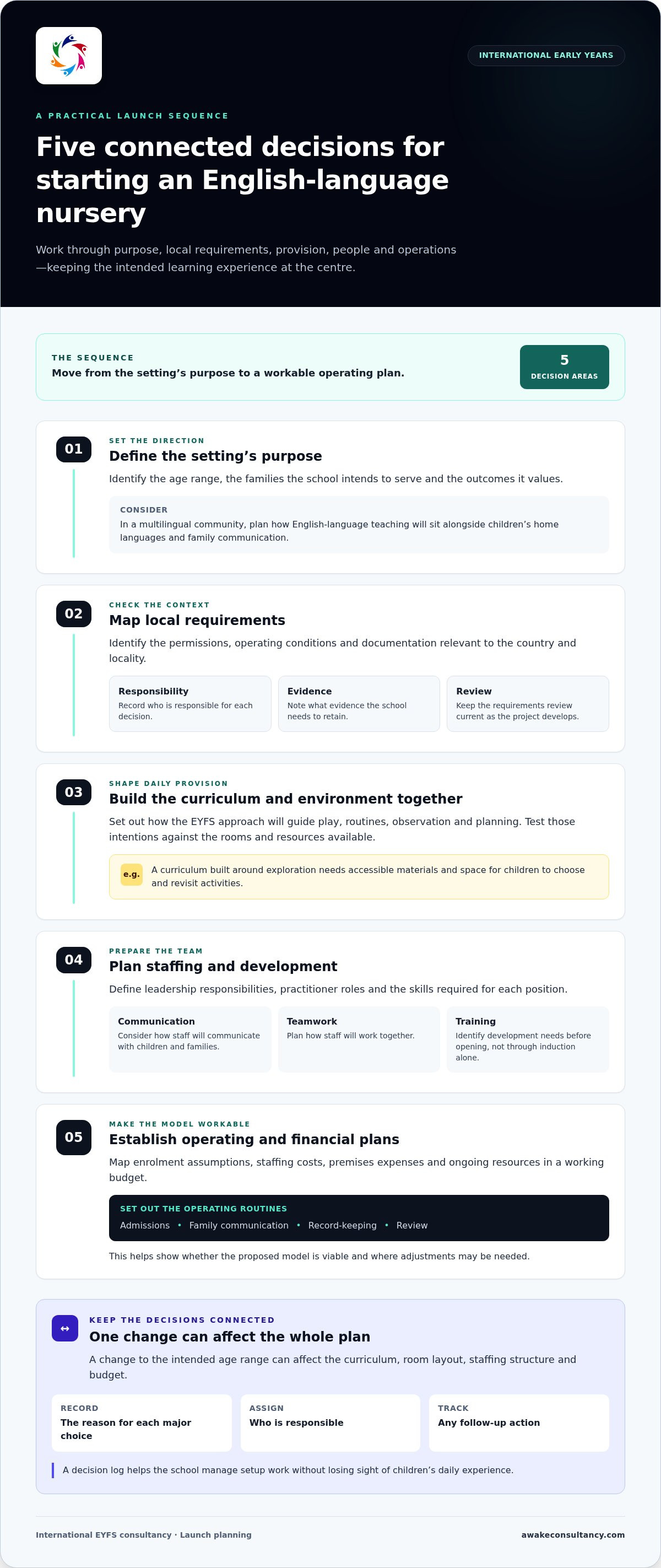
Launching an English-language early-years setting calls for coordinated decisions, not just a curriculum choice. School leaders need to connect the educational model with local requirements, premises, staffing and sustainable operations. Work through these areas in sequence so decisions about teaching and early-years provision support the same purpose.
- Define the setting’s purpose. Identify the age range, families the school intends to serve and the outcomes it values. For example, a school serving a multilingual community can plan how English-language teaching will sit alongside children’s home languages and family communication.
- Map local requirements. Identify the permissions, operating conditions and documentation relevant to the country and locality. Record who is responsible for each decision, what evidence the school needs to retain and how local expectations affect the proposed model. Keep this review current as the project develops.
- Build the curriculum and environment together. Set out how the EYFS approach will guide play, routines, observation and planning, then test those intentions against the rooms and resources available. A curriculum built around exploration, for instance, needs accessible materials and space for children to choose and revisit activities.
- Plan staffing and development. Define leadership responsibilities, practitioner roles and the skills required for each position. Recruitment planning should consider how staff will communicate with children and families, work as a team and apply the curriculum consistently. Identify training needs before opening, rather than relying on induction alone.
- Establish operating and financial plans. Map enrolment assumptions, staffing costs, premises expenses and ongoing resources in a working budget. Then set out routines for admissions, family communication, record-keeping and review. This makes it easier to see whether the proposed model is viable and where adjustments may be needed.
These decisions are connected. A change to the intended age range can affect the curriculum, room layout, staffing structure and budget. Keep a decision log recording the reason for each major choice, who is responsible and any follow-up action. A tailored plan helps the school manage extensive setup work without losing sight of children’s daily experience.
Early Years Consultancy can help leaders organise these decisions, while Startup Support addresses the practical work of establishing a setting. For example, leadership can use a readiness review to identify gaps between the intended curriculum and current premises or staffing plans. Consider startup support for an early-years setting when you need structured guidance to turn the school’s plan into workable next steps.
Which countries and schools offer international EYFS consultancy services?
International EYFS consultancy is relevant wherever a school chooses to use the English framework in its early-years provision. The country alone does not determine whether support is suitable. Leaders should consider the school’s curriculum, local operating context, children’s languages and the practical questions facing the team.
International activity around EYFS training offers examples of where practitioners have engaged with the subject. Sue Asquith was scheduled to present a keynote speech and two workshops at the BSME Early Years Conference in Dubai on 1st June, 2024. Her play-based learning course was scheduled at Hartland International School Dubai on 19th June 2024, followed by a course on effective teaching, learning and STEM on 20th June 2024.
Other scheduled courses show activity across further locations. Training on physical development and personal, social and emotional development can be part of early-years professional development. In Bangkok, Thailand, the physical development and personal, social and emotional development courses were scheduled for 18th November 2024 and 19th November 2024 respectively. In Singapore, the corresponding courses were scheduled for 21st November 2024 and 22nd November 2024.
- Dubai, UAE: Hartland International School hosted scheduled EYFS training on play-based learning, teaching and STEM in June 2024.
- Thailand and Singapore: Bangkok and Singapore had scheduled courses on physical development and children’s personal, social and emotional development in November 2024.
- Italy: Sue Asquith’s Power of Play course was scheduled for 28th March 2025. A course on supporting children’s behaviour and self-regulation was scheduled for 29th March 2025.
These examples identify training locations and host venues, not a complete directory of consultancy providers. Before seeking advice, define the need: launching an EYFS-based nursery, reviewing practice, supporting leaders or developing practitioners. Then assess whether the adviser understands international-school contexts and can tailor guidance to the setting. A bilingual kindergarten, for example, may need to consider how English-language curriculum aims work alongside children’s other languages and local expectations.
Schools can also distinguish between a course and consultancy. A course develops knowledge about a defined topic; consultancy connects review, advice and action to a particular school’s needs. Describe the setting, its priorities and the decisions that need to be made. This gives an adviser a clear basis for explaining how the work can apply.
This distinction helps leaders frame a request: identify the setting, the priority and what a useful outcome would look like. Ask how recommendations would relate to the school’s existing approach and what follow-up would involve. If experience with a particular group of schools matters, clarify the scope of that experience rather than treating a course listing as evidence of consultancy capability.
Helen Tate has worked with the schools described by a Deputy CEO for 10 years. Schools can use that experience as a starting point for questions about fit, while clarifying which needs it covers and whether the support proposed is tailored to their own circumstances.
What qualifications and experience should an EYFS consultant have?
Look for a consultant who connects early-years knowledge with the decisions school leaders face. Relevant experience includes understanding the EYFS framework, reviewing practice and translating findings into workable actions. Qualifications matter, but they should be accompanied by sound judgement, clear communication and practical early-years experience.
Match the consultant’s background to your school’s needs. A setting preparing to open may need guidance on curriculum design and operational planning. A school reviewing provision may need someone who can observe teaching, discuss findings with practitioners and help leaders prioritise improvements. Ask how the consultant’s experience relates to the specific work you need.
Helen Tate says she has worked in education for 32 years, the majority of that time in Early Years. That depth of experience illustrates why a consultant’s career history can offer useful context. Consider the responsibilities they have held, the settings they have worked with and whether they have helped teams make changes that lasted beyond an initial review.
Assess practical capability through examples and discussion. A suitable consultant should explain their approach in plain language, show how they gather evidence and describe how they involve school staff. For example, ask how they would respond if planning documents showed clear intentions but classroom observations revealed inconsistent practice. Their answer should explain how they would investigate, agree priorities and support follow-through.
- Early-years knowledge: Ask how they interpret EYFS principles in curriculum planning, assessment and daily provision.
- Leadership experience: Discuss how they work with senior leaders, clarify responsibilities and keep improvement actions manageable.
- Relevant evidence: Request examples of previous work that relate to your school’s needs, while respecting confidentiality.
- Communication: Look for clear feedback that recognises strengths, identifies gaps and gives staff practical next steps.
International work calls for additional judgement. A consultant should understand that schools operate across different languages, cultures and local requirements. Ask how they adapt advice when EYFS is used alongside another curriculum or when families and practitioners have different expectations. For instance, the consultant should help leaders examine how classroom routines support English-language learning without overlooking children’s broader communication needs.
Before engaging a consultant, agree the purpose, scope and expected outputs in writing. Set out which leaders and practitioners will take part, what information will inform the review and how recommendations will be followed up. This gives everyone a shared basis for assessing progress and keeps the work focused on the school’s priorities.
How do international EYFS consultants help schools implement the EYFS framework?
Implementation works best when leaders translate framework principles into observable daily practice. A consultant can help a school review its curriculum, support practitioners and establish a cycle for checking whether planned changes benefit children.
Start with evidence from the setting, not a pre-written action list. A consultant may review curriculum plans, observe classroom routines, discuss teaching with practitioners and examine how assessment informs next steps. For example, if children’s interests appear in observations but rarely shape activities, the review can trace where planning breaks down. Leaders can then focus support on that specific gap.
A practical implementation sequence might include these steps:
- Map the framework against current practice. Compare curriculum intentions with activities, interactions and learning environments. Note where provision already reflects the framework and where staff need a shared interpretation.
- Agree priorities with leaders and practitioners. Select actions that address evidence from the review. If children have few opportunities to lead play, teams might adjust room resources and plan more open-ended experiences.
- Build staff understanding. Use focused training, examples and professional discussion to explain how principles apply in daily work. Practitioners can examine observations together and consider how they inform meaningful next steps.
- Put changes into practice. Assign responsibilities, adapt routines and provide coaching where needed. A leader might model a planning discussion, then support staff as they apply the approach independently.
- Review and refine. Return to the original evidence and examine changes in practice. Discuss what has improved, what remains difficult and which actions should continue or change.
International settings also need to interpret the framework in context. A school may use English as its teaching language while children speak other languages at home. Leaders should consider whether routines support communication, participation and relationships across the community. Local expectations, school policies and another curriculum may also shape implementation. Consultants can help leaders identify practical points of alignment and areas requiring careful planning, without treating one model as suitable for every setting.
Useful advice leaves the school with stronger internal capability. Staff should understand why a change matters, how to apply it and how leaders will review its effect. This is different from preparing documents that look complete but do not guide classroom decisions. Agree review points and evidence sources before implementation, such as updated plans, examples of children’s engagement and practitioner reflections.
For support translating EYFS principles into a workable improvement process, discuss international EYFS implementation support and the priorities your school needs to address.
Awake Early Years Consultancy: Early Years Consultancy
Awake Early Years Consultancy provides Early Years Consultancy for leaders seeking to strengthen practice, plan improvements or develop their setting. Support can help when a school needs a clearer view of its provision, practical next steps or preparation for an inspection. Practitioner Training & Development can support staff learning, while Recruitment Support can help address recruitment needs.
For international EYFS work, leaders can discuss their setting’s context, priorities and implementation challenges with Awake. The focus is on advice tailored to the school’s needs, rather than a standard plan applied without adjustment. Awake also provides Ofsted Preparation & Mock Inspections for settings preparing for inspection.
To discuss your setting’s priorities, visit Awake Early Years Consultancy.
Set a clear direction for your next step
The value of international EYFS consultancy lies in what a school can sustain after advice is given. Before commissioning support, agree the decision you need to make, who should shape it and what practical progress would look like. This keeps the work focused on your setting’s priorities and gives leaders a useful basis for review.
Awake Early Years Consultancy supports schools through Early Years Consultancy, Recruitment Support and Practitioner Training & Development. These services can help leaders address connected priorities, from strengthening staff capability to developing a more coherent approach to provision. Choose the starting point that best reflects your school’s immediate need, then consider how it supports longer-term development.
Contact Awake Early Years Consultancy to discuss the priorities you’re working through. A considered next step can help your team move forward with greater clarity and purpose.
Frequently Asked Questions
What is international EYFS consultancy?
This specialist guidance helps schools outside England use, adapt or consider England’s Early Years Foundation Stage framework. International EYFS consultancy can help leaders examine how curriculum intentions translate into planning, staff practice and children’s experiences. For example, a school might seek advice on aligning its EYFS approach with an existing international curriculum while keeping local context and family expectations in view.
What services do international EYFS consultants provide?
Consultants can review provision, advise leaders on improvement priorities and support staff development. The work is tailored to the school’s needs. For instance, a leadership team might request a review of curriculum planning, then use the findings to shape practitioner training and follow-up actions. Awake Early Years Consultancy also provides Recruitment Support to help settings attract, assess and appoint early-years practitioners. International EYFS consultancy can help schools shape advice around their particular context.
What are the EYFS framework requirements for schools outside England?
Schools outside England need to distinguish between adopting EYFS as an educational framework and meeting requirements that apply in their own country. International EYFS consultancy can help leaders consider how the framework fits their setting, but using EYFS does not, by itself, determine which local rules apply. Identify the relevant local authority or regulatory body, clarify how the school is classified, and map applicable requirements against curriculum plans, premises, staffing and operational policies.


