

EYFS consultancy in the UK can help early years settings strengthen practice, learning environments, curriculum and leadership. The most useful support connects these areas to children’s everyday experiences, rather than treating improvement as a paperwork exercise. It can be relevant to nurseries, pre-schools, school-based provision and local authority teams, with the focus shaped around each setting’s priorities.
It’s understandable to want clear, practical guidance when a curriculum needs reviewing, staff need development or leaders are preparing for inspection. Consultancy should do more than identify gaps: it should help teams understand what to change and how to embed improvements in everyday work.
This article explains what EYFS consultancy can cover, how support can be tailored to different settings and what to consider when choosing an approach. It also explores how advice, training and inspection preparation can help leaders build consistent practice, develop their teams and decide on practical next steps.
Key Takeaways
- Match consultancy to your setting’s needs, whether you lead a nursery, school provision, childminding service or forest school.
- Look beyond paperwork: consider how changes to practice, learning environments and curriculum connect with children’s everyday experiences.
- Set clear priorities before shaping bespoke support, so advice and development work address practical needs rather than generic goals.
- For organisations working across different settings, align support with the responsibilities and improvement priorities of each team.
- Use inspection preparation, practitioner development and leadership advice to turn review findings into practical next steps.
Consultancy for early years providers, childminders and forest school leaders
Useful consultancy starts with a setting’s needs, whether that means reviewing a nursery curriculum, a childminder’s routines or a forest school’s learning environment. The aim is to turn review findings into practical steps for adults and children.
Bespoke Nursery and Setting Consultancy
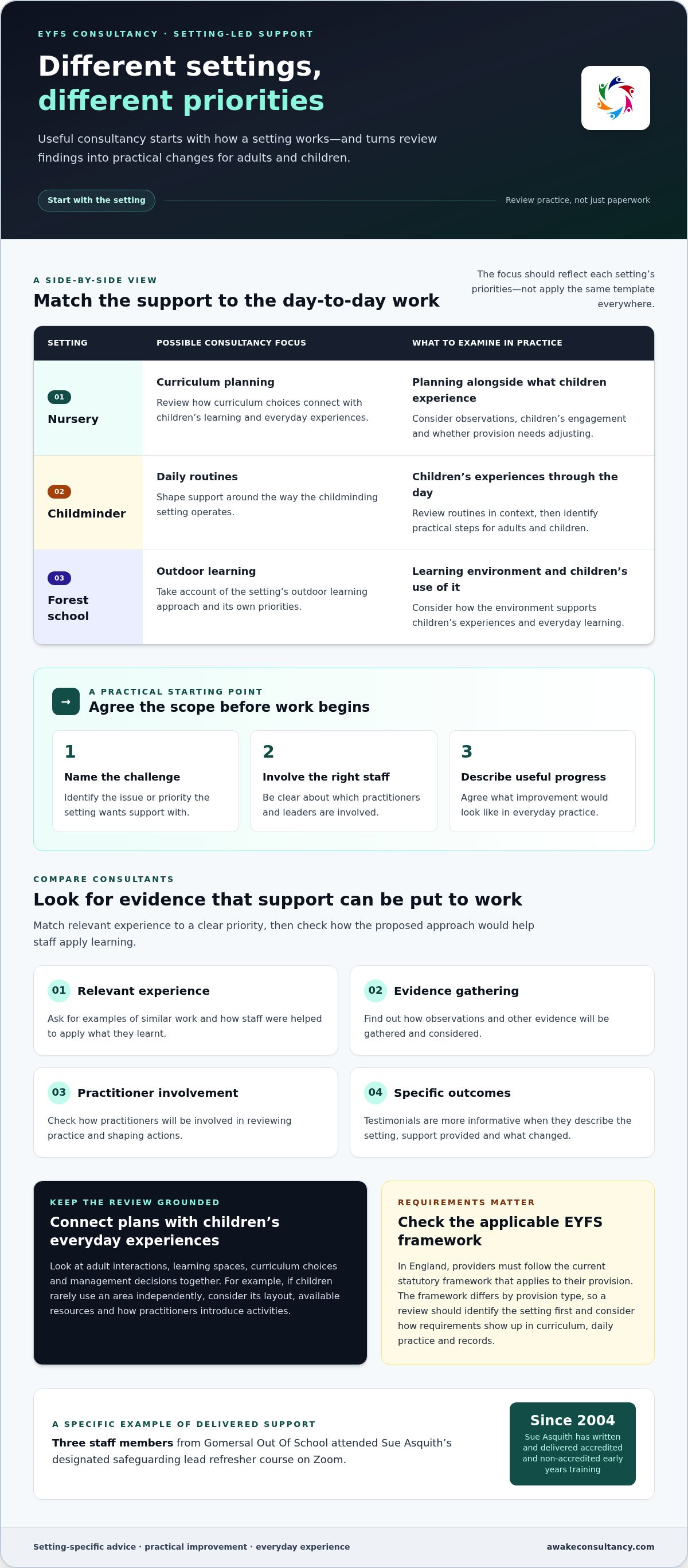
Tailored support should reflect how each setting operates, rather than apply the same template everywhere. A nursery might focus on curriculum planning, while a childminder may want to review daily routines and children’s experiences. Forest school leaders may need advice shaped around outdoor learning and their setting’s priorities. Before agreeing the scope, identify the challenge, the staff involved and what useful progress would look like in practice.
Comparing EYFS Consultants
When comparing consultants, match their relevant experience to a clear priority, then examine their proposed approach. Ask how they gather evidence, involve practitioners and turn observations into workable actions. Testimonials are most useful when they describe a specific setting, the support provided and what changed afterwards, rather than offering general praise. For example, three staff members from Gomersal Out Of School attended Sue Asquith’s designated safeguarding lead refresher course on Zoom. This is a concrete example of training delivered and its audience.
Consultancy Scope and Framework Requirements
In England, providers must follow the current EYFS statutory framework that applies to their provision. Consultancy can help teams examine how their curriculum, daily practice and records reflect the relevant requirements. The framework differs according to provision type, so a useful review begins by identifying the setting and its applicable framework, then considers how requirements are reflected in everyday work. Sue Asquith has written and delivered accredited and non-accredited early years training since 2004. When reviewing training, consider whether its subject and format address the team’s actual development needs.
Consultant Qualifications and Experience
Choose a consultant whose experience relates to your setting and priorities. Relevant work may include supporting early years practitioners, advising leaders, delivering training or reviewing practice. Ask for examples that show how the consultant approached a similar challenge and helped staff apply learning. Alexandra has more than 30 years of experience working with children and educators across schools and early years settings, including international work. For keynote speaking, check that the proposed subject suits your audience and offers practical ideas for practitioners, not just broad themes.
Relevant experience can take different forms. Clare King has proven knowledge of early childhood development for children aged 3-7yrs. Sue Asquith was involved in the Kirklees Listening to Children Project with Coram, and a case study was printed in the 5th edition of Contemporary Issues in the Early Years. Nikki Walters has over 20yrs of experience supporting school improvement and developing EYFS and KS1 practice in schools.
Alexandra has worked as an Early Years Ofsted Inspector and an Associate Lecturer at Manchester Metropolitan University. Lynda Trueman has worked in the Early Years and Primary Sector for 35 years. Matthew Sayer has over 20yrs of experience in education as an early years teacher, EYFS Lead and LA Advisor.
Practice, environment, curriculum and leadership support
Effective improvement connects what leaders plan with what children experience each day. A focused review can consider adult interactions, the organisation of learning spaces, curriculum choices and management decisions together. For example, if children rarely use an area independently, leaders can examine its layout, available resources and how practitioners introduce activities. This grounds changes in practice, rather than limiting them to written plans.
Start by identifying the issue staff notice most often, then trace its effects across the setting. Room layout may affect children’s access to resources; staff deployment may shape interactions; curriculum planning may determine whether learning builds over time. Reviewing these connections helps leaders choose actions that support children and remain workable for practitioners. Record what is already effective, what needs attention and who will lead each change.
Curriculum support can help teams clarify the knowledge, experiences and learning they want children to develop. Leaders can review planning alongside observations and children’s engagement, then identify where provision needs adjusting. Cheryl Sargeant served as an NPQEYL Facilitator, supporting early years leaders with curriculum design and leadership practice. Her experience illustrates how curriculum decisions and leadership responsibilities can be considered together.
Leadership and management reviews are most useful when they examine daily systems, not just written policies. A review might map how leaders communicate expectations, support staff and follow up agreed actions. It can also consider whether responsibilities are clear when priorities compete. The outcome should be a practical sequence: identify the pressure point, agree an owner, set a review point and assess whether the change has improved consistency.
Mentoring can give nursery owners and leaders a structured space to work through operational decisions. A monthly rhythm, where appropriate, allows each conversation to revisit previous actions, address a current challenge and agree the next priority. The focus might shift from staff development to curriculum oversight or business planning as needs change. This format is useful when leaders need continuity, rather than a one-off discussion detached from implementation.
Leadership development should strengthen judgement as well as provide information. A session on delegation, for instance, can help a manager clarify which decisions are theirs and which staff can take forward. Anna Caulfield has facilitated the NPQSL programme, demonstrating experience in leadership development. Consider whether mentoring or training will help leaders apply learning to their current responsibilities and sustain developing practice across the team.
To make support actionable, connect each review finding to an observable change in practice. Leaders might agree to reorganise a learning area, adjust how staff discuss children’s learning or revisit a curriculum sequence. They can then use team discussions and direct observation to assess how the change works. This cycle helps education leaders refine practice, respond to children’s experiences and make improvement part of everyday management.
Bespoke consultancy packages
A tailored programme should begin with a defined need, not a preset menu of sessions. A school seeking to strengthen early years provision may need curriculum review, leadership discussion and practical staff development. A nursery facing different pressures may prioritise routines, team knowledge or inspection preparation. Set the intended outcome first, then agree which activities can address it within the setting’s existing capacity.
Map the work in stages. Begin with a discussion about current priorities, then identify what evidence will help clarify them. This could include reviewing planning, discussing staff experience and observing how children use learning spaces. The next stage is to translate findings into actions, with clear responsibilities and a way to revisit progress. This gives leaders a route from initial questions to changes in practice.
Different forms of support can be combined without treating every setting alike. A school might need leadership advice alongside practitioner training, while a nursery may benefit from a focused review and follow-up mentoring. A setting working internationally may also need help interpreting EYFS principles within its operating context. Agree what knowledge the team needs, who will use it and how it connects to children’s daily experiences.
Inspection preparation should be a practical part of improvement, not a separate performance exercise. A review can help leaders examine whether stated priorities are visible in everyday practice, staff understanding and the environment. Where Ofsted is relevant, agree the scope clearly: identify the areas to explore, the feedback required and how the team will use the findings. The purpose is stronger understanding and readiness, not a promised inspection outcome.
Before commissioning a programme, define its boundaries. Clarify whether the work covers one room, a whole setting or several teams, and identify who will participate. For a school with nursery and reception provision, leaders may want shared principles alongside distinct actions for each age group. A written scope helps prevent unrelated issues from displacing the original priority and gives everyone a common reference point.
Review the programme as it progresses. After each agreed activity, leaders can record what staff learned, which action they will apply and what evidence will show its usefulness. If a curriculum discussion identifies inconsistent planning, for instance, the next step might be a shared planning approach followed by team reflection. This creates a connected programme in which each stage builds knowledge and helps settings sustain developing practice.
Consultancy for nurseries, schools and local authorities
Different organisations need advice shaped around their responsibilities and priorities. A nursery may want to strengthen curriculum practice, while a school could focus on early years provision across its wider team. Local authorities may need support that considers several settings and helps leaders build consistent approaches. Begin by defining the challenge, the teams involved and the practical change they want to see.
For a nursery, a useful starting point is to connect leadership decisions with children’s everyday experiences. Leaders can review how staff understand curriculum priorities, how learning spaces support children and where professional development would help. A school might compare early years practice across classes, then identify shared expectations and local differences. Local authority teams can likewise clarify whether their priority is advice for individual settings, leadership development or wider practitioner learning.
Support can draw on different kinds of professional experience. Cheryl Sargeant has over 24 years of primary education experience supporting school improvement across schools, MATs and settings. Her background illustrates why a senior adviser’s understanding of both school structures and early years practice can matter. For a local authority, ask how the proposed work will account for varied settings; for a nursery, focus on how advice will translate into staff action.
Courses and training can help teams develop knowledge around a defined need. Sue Asquith has written and delivered accredited and non-accredited early years training since 2004. A course may support shared understanding, whilst consultancy can help leaders apply that learning to their own routines and priorities. Look for a clear connection between the subject, the staff attending and the change they are expected to make afterwards.
Are EYFS consultancy services available locally or remotely across the UK? Alexandra is based in Altrincham and works across the UK and internationally. Remote delivery is also used for some training: three staff members from Gomersal Out Of School attended Sue Asquith’s designated safeguarding lead refresher course on Zoom. The setting’s needs and the type of support shape the most suitable format.
For international organisations, clarify how advice will relate to their local context and the EYFS approach they want to develop. Alexandra’s international early years work has taken her to Romania, Italy, Madrid, China, Thailand and Singapore. This provides an example of work across different locations. A school group or local authority can define the intended scope, identify participating teams and agree how recommendations will be used.
Before work begins, record the priority, the relevant settings and the people responsible for acting on advice. A nursery may focus on one team, while a local authority may need a shared approach across several providers. Clear boundaries keep the work relevant. Passion for early education matters, but practical experience and a plan for applying knowledge make support useful to senior leaders.
What does EYFS consultancy in the UK include?
EYFS consultancy can help a setting examine practice, curriculum, learning environments and leadership as connected parts of its work. A review might begin with a specific concern, such as planning that staff find difficult to apply. The consultant and leaders can then identify useful evidence, discuss current routines and agree practical priorities. This keeps the work focused on the setting’s needs and children’s experiences.
For inspection preparation, Sue Asquith’s inspection-preparation visits can include sampling paperwork, exploring specific priorities and giving verbal feedback on strengths and possible improvements. This gives leaders a way to examine documentation alongside their chosen areas of focus. For example, if planning is a priority, the discussion can consider how records relate to staff practice and children’s learning, then identify clear areas for follow-up.
Consultancy can also help leaders review how the curriculum is understood and put into practice. A useful process is to select a curriculum priority, consider how staff support it through daily experiences and discuss where further development could help. If a setting wants to strengthen children’s access to resources, for instance, leaders can look at how the environment and staff decisions support that aim.
Practitioner development can connect review findings to staff learning. A team may need a shared discussion of an approach, training on a specific subject or structured reflection on a routine. Leaders should identify who needs support and how they will see learning applied afterwards. That could mean revisiting team discussions, planning or interactions, rather than treating attendance at a session as the final outcome.
Leadership support can help managers prioritise actions and clarify responsibilities. After a review, leaders might group findings by urgency, assign ownership and decide how to revisit progress. Where a setting has several rooms, they can consider whether an approach needs to be used consistently across the team or adapted for particular children. The emphasis stays on workable changes, not a longer action plan without follow-through.
For international settings, consultancy can help distinguish EYFS-informed practice from local requirements and organisational priorities. Leaders can explain the context, identify which elements they want to develop and agree how advice should be applied by their team. To explore support for a specific setting or inspection priority, discuss early years consultancy as a practical next step.
Awake Early Years Consultancy: Early Years Consultancy
Awake Early Years Consultancy helps settings turn review findings into practical changes in practice, curriculum and leadership. Its Early Years Consultancy provides tailored advice, while Practitioner Training & Development supports teams building skills around identified priorities. For inspection preparation, Ofsted Preparation & Mock Inspections helps settings examine their practice and prepare constructively. Recruitment Support is available when workforce planning is part of the wider challenge.
Consider this support when your team needs a clearer plan, focused development or structured preparation. The next step is to outline your setting’s priorities and the support you are seeking. Contact Awake Early Years Consultancy to discuss your needs.
Turn your priorities into practical next steps
The value of EYFS consultancy in the UK depends on what happens after advice is given. Choose a priority your team can act on, identify who will lead it and decide how you will review its effect on daily practice. A defined starting point keeps the work relevant to your setting, whether you are addressing a leadership question or developing provision for children.
Before speaking with an adviser, set out the issue in plain terms. Note what staff experience, what you want to improve and what support would help your team move forward. This gives the conversation a practical focus and helps shape a useful next step, without committing to a wider programme before you understand what is needed.
Awake Early Years Consultancy works with early years settings on consultancy and development needs. Contact Awake Early Years Consultancy to discuss your priorities and consider a considered way forward.
Frequently Asked Questions
How do EYFS consultants help settings prepare for Ofsted inspections?
EYFS consultants can help settings prepare by reviewing priorities and helping staff explain their everyday practice clearly. A mock inspection gives leaders a structured opportunity to consider how evidence reflects what happens in the setting. For example, practitioners might discuss why they chose particular experiences for children and how they adapt them. The value lies in clearer understanding and practical preparation, not a promised inspection result.
What EYFS consultancy services are available for nurseries, preschools, and childminders?
Support can include tailored early years advice, practitioner development, recruitment support and inspection preparation. The emphasis depends on the setting’s needs: a nursery might focus on aligning team practice, while a pre-school could need guidance on curriculum planning. A childminder may have different priorities, such as reviewing routines and children’s experiences. A useful starting point is to define the particular challenge and the people affected.
How can an EYFS consultant support safeguarding, curriculum, and staff training?
An EYFS consultant can help leaders examine how safeguarding procedures are understood, how curriculum intentions appear in practice and where staff need further development. For instance, a team discussion could explore how practitioners respond to a safeguarding concern, then identify whether guidance or training would help. Curriculum support might focus on connecting planned learning with children’s interests. Training is most useful when it responds to an identified need and supports consistent practice.
How can providers check an EYFS consultant’s references, reviews, and results?
Assess references and reviews for specific examples of the work, the setting’s challenge and the practical outcome described. Look for feedback that explains how advice was applied, rather than relying only on broad praise. Compare those examples with your own priorities: experience supporting a nursery may not directly match a childminder’s needs. Clear descriptions of approach and scope can help you judge relevance before deciding on next steps.


