

Trust can return after a service failure, but reassurance alone is not enough. Building parent trust after a service failure means listening to families, acknowledging the impact, taking responsibility and following through, while maintaining clear, appropriate boundaries.
A failure can leave parents feeling unheard or unsure what will happen next. A sincere apology matters, but trust grows when actions match words and families can see what has changed.
Respond with care and clarity: invite parents’ perspectives, apologise without defensiveness, explain decisions plainly and agree practical next steps. Offer a route to rebuild trust without making promises you can’t keep or weakening the boundaries that support safe, consistent practice.
Key Takeaways
- Invite parents to share their priorities and concerns, then show how their perspective informs decisions.
- Offer a direct apology that recognises the impact of the failure without becoming defensive.
- Rebuild confidence through clear ownership, practical follow-through and honest updates.
- Explain the reasons behind decisions in plain language, while being open about what could be handled differently.
- Create realistic opportunities to restore trust, keeping expectations and professional boundaries clear.
1. Making additional efforts to include families’ perspectives
In the United States, communication depends on the setting, the information involved and applicable privacy requirements. Share relevant details only with authorised family members, and avoid identifying another child. Notify parents promptly once essential facts are clear, explain immediate steps and provide updates as the review develops. Appropriate timing depends on what happened and what can responsibly be shared.
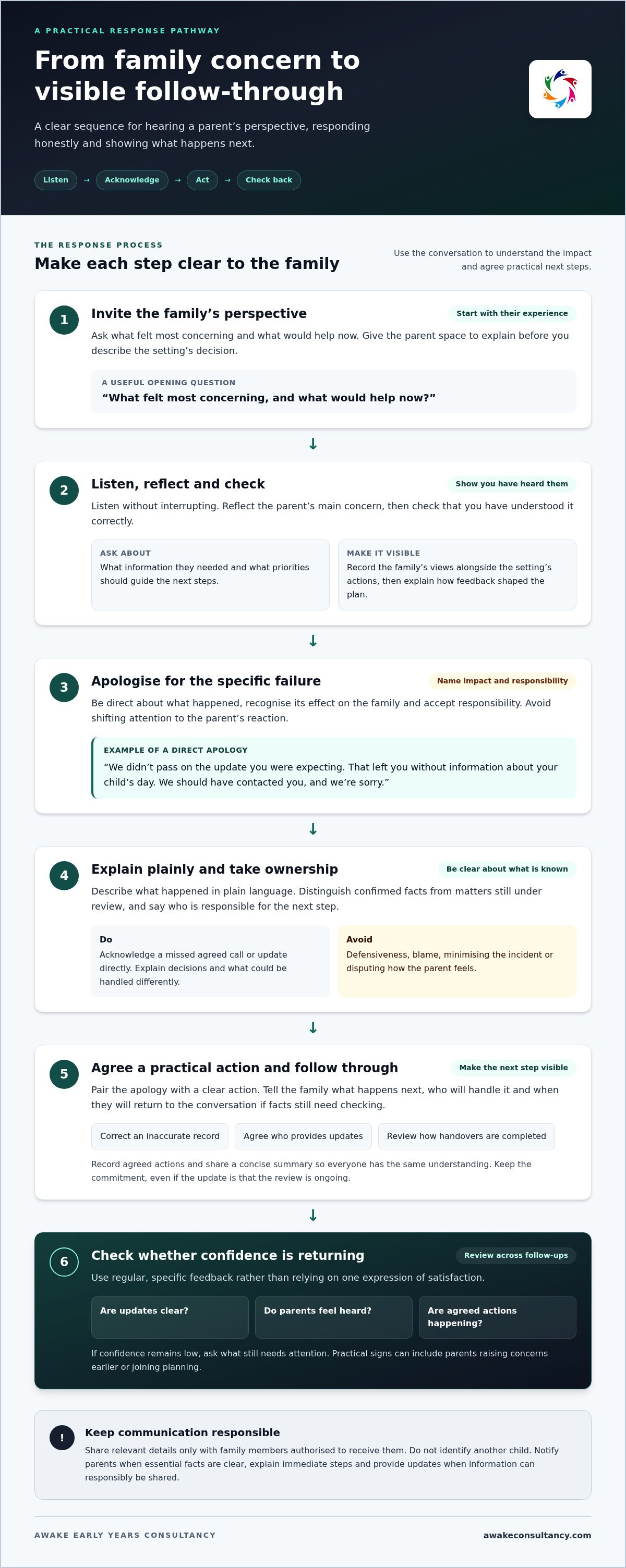
Begin by asking about the family’s experience, not defending the school’s decision. Ask, “What felt most concerning, and what would help now?” Listen without interrupting, reflect the parent’s main concern and check that you understood. If a family member says they felt excluded from a decision, clarify what information they needed and how future communication can include them.
Families may be guarded after earlier difficulties, repeated disappointments or a stressful incident. Treat caution as a reason to communicate more consistently, not as evidence of hostility. For example, agree who will make the next call, what they will discuss and when. Keep that commitment, even if the update is simply that the review is ongoing.
Assume practical barriers when a parent doesn’t respond. Work schedules, complicated family dynamics and changed contact details can all affect communication. Try another agreed channel or time, and keep the message clear and respectful. A short note offering conversation times may work better than repeated calls during a parent’s shift.
Trust supports equitable family engagement because parents need a genuine opportunity to shape decisions affecting their child. Ask what has worked before, which routines matter at home and what priorities should guide the next steps. Record the family’s views alongside the setting’s actions, then explain how their feedback shaped the plan. This makes collaboration visible rather than symbolic.
If a breakdown affects relationships at home, family therapy may provide a facilitated space to discuss emotional responses and communication patterns. Sessions can help family members express how the incident affected them and consider ways to talk about it. This is separate from the setting’s responsibility to listen, explain its decisions and address its own service failure.
Assess whether trust is returning through regular, specific feedback, not a single expression of satisfaction. Ask parents whether updates are clear, whether they feel heard and whether agreed actions are happening. Compare their responses across follow-up conversations, and note practical signs, such as parents raising concerns earlier or joining planning. If confidence remains low, ask what still needs attention.
Share relevant information only with family members authorised to receive it, and never identify another child. Provide updates when information can be shared responsibly.
2. Acknowledging mistakes and apologising
A useful apology names the failure, recognises its impact and accepts responsibility. For example: “We didn’t pass on the update you were expecting. That left you without information about your child’s day. We should have contacted you, and we’re sorry.” This is more meaningful than “Sorry if you were upset”, which shifts attention from the service lapse to the parent’s feelings.
Be specific without becoming defensive. Describe what happened in plain language, distinguish confirmed facts from matters still under review, and explain who is responsible for the next step. If a staff member missed an agreed call, acknowledge it directly. Don’t blame a busy shift, another team member or a misunderstanding before hearing the family’s account.
A sincere apology also leaves room for the parent’s response. They may feel angry, anxious or disappointed, and need time before discussing solutions. Listen, acknowledge the effect on the family and ask what they need addressed first. If a parent says the lack of notice disrupted their plans, recognise that practical consequence rather than rushing to explain your thinking.
Common mistakes that undermine trust include minimising the incident, disputing a parent’s feelings, giving a vague apology or promising changes before checking what happened. Don’t ask a family member to accept an apology, forgive staff or move on. Such responses can make parents feel responsible for easing the setting’s discomfort.
An apology alone rarely restores confidence because it doesn’t show whether the underlying problem will change. Pair it with a clear action: correct an inaccurate record, agree who will provide updates or review how handovers are completed. Tell the parent what happens next and follow through. If the review identifies a different cause, explain it honestly and still address the impact.
Choose someone who understands the incident and can answer practical questions to deliver the apology. If they need to establish the facts first, say so and agree when they’ll return to the conversation. Don’t leave the family wondering who is handling the concern. Record the agreed actions and share a concise summary so everyone has the same understanding.
Staff can prepare by separating three points: what happened, how it affected the family and what the setting will do now. Practise the wording, but avoid making the apology sound scripted. A calm, direct acknowledgement carries more weight than elaborate language. Keep the focus on the child and family, not on defending personal intentions or seeking immediate reassurance.
If apologies keep recurring for similar problems, review the communication process and staff practice, not just individual wording. A structured review of communication practices can help a setting identify where responses need greater consistency.
3. Accepting consequences and demonstrating responsibility
Responsibility becomes credible when the setting changes its practice after a failure. Name one person to coordinate the response, record each agreed action and track its completion. If a promised update wasn’t sent, the responsible lead should contact the parent, explain the missed commitment and agree how updates will be handled next time.
Taking responsibility also means allowing a parent to express dissatisfaction without demanding quick reassurance. A family may ask for a different contact person, a written account or a review of the process. Discuss each request, explain what action is possible and give a clear reason if a request can’t be met. Keep the focus on the child’s needs, not on shielding staff from discomfort.
Remedies should address the specific failure: a missed appointment may call for rescheduling, while an incomplete update may require a corrected account and a reliable communication plan. A provider can consider appropriate compensation if a payment covered a service that wasn’t delivered, and explain the decision clearly and consistently.
Culturally responsive practice makes accountability more meaningful because families may express concerns in different ways. Ask each parent how they prefer to communicate, who should take part and whether language support would help. Don’t infer a family’s values from their name, accent or background. For example, offer a choice between a phone conversation and a written summary, then respect the parent’s preference.
During follow-up, invite the family to comment on the proposed remedy. A parent may explain that repeated calls during work hours are impractical, or that a relative should receive updates. Confirm the arrangement, record it appropriately and follow it consistently. These steps show that cultural responsiveness is part of the response, not a gesture added after decisions have been made.
The word “trustee” can also refer to a person managing a legal trust, a role distinct from rebuilding a provider’s relationship with a parent. In that role, responsibilities include investment decisions, distributions, beneficiary shares, accounting, tax filings, record keeping and communication with beneficiaries. Those financial duties don’t replace a childcare setting’s direct responsibility to address its service failure.
Make improvement visible through a brief review with the parent. Explain what changed, who now owns the task and how the setting will notice if the problem recurs. For instance, after a missed handover, the manager might review the process with staff and check that they follow the agreed communication step. Close the loop with the family rather than assuming internal action has restored confidence.
4. Explaining intentions and reflecting on decisions
Parents need to understand both what happened and how the setting reached its decision. Explain the purpose of the action, the information staff considered and what they would change now. For example, if a planned update was delayed during a busy handover, acknowledge the operational pressure without using it as an excuse. The family needs clarity, not a defence.
Separate intention from impact. A practitioner may have intended to protect a child’s privacy, yet the family may have felt excluded from an important discussion. State both points plainly: “We wanted to handle the matter carefully, but we should have explained our approach sooner.” Good intentions don’t remove responsibility for the effects of a decision.
A transparent communication plan should identify the contact person, preferred channel, information to be shared, update points and route for raising concerns. It should explain what the setting can’t discuss, such as another child’s private details, while offering relevant information about the family’s own child. Agree and record the plan with parents so staff follow a consistent approach.
Reflect on the decision process, not just the final outcome. Ask what information was available at the time, whose perspective was missing and whether the response matched the child’s needs. If staff relied on an assumption, identify it. A manager can then review how future decisions are made, including when to consult families and how to record those conversations.
Consider a parent who hears about an incident only at collection. The setting might explain that staff prioritised immediate care, then consider whether another team member could have contacted the family sooner. A practical lesson might be to set a clearer trigger for parent updates during handover. Explain the change directly instead of saying only that the team has “learned from it”.
Use plain language to explain complex decisions. Replace internal terms with a short explanation, then pause for questions. For example, describe what “reviewing the incident” involves, who is involved and when the family can expect another conversation. Don’t imply an outcome is certain before the review is complete. Clear limits build confidence by distinguishing known facts from actions still underway.
Reflection also means considering how a decision felt to the child and family. A child may have felt worried, embarrassed or confused, even if adults intended to resolve the issue quickly. Ask parents what their child said at home and use that insight to shape follow-up. Their account can reveal where the setting’s process missed an emotional need.
End the discussion by summarising the decision, its rationale and the next action. Invite the parent to correct any misunderstanding. A brief written record can capture the agreed steps and the person responsible, giving everyone a dependable reference for the next conversation.
5. Offering chances to regain trust while reaffirming boundaries and consequences
Trust returns through repeated evidence, not one reassuring conversation. After a service failure, agree on a practical opportunity for the family to see change. For example, parents may choose how they receive updates, then review whether the arrangement works. Keep the commitment realistic, specific and connected to the original concern.
Set clear boundaries alongside that opportunity. Explain what staff can share, who will communicate and which decisions remain the setting’s responsibility. If a parent asks about another child, protect that child’s privacy while sharing relevant information about their own child. Respectful limits should clarify the response, not shut down questions.
Safety-related failures need a direct, organised response. First address any immediate risk and establish what happened. Then explain the steps taken, changes introduced and how staff will monitor the situation. Give parents clear information about their child while protecting others’ private details. Don’t promise that a problem can never happen again.
Parents are more likely to feel reassured when they can see how a change works in practice. If a handover omission caused concern, explain how the team will record and pass on essential information. Identify who oversees the process and how parents can raise further concerns. Share progress in plain language rather than relying on broad claims about improved practice.
Make the next steps collaborative. Ask parents what would help them recognise positive change, then agree on a suitable way to review progress. A family might want a planned conversation after staff have followed the revised process. Record what the setting will do and what feedback it needs. This gives parents a meaningful role without making them responsible for staff performance.
Boundaries also include fair, consistent consequences for staff or process failures. Explain that concerns will be reviewed through the setting’s procedures, but don’t disclose confidential personnel matters. If the review identifies a training need, describe how the setting will address it without naming individual staff. Clear limits can preserve respect while showing that concerns have been taken seriously.
Some families need more time before they feel ready to take part again. Offer manageable steps, such as a brief update before a longer planning meeting, and let parents choose when they’re ready to discuss progress. Don’t treat silence as restored confidence. Keep agreed communication open and invite feedback once the family has experienced the change directly.
Review your setting’s response process to clarify responsibilities, communication and follow-through. Strengthen your setting’s response planning with a practical review of how decisions and actions are carried through.
Awake Early Years Consultancy: Early Years Consultancy
Awake Early Years Consultancy helps settings review practice and strengthen leadership after a service failure. Its Early Years Consultancy provides tailored advice to nurseries, pre-schools and other early-years settings seeking to improve their approach and rebuild confidence through consistent practice.
If the review highlights gaps in staff knowledge or inspection readiness, Practitioner Training & Development and Ofsted Preparation & Mock Inspections can support the next stage of improvement. This is a practical option when leaders need an external perspective to examine processes, identify priorities and turn learning into sustainable changes. The focus is on strengthening the setting’s practice, not promising a particular outcome.
Contact Awake Early Years Consultancy to discuss the challenges your setting is working through.
Make the learning part of everyday practice
Building parent trust after a service failure continues beyond resolving one family’s concern. Use the experience to examine how your setting learns: can staff raise process weaknesses early, and can leaders turn those observations into practical changes? A brief team reflection after a difficult situation can help identify where procedures, responsibilities or communication need clearer support.
Choose an improvement to carry forward, assign ownership and revisit its effect in day-to-day practice. This connects learning to the conditions that shaped the failure rather than treating it as a one-off conversation. It also gives leaders a stronger basis for supporting staff and maintaining consistent relationships with families.
If your setting would benefit from an external perspective on practice and leadership, contact Awake Early Years Consultancy to discuss the challenges you’re working through. Steady improvement begins with an honest review and a clear next step.
Frequently Asked Questions
Can trust fully return?
Trust can grow again, although the relationship may not return to exactly how it was before. Parents will judge the setting by what happens after the failure, not just by the incident itself. For example, if staff consistently follow a revised collection procedure, families may gradually feel more confident. Keep listening to concerns and let parents decide how quickly they’re ready to re-engage.
How does this connect back to trust?
Trust grows when a setting’s actions make its words credible. After a failure, families may watch closely to see whether staff communicate reliably, follow agreed procedures and treat concerns fairly. When a promised update arrives through the agreed channel, parents have direct evidence of follow-through. Consistent interactions reduce uncertainty and show that the setting takes its relationships with families seriously.
How long does rebuilding trust take?
There’s no fixed timetable for rebuilding trust. It depends on the impact of the failure, the family’s experience and the consistency of follow-up. A missed message may be addressed through dependable communication, while a repeated problem may require sustained evidence of changed practice. Don’t ask parents to move on by a set date. Review progress through their feedback and the setting’s ability to maintain agreed changes.
What are the best steps to rebuild parent trust after a service failure?
Start by establishing what the family experienced and what the setting knows. Acknowledge the impact, explain the next action and give one person responsibility for following through. For example, after an unclear collection handover, agree how authorised collection details will be checked and communicated. Follow up to find out whether the revised arrangement works for the family, and adjust the process if a practical issue remains.
How should a school or childcare provider apologise to parents after a mistake?
Give a direct apology that names the provider’s action and its effect, without making the parent responsible for accepting it. For example: “We recorded the wrong collection detail, which caused confusion at pick-up. We’re sorry. We’re correcting the record and reviewing how staff check it.” Ensure the person apologising understands the incident, then answer questions honestly and distinguish known facts from matters still under review.
How should staff respond to angry or distrustful parents after a service failure?
Stay calm, let the parent explain their concern and avoid arguing over their emotional response. If the conversation becomes difficult, suggest a quieter setting or a meeting with a manager present. Staff should focus on the specific issue, clarify what can be discussed and agree a suitable next contact. If anyone feels unsafe, pause the conversation and follow the setting’s established procedures for managing the situation.


